






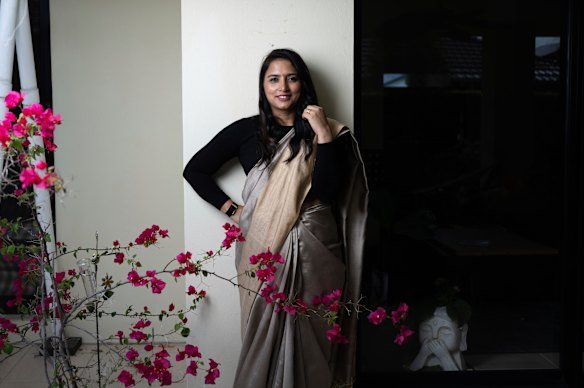
Brisbane software engineer Treassa Joseph is part of Australia’s 1 million strong Indian-born community. But her background means she belongs to a much larger migrant group: India’s global diaspora.
There are over 35 million “overseas Indians” living across more than 200 countries according to the Indian government.
Joseph was one of about 500 members of that diverse diaspora who gathered recently at a swank resort near Bengaluru in south India for an event called the Indiaspora Forum.
The speakers included tech billionaires, industrialists, academics, philanthropists, artists, and sports stars.
The famed spiritual leader Gurudev Sri Sri Ravi Shankar led a late afternoon meditation and veteran Bollywood singer Usha Uthup was on hand for evening entertainment.
Indiaspora, the non-profit organisation staging the Forum, acts as a global network for diaspora leaders and participants turned up from 20 different nations.
Joseph said there was a positive “sense of coming together” at the event.
Another Australian in the crowd was Shanthini Naidoo, a not-for-profit sector executive from Sydney. Her Indian-origin family moved to Australia from South Africa when she was a child.
“As a member of Australia’s Indian diaspora, being in Bengaluru with such a diverse group from across the global diaspora felt incredibly energising and grounding at the same time,” she says.


During the past two decades Australia’s Indian origin community has emerged as one of the nation’s most dynamic migrant groups.
Figures released by the Bureau of Statistics last week revealed the number of Indian-born residents climbed above 971,000 last year lifting India above England as Australia’s top overseas country of birth for the first time.
The gathering in Bengaluru highlights how the community is part of a far larger, and influential, global diaspora. (The word “diaspora” describes a population which has spread from its original homeland to other nations.)
A report released in March by Indiaspora found the number of overseas Indians has tripled since 1990. The group also has enormous financial clout; the diaspora earns a combined US$730 billion ($1,030 billion) a year, not including business income, stock options, and property holdings.
Indian-origin leaders permeate the highest levels of global corporations, especially in the technology sector.
“In large public markets, CEOs of Indian origin lead some of the world’s most valuable Fortune 500 firms,” the report says.

Researchers and engineers from the diaspora are also disproportionately represented in the labs driving the generative AI revolution.
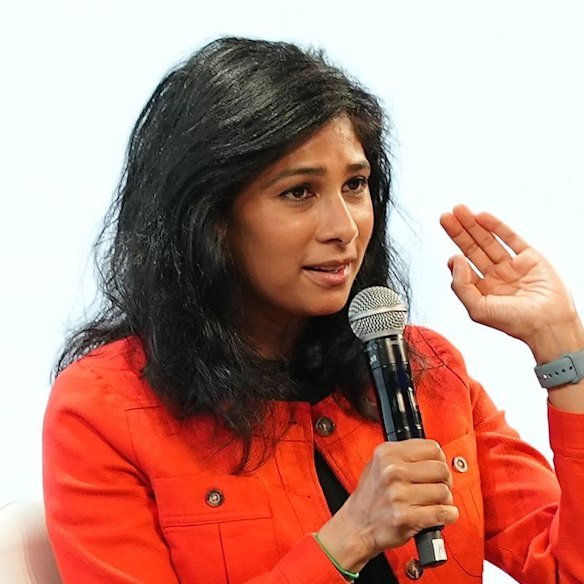
Gita Gopinath, a speaker at the Indiaspora event in March, formerly worked as first deputy director and chief economist of the International Monetary Fund. She says Indian origin leaders are becoming more prominent in international finance and economics including at global institutions like the IMF.
“I mean it’s not surprising – it’s a country of 1.4 billion people so we should be seen in larger numbers around the world,” she told this masthead.
Gopinath, now an economics professor at Harvard University in the US, feels her own diaspora experience has been a professional asset.
“For instance, when I was at the IMF where I was the chief economist and then the first deputy managing director, I think people saw me as somebody who could bridge different worlds because I had seen – having come from India where I grew up, but then having lived now most of my life in America,” she says.
The Indian diaspora is also a force in international politics – former US vice president Kamala Harris and former British prime minister Rishi Sunak are high-profile examples of this trend.


Indiaspora’s Australia country head, Jai Patel, who also leads KPMG’s India Business Practice, says Indiaspora’s aim is to harness the knowledge and experience of “leading lights across India’s global diaspora”.
He says Australia has much to gain from its migrant links to the unique community of overseas Indians.
“Australia’s diaspora provides connections not just to India but to the global diaspora in many other parts of the world,” says Patel. “There is a huge opportunity for us to plug into that.”
Australia’s Indian community already has deep personal and family ties to places like the US, Canada, UK, Singapore and Malaysia, as well as India. “We have uncles, aunties and cousins just about everywhere,” says Patel.
University of Queensland Associate Professor Elin Charles-Edwards, who recently co-authored a study on the Indian diaspora for the federal government, says the community is notably young and very highly educated.
“Something like 70 per cent has an undergrad or further degree, so it’s an incredibly educated group of people that we’re gaining,” she says.

The number of Indian origin entrepreneurs and business managers in Australia is also on the rise; Charles-Edwards says many are in a position to exploit the “globalised network” of the international diaspora.
“We have people who are highly connected across multiple global sites, and they are choosing to locate in Australia,” she says.
Pawan Luthra, a prominent member of Australia’s Indian community and chief executive of the popular India Link publication, says there’s a “sense of pride” in the diaspora at the achievements of Indian-born leaders in global business and politics.
But the size and influence of India’s international diaspora is not well understood in the broader Australian community.
“The bottom line is there’s now a very strong Indian global diaspora,” he says. “We need to see how we can manage this, and how we can apply this strength on a global basis.”
The founder of Indiaspora, and a driving force behind the meeting in Bengaluru, is M.R. Rangaswami, a charismatic San Francisco tech entrepreneur and “angel investor”.
“I love building communities that make an impact, so 14 years ago I asked myself ‘what can I do for my own people?’” says Rangaswami, who was born in the Indian city of Kolkata but has lived most of his life in the US.
Indiaspora now operates in six key hubs – the US, UAE, Canada, UK, Singapore and Australia. Its mission is to “inspire the Indian diaspora to be a force for good by providing a platform to collaborate and build community engagement, and catalyse social change”.
Rangaswami, a regular visitor to Australia and keen supporter of the Hawthorn AFL team, says the scale and diversity of India’s global diaspora offers unique opportunities for connection.
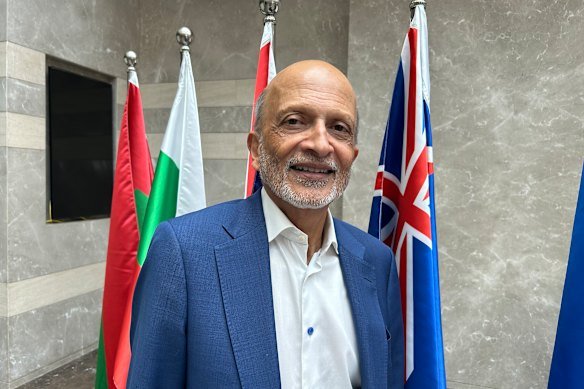
“We are the largest diaspora in history – 35 million people – there’s no other diaspora close to the size,” he says. “But it’s also the spread of this diaspora … there are sizable populations spread across multiple countries and I think is a huge differentiator.”
Shanthini Naidoo, chief executive of the St Vincent’s Curran Foundation, which raises funds for St Vincent’s hospitals in NSW, has witnessed the benefits of the diaspora network firsthand.
While attending an Indiaspora event in Dubai last year she met Neetisha Besra from the Gupta-Klinsky India Institute, which is part of America’s Johns Hopkins University; the pair found that their respective organisations were both working on Indigenous health – one in Australia and one in India.

“We spoke about the challenges of improving Indigenous health and I learnt a lot about the similarities in the gaps in outcomes for Indigenous populations in India,” says Naidoo.
As a result of the meeting, Naidoo and Besra are working to establish a knowledge exchange program to allow Indigenous community members and experts involved with both organisations to travel between India and Australia to learn from one another’s work.
India’s Indigenous community, commonly known as Adivasis, accounts for about 8 per cent of the population and experiences many disadvantages.
Naidoo says she “would never have met” Besra if not for the Indian diaspora network, but their meeting has paved the way for an exciting collaboration.
“If we can bring our Indigenous health staff and experts to India, and give those working in India to come to Australia, I think that would be an amazing connection,” she says. “We hope it will lead on to much bigger things.”
Each year India’s diaspora sends and estimated US$138 billion ($193 billion) to India in remittances (payments by overseas workers to individuals or households in their country of origin, normally family members).
Gopinath points out the annual value of remittances “exceeds the gross foreign direct investment that comes into India”.
Diaspora philanthropy in India is also booming. While India has made rapid economic progress in recent decades, tens of millions of its citizens are still relatively poor.

Joseph thinks most members of the Indian diaspora, successful or otherwise, want to do something to help people in their country of origin.
“So many Indian Australians I speak to ask me, ‘Do you know any projects that we can support back home that could educate people?’ or something like that,” the Indian-born mother of two, who has lived in Australia for 15 years, says.
Joseph works for a payments company called Merchant Warrior, co-founded by her husband, but has also founded an organisation that raises money for projects supporting poor communities in India. “I believe strongly that we have a responsibility to create a positive social impact,” she says.
India’s international diaspora has a diverse and layered history.
During colonial rule in the 19th and early 20th centuries, a large number of Indians was sent to other British colonies, mostly as indentured labourers working in agriculture and construction. The destinations included the Caribbean, East Africa, South Africa, Sri Lanka, Myanmar, Malaysia and Fiji.
Biman Prasad’s forebears arrived in Fiji from north India in the early 1900s. But Prasad, a member of Fiji’s parliament and a former deputy Prime Minister of Fiji, is a proud member of India’s diaspora. He speaks fluent Hindi (one of India’s official languages) and feels an “affinity” with India.
“Our identity is deeply rooted in Fiji – it is our home – and we are part of Fiji’s social, cultural and political fabric,” says Prasad. “But we also have deep connections with India because of our linguistic heritage, our traditional cultural practices and religious links.”
Prasad, who spoke at the Bengaluru forum, also feels a sense of pride at India’s recent economic progress. “I think it’s good for the Indian people and good for the world,” he says.
A second diaspora grouping is the migrant workforce employed in the Middle East, especially the Persian Gulf. Around 9 million Indians – nearly a third of the global diaspora – are in that region, especially UAE (3.9 million) and Saudi Arabia (2.7 million). Over US$50 billion ($70 billion) flows to India in remittances from this group each year.
A third diaspora group consists of Indian families who migrated permanently to Western countries during the post-war era, including Australia.
Charles-Edwards says Australia’s Indian diaspora is the “new kid on the block” relative to other Western nations, especially the US, Britain and Canada, but is growing rapidly.
Her projections show the Indian-born population in Australia will reach 1.7 million by 2041 having more than doubled over the previous 20 years.
Matt Wade attended the Indiaspora Forum as the guest of Indiaspora
Start the day with a summary of the day’s most important and interesting stories, analysis and insights. Sign up for our Morning Edition newsletter.
Read the full article here