






Years ago, when Pauline Hanson first emerged on the national stage, the collective response was that she was a political aberration who would have a few days in the sun, then disappear. A few stunts gave her some traction in the press but no one took her particularly seriously. Fast forward to now and the Hanson phenomenon has developed into a circus inflamed by social media and increasingly, the mainstream media (“Hanson blasted for White Australia comments after attending lavish Italian fashion show”, July 18). But one aspect has not changed – she has no policies, except rage, and proposes simple solutions to complex problems, yet still she commands a prominent place in the national media. Perhaps this is the problem, namely that she is given fundamentally free marketing every day, with commentators ever keen to report on her latest outrage (“‘We are a threat’: What leaked audio of Pauline Hanson at right-wing dinner reveals about her plans”, July 18). This just gives her and her supporters fuel to pursue their divisive opinions and thus the Hanson train continues on its narrow, flawed journey, still with no solutions, just a lot of hot air. Max Redmayne, Drummoyne
The prominence being given to Senator Pauline Hanson and similar opposition voices should concern Australians (Letters, July18). Too often, the loudest political voices dominate the debate while doing little to reflect what most Australians actually want: fair taxation, well-funded schools and hospitals, a capable defence force and constructive international relationships that recognise the multicultural nation we have become. Instead, we are repeatedly presented with divisive rhetoric, simplistic solutions and personal opinions promoted as though they represent mainstream Australia. They do not. Democracy depends not on who shouts the loudest, but on representatives who listen to their communities and respond to the practical needs of the people they serve. Too much of today’s political discourse, amplified by sections of the media, rewards outrage over thoughtful policy. Australians deserve better. Chris Rivers, Port Macquarie
For the life of me I cannot understand why Hanson and others are so frightened of trans people, women in particular (“Hanson takes aim at privilege and trans rights”, July 18). For a start they make up such a small percentage of the population. In my long life I have met two Australian trans women, and both just wanted to get on and live a normal life. In some cultures trans people are completely accepted, like the Kathoey in Thailand, the Mahu in Hawaii, the Hijras in India, among others. Hanson’s objection to this group seems unhealthy. Don Easter, Dubbo
I sort of feel sorry for Pauline Hanson. In 1965, as a 12-year-old, I moved to Cooma as the Snowy Mountains Scheme was nearing completion. I thought nothing of the fact that most of my new classmates had surnames like Makeev, Treki, Macjowski, Klima, Olay, Schoon, Barisic, Kevadras, Mueller, Zanini and Cargnelluto and that my Celtic name was a distinct minority. Tony Abbott’s Anglo-Celtic fantasy didn’t exist. We were all mates. It was only as I aged that I realised how multicultural a town Cooma was and how integrated the society was. My father was in the Lions Club and became friends with many who had fought on the other side during World War II. Unfortunately, Hanson has obviously not benefited from something resembling my experience. I really pity her for missing out on such a valuable experience, rather than having her views forged in a limited monoculture. Denis Minehan, Cooma
What a shame that one of Sicily’s gems has now been pushed beyond the budget of modest travellers due to Instagram and White Lotus (Letters, July18). Thank goodness we visited Taormina in 2010 when it was off the radar of many tourists. We stayed at a reasonably priced hotel in an unpretentious room, but with a view of the sea, Mt Etna to the side, a bougainvillea-clad pool and a delightful breakfast terrace. I looked up the hotel again and it would cost nearly $1500 a night for the same room. The accommodation used on the Hanson/Rinehart junket costs anything from $1800 to $5000 a night. Hanson might have been one of the battlers once, but she sure ain’t one now! Fran Brew, East Killara
Hanson needs to remember British and European colonial history over many centuries. Her “undesirables” invading Britain and Europe aren’t really immigrants, illegal or otherwise, but just members of the colonial family returning to the mother country. Fair is fair, you move to my country, I move to yours. Peter Kamenyitzky, Copacabana
Why is it that politicians posing as “battler’s friends” always seem to prefer the company of the rich and quickly take to living in luxury? Paul Duncan, Leura
Hit the brakes
There it is in Peter Hartcher’s piece on rapidly increasing concerns about AI – the statement that “Albanese signalled to his party that he will legislate for AI in Australia, but flexibly, to attract investment, he will not deter it” (“Nothing artificial about Albanese’s intelligent intervention, and the urgency is real”, July 17). Unfortunately, the Albanese government has form in talking tough on big issues but settling for weakness in negotiations with vested interests. The announcement is a welcome step but leaves too much wriggle room. Australia should immediately follow New York’s example, with its 12-month moratorium on all data centres while it establishes the strongest possible framework to protect communities. Middle-power Australia should be calling on world leaders to address this crisis urgently, in forums such as the UN General Assembly or possibly at the upcoming COP31, in which case the climate meeting could become the international forum for discussing the challenges of AI and climate change, both of which are man-made and carry existential risks for humanity. Rob Firth, Red Hill (ACT)

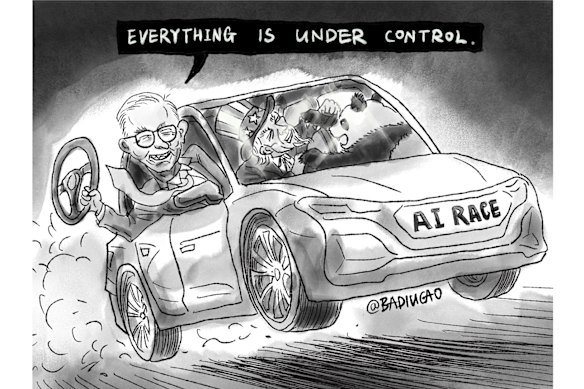
With such rapid growth, it already feels like hyperscale data centre development is a runaway train. The tide of construction draining energy and water, taking valuable land and creating unwanted noise suggests that tech companies are enjoying a Wild West era at our expense. The PM certainly has his work cut out to make data centre approvals and developments transparent and fair for everyday Australians. A New York state-style moratorium on hyperscale data centre approvals until proper guardrails are in place seems a sensible starting point. Australians should not be left paying for big tech’s appetite for endless expansion. Isabelle Henry, Ascot Vale (Vic)
Saturday’s editorial rightly points out the need to better understand what we are really signing up for with AI (“PM diagnosis of data centres now needs a fix,” July 18). But what are the net benefits to Australia? As usual, the devil will be in the detail. We know that many US states are pushing back – and not just because of the power and water required to run them. Where will the workers come from to build the data centres? What are the specific trade-offs given the potential for AI to replace jobs? What specific value will Australia gain when they are completed, and how can we assess that? How do we decide which projects will provide us with the greatest benefits? Margaret Wright, Millers Point
It certainly appears that Albo has got the message about data centres, and not a moment too soon. If we allow these centres to proliferate unchecked, they will play havoc with our renewable energy targets and our water supplies. If they truly want to make Australia their home, they will have to serve our interests as well as their own, and that means helping with the energy transition, not hindering it. Anything less is completely unacceptable and should be rejected out of hand. Ken Enderby, Concord
Palmer effect
Roger Cedergreen writes that Clive Palmer has little effect on elections (Letters, July 17). But in reality his usual practice is to give preferences to the Coalition, so if voters follow his “how to vote” there’s little chance his UAP will ever get over the line. So essentially, he pays his mega dollars to give a leg up to the Coalition by default. They will certainly need it next time around. Carey Buls, Saratoga
Housing dream a fantasy
Dr Kate Shaw hit the nail on the head with her comments on our housing problems (“We can make homes cheaper but not with endless towers”, July 18). As she said, Vancouver and Toronto have built thousands of new apartments over the past 20 years and they are still some of the least affordable anywhere. It’s a fantasy that developers would release large tracts of land and build affordable dwellings. It’s Business 101 to keep supply tight and prices high. Politicians here and in other Western countries have done their populations no favours by putting housing, not to mention other services, entirely in the hands of the private markets. Mark Johnston, Ruse
Public money, private profit
Wayne Duncombe is on the right track (Letters, July 19). I have long held concerns that the public service, after many years of restructuring and downsizing, has lost those old wise heads who can confront high-powered business negotiators at their own level in negotiating public/private partnerships. That, combined with political pressure to go easy on “our friends in the boardroom” has lead to numerous contracts that turn out to be lucrative for businesses but very poor for taxpayers, toll-payers, high-rise flat buyers and airport train travellers, to name just a few. To add insult to injury, we now find that the consultants who do the work of the sacked public servants are lacking the ethics needed to protect the interests of the populace. When it’s a win/lose situation, it’s always the taxpayer who loses. Stein Boddington, St Clair
Smoke and mirrors
Just when you think things can’t get any more ridiculous, you look at the day’s news and they do (“Massive wildfires rage across Canada”, July 19). At a time when we are all living with the consequences of the USA’s attack on Iran, carried out with no consultation with allies, I read this morning that republican governors in some US states are threatening sanctions on Canada over smoke from large wildfires in Canada, which has had the temerity to move south over the border. Really? Susan Threlfall, Minto

Trump has got it wrong again. If China was supporting any candidate in the 2020 US presidential election it would be Donald Trump. What better way to wreak havoc (“Trump’s ‘big news’ speech only confirmed his own midterm crisis”, July 18)? Rick Johnston, Potts Point
Leave no one behind
Reading Jenna Price’s article, I understand many of the challenges Ralph Jackman faced while working with kids in youth detention (“The book every aspiring teacher should read”, July 17). I taught at TAFE in what was then Outreach for 18 years. Many of my students were deemed at-risk youth: disengaged from school and sent to TAFE as a hopeful alternative. Some had dysfunctional or abusive families or learning difficulties that kept them perpetually behind, but the majority experienced generational deprivation: families stuck in poverty, unemployment, insecure housing, relatives in and out of jail. Most were angry, sometimes aggressive, occasionally violent. I made plenty of mistakes in my career and had many embarrassments, as experienced by Jackman, but the successes, oh, the successes. Possibly the most rewarding experiences I’ve ever had came when former students told me they’d got an apprenticeship and thanked me for not treating them like lost causes. Price is right: we need more heroic politicians, but we also need more funding for programs such as Outreach at TAFE. We need to treat these children as valued human beings with a sense of self-worth. This often begins with family support and education. We need to break the cycle. Jen Hacker, Ettalong Beach
Divine cause
I side entirely with the case canvassed by Arts Minister John Graham for funding the Divine Playhouse (“Arts minister defends new gay venue in former church”, July 18). It always amuses me how a deity whose core attributes are believed to be omniscience, omnipotence and sovereignty needs a chorus of rancorous fundamentalist protesters for protection. Many times when reading the Bible, I’ve had to stop and realise that God probably has a sense of humour. If that’s true, the farce over Kent Street must be side-splitting. John Williams, Balmain


Enemies and friends
Alexander Hutton, born in Glasgow, introduced football to the high school students he was teaching in Buenos Aires in the 1890s. He founded the Argentine Football League, and other Scots expats among his pupils, notably from the Brown family, went on to play for Argentina. This history only serves to reinforce the delight of many Scots (as if they needed it) at England’s loss to the South Americans last week. Eric Scott, Bondi Junction
Thoroughly hounded
I’m glad Malcolm Knox has found his humanity through his ratter, Ferdie (“I never liked small dogs. But then along came Ferdie”, July 18). As a cat lover, I am doggone tired of the expectations of dog people. My walk around the block involves a stop every 10 metres as a cockahoop canine bounds into my personal space. The expectant owner waits for my response as I pretend to enjoy the experience of eau de chien. By the time I arrive home, I waft from a musky combination of cavoodles and pekepoos. “They must be barking mad,” I say to my cat as she passively aggressively ignores me. Beverley Fine, Pagewood
- To submit a letter to the Sydney Morning Herald, email letters@smh.com.au. Click here for tips on how to submit letters.
- The Opinion newsletter is a weekly wrap of views that will challenge, champion and inform. Sign up here.
Read the full article here