






Guy Curtis’ defence of Professor Pat Ellis and her use of AI is spot on (Letters, June 5). Ellis’ original article highlights a misunderstanding between the use of AI to completely generate written content (generative AI) and using it to organise ideas, research aspects of a topic and make suggestions regarding structure etc (assistive AI). The Herald’s own webpage, AI guidelines for Nine Publishing, states that editorial employees may use assistive AI “to do initial research, prompt ideas, analyse data, suggest headlines or key point summaries”. That’s a good policy that uses the technology to enhance productivity. The mistake Ellis may have made was not to have declared that she used assistive AI in preparing the article. The use of AI should be encouraged because of the enormous benefits it offers. But it must be properly regulated to manage the very high risks from both inadvertent or deliberate misuse. For full disclosure, I did not use either generative or assistive AI in writing this letter. However, I did use voice recognition software rather than typing – another instance of how predictive AI can improve productivity. Donald Hector, Beecroft
If Professor Guy Curtis is indeed “one of Australia’s leading researchers on academic integrity and student cheating”, then it certainly explains why our universities continue to fall down the global rankings, as his argument is, with due respect, nonsense. If Curtis can’t see the problem and lack of academic integrity in using undisclosed AI to write an article about undisclosed AI, then maybe he’s the wrong guy for the job. Shooting the messenger doesn’t refute the message. Chris Roylance, Paddington (Qld)
Professor Guy Curtis is only too willing to excuse the use of AI to write an essay on the use of AI. The irony seems lost on him. As a recent university graduate who prided themselves on their research and academic achievements without any such assistance, I am appalled that he thinks using AI is acceptable because it is more “efficient”. A senior academic who cannot be bothered to write their own material alone – reading it and rewriting it, honing it to best reflect their ideas – goes against the whole idea of both academia and creativity. Marea Reed, Randwick
Cannabis and cars
Dr John Crozier highlights lobbying by the medicinal cannabis industry in his opinion piece (“As a trauma surgeon, I know cannabis kills. Don’t green-light ‘medicinal’ drivers”, June 5). We have also read how approvals from the Therapeutic Goods Administration for cannabis products are extremely limited, yet doctors are using “special access pathways” to write scripts for unapproved medicines (“Cannabis sales plummet as regulators crack down on booming industry”, April 16). In 1982, as a Labor police minister, George Paciullo stared down powerful vested interests when he introduced random breath testing. He would be turning in his grave at Chris Minns prioritising the huge medicinal cannabis industry over road safety. Michael Timms, Australasian College of Road Safety
NRMA spokesman Peter Khoury is quoted as saying “more people are now dying of drug driving than they are drunk driving” (“NRMA and Coalition slam medicinal cannabis driving reform”, June 5). This has absolutely no relevance to the proposed reform in NSW, which applies to prescribed medicinal cannabis users. There is absolutely no evidence that this innovation will lead to an increase in the road toll. The defence in Tasmania is proof. Shame on the NRMA for not supporting their tens of thousands of members who are forced to choose between their medicine and their transport. Professor David Heilpern, Southern Cross University


Maybe we lapped her?
Before Pauline Hanson becomes too overconfident, she should be reminded that her high polling is simply because the Coalition is in such an abysmal state (“I’ve not changed, Australia has caught up with me”, June 5). She has merely done a Bradbury. Her interview was reminiscent of Donald Trump – opinionated, racist, blame shifting and not entirely coherent. Of course, she wouldn’t be influenced by Gina Rinehart, even if she did accept a $2 million plane as a gift. Her self-absorption will plant the seeds of her undoing, and the excessive attention she is now enjoying will surely be fleeting. Bernard Moylan, Bronte
Agreeing with Pauline Hanson is not so much a case of “catching up” as falling back into a time of white Australia, fossil fuels and degradation of the environment. While the Coalition heads off into the political wilderness, One Nation is gathering the stragglers with policies that promote division over diversity and discontent over understanding. While Hanson may not welcome extremists in her ranks, it is not difficult to see why they are drawn to her (“Hanson says she’s had to fight off extremists trying to infiltrate One Nation”, June 5). Philip Cooney, Wentworth Falls
“Australia has caught up with me.” Really, Pauline? I dearly hope most Australians are running away from you. Victoria Harrington, Thirroul
You can’t tax ignorance
Thank you, David Sayers, for mansplaining why you think many women will desert the teals and Labor at the next election – because we disapprove of the budget in our quest for “financial freedom” (Letters, June 5). Speaking as a woman, I would never vote One Nation for the many reasons identified by Niki Savva and Jenna Price in their Herald articles this week. These include the party’s racism and bigotry, it’s position on immigration and religion, it’s dearth of policies and its promotion of fossil fuels. Kate Lumley, Hurlstone Park
I find it difficult to stay silent after reading David Sayers’ letter claiming Labor would lose woman voters because the budget “removes their ability to attain financial success”. How is removing tax concessions that enable a few to build their personal wealth preventing their financial success? They still have opportunities to invest and can succeed or fail depending on their investment nous, but what they won’t have is the financial assistance of Australian taxpayers. I say fair suck of the sauce bottle for all, not just the well heeled. Pass the budget tax changes and let’s have a fairer society. Fay Semple, Bateau Bay.
Hear, hear to David Sayers, who writes that the budget tax changes penalise financial success.
Personally, I am sick and tired of ordinary taxpayers subsidising the “financial success” of the few.
If all the women voters you mention (and the larger number of men) cannot pay the same tax on their capital gains as the many wage and salary earning taxpayers, then perhaps their success is only due to poor government decisions in the past. I am thankful that Jim Chalmers’ proposed budget changes might change that “steal from the poor to give to the rich” philosophy. Howard Clark, Ryde
Au contraire, David Sayers. Labor’s recent budget does not penalise success, it just mildly reduces some subsidies. And the community independents (teals) are by no means puppets of Labor. Some voted against the tax bill, for instance. But let’s not let facts get in the way. Andrew Taubman, Queens Park
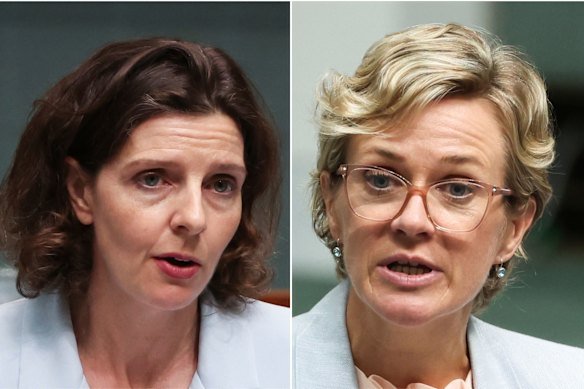
I have too much respect for women’s intelligence to believe that they really are flocking to Pauline Hanson and One Nation (Letters, June 5). Surely no intelligent voter of any gender would choose a party devoid of core policies, offering little more than populist nonsense instead of thoughtful debate. Bob Cameron, Coffs Harbour
Turn the boat around
The “people’s inquiry” into AUKUS expresses a fundamental frustration that Waleed Aly sums up well: “We woke up one morning and there it was” (“The big, unspoken issue that drives our feelings about second-hand submarines”, June 5). But the fact that it was unexpected should come as no real surprise, considering its architect was Scott Morrison, the least transparent and most reckless, incompetent and deceitful prime minister this country has ever had. Moreover, we do indeed need to think about realigning our international relations. Rather than follow a misguided view that China is a global bogey man of whom we should be wary, we might rather extend and strengthen our own influence with China itself. This makes more sense, if only because China is our biggest trading partner and arguably a more reliable economic and general ally, looking forward, than the USA. Frederick Jansohn, Rose Bay
I agree with Waleed Aly’s opinion that “AUKUS is now a proxy debate for the big geopolitical conversation we’ve never been able to have”. Ultimately, this debate is not about the type of submarine Australia is going to put into the water. It is more about the geopolitical rivalry between the world’s two great nuclear powers, the US and China, that will probably define the course of humanity until the end of this century. A potential US-China war over the strategic flashpoint of Taiwan would raise the danger of the world’s first nuclear exchange. So with Australia standing between these two global superpowers, is it really in our interest to stoke the fires of war? Perhaps we should rather be calling for a negotiated peace settlement over the future of Taiwan in the interest of humanity. Rev Vincent Zankin, Rivett (ACT)
I wouldn’t buy anything from US Defence Secretary Pete Hegseth, let alone a used submarine. As Clive Williams points out, the shelf life and ongoing costs will be astronomical (“Would you buy a used submarine from Pete Hegseth? First, a history lesson”, June 4). Of course, the submarines will not be fit for purpose either and are not what we need. Unfortunately, that question was never examined. We won’t be able to dictate where and how they are used. In his latest article, Waleed Aly discusses that question very well. These AUKUS subs were a wedge against Labor by Scott Morrison, arguably our worst prime minister, who has set up a cosy retirement job out of the whole deal. The extraordinary cost has never been publicly examined or justified. Geoff Nilon, Mascot
The last thing any politician wants to deal with is an issue that just won’t go away. AUKUS is increasingly becoming that for Labor, despite having largely bipartisan support for the purchase. We seem to hear regularly the next warning sign that all is not good with the submarines’ acquisition, and then the inevitable rationalisation of the new policy landscape appears. Richard Marles must be wishing that Labor never went near them. Grahame Riethmuller, Redbank
When you buy a second-hand car you would be wise to have its road worthiness and driveability checked out by the NRMA or your trusted mechanic. But who will check the reliability and seaworthiness of the second-hand subs we’ve signed up for? Brian O’Donnell, Burradoo
Do us a favour
Just how long will it take this timid government to call out the appalling behaviour of America and Israel’s so-called leaders? Vladimir Putin gets his serve, as it should be, and even Xi Jinping gets criticised occasionally, but, despite the blatant lying about ceasefires in the Middle East, the one-sided decision to change our AUKUS contract and the new “anti-slavery tariff”, Donald Trump and Benjamin Netanyahu seem to be beyond reproach. Australians deserve better than this, but we obviously won’t get it from the risible opposition or the ludicrous One Nation. It’s time the government took a stronger stand. Ian Usman Lewis, Armidale

It’s not an assembly line
Belonging to the older working demographic, I find it simplistic, even offensive, to read the opinion that work for older people “is a core part of their identity and daily structure” (“Is your workplace facing a Boomer bottleneck?” June 5). While some reference is made in the article to the value and experience of older workers, many in this demographic have observed the opposite problem, as younger, less experienced employees are promoted over them simply because they are young – often with less than ideal outcomes. One real-world driver of delaying retirement is watching our own “young worker” children and their families seriously struggling with the cost of living, including expensive childcare, insurance, energy and unaffordable housing. This is a major reason for us to stay employed, so we can provide them with some financial help from the savings we’re not spending. This isn’t simply another generational war. Perhaps the fact that older workers continue to pay tax and delay dependence on a public pension might be acknowledged when discussing the “Boomer bottleneck”. Robyn Dalziell, Kellyville
Not so fast
I agree with Andrew Moran that we are lagging countries such as China in fast rail (Letters, June 5). But let’s look at another vast country like ours, Russia, where even the slower regional trains are much better than ours. The 9289 kilometre trans-Siberian railway is completely electrified and a huge asset to the economy. NSW can’t even completely electrify the Bomaderry-to-Sydney line, which spans 160km. Instead, it uses ancient rail motors for the first 40km, adding about 40 minutes to the trip as commuters waste time changing trains at Kiama. For long trips in Europe it is almost always faster to take the train than the car. In Australia it’s the opposite. We need better electrification of our rail network to bring us up to speed. Mike Reddy, Vincentia
In comparing the statistics regarding high-speed rail between Australia (0km) and China (45,000km) correspondent Andrew Moran neglects some overriding numbers: Australia covers 7.7 million square kilometres and has a population of 28 million. On the other hand, China covers 9.6 million sq km but has a population of 1.4 billion. That’s about 50 times more people in a country of comparable size. High-speed rail may be important to China, but it will never fly in Australia. Dale Bailey, St Leonards

Loss leader?
Prime Minister Anthony Albanese’s claim that Labor is doing more to curb gambling than “any government in Australian history” is a joke if you examine the details of his claim (“Howard joins MPs’ push for gambling reform”, June 5). Take one example: capping TV ads to three per hour. That’s hardly tackling the problem. The simple fact is, like all previous prime ministers, no one is keen to take on the gambling lobby with its immense pool of funds. Now even former prime minister Howard has thrown his weight behind gambling reform. Australia is viewed as a world leader in gambling losses. Does Albanese want to his name linked to that? Larry Woldenberg, Forest Lodge
Familiar shenanigans
The revelations from the ICAC hearings into Parramatta Council would not be a surprise to many who have worked in NSW government departments and agencies, myself included (“Parramatta council staff on being labelled the ‘Witches of Eastwick’”, June 2). It’s just business as usual. Unethical conduct by senior managers is nothing new – hiring and promoting their cronies, friends and relatives despite rigorous recruitment procedures and regulations specifically designed to prevent this. It is also quite common to find out that many advertised public service positions are filled by employees already “acting” in the “vacant” positions. In the past, the ICAC has overlooked reports of dodgy appointments and recruitment practices, so many of us are surprised at this investigation and watching with interest where it leads. Joseph Palmer, Newtown
Motherhood statements
We sympathise with stay-at-home mother Celeste Hankins, who feels the role of a parent has become undervalued (Letters, June 5). My fiancée also received backhanded judgments about the unglamorous, unpaid business of raising children. The sniping sisterhood tried to inflict guilt and shame. “What? No degree or fabulous career on hold?” How dull and unambitious – scrimping to kill the mortgage, forgoing renovations, travel or the latest fashion. Somehow they can’t see the importance of raising well-balanced, healthy children, feeding them with home-grown fruit and vegetables, and enjoying the odd lunch or game of tennis with other unapologetic and improperly employed women. Ronald Elliott, Sandringham (Vic)
We know where you’re coming from, Alan Eason (Letters, June 5). My husband and I baby-proofed the house, but two of them still managed to get in. Pauline McGinley, Drummoyne
New lens, old world
I have just had cataracts removed from both eyes. I had hoped that when my sight was restored it would be like putting on rose-tinted glasses. Sadly, though, the world is still a mess, people are still killing each other, prices are still rising, and generally no one seems happy. I think I will wear blinkers from now on. Janet Scilly, Waterloo
- To submit a letter to the Sydney Morning Herald, email letters@smh.com.au. Click here for tips on how to submit letters.
- The Opinion newsletter is a weekly wrap of views that will challenge, champion and inform. Sign up here.
Read the full article here