


“Where did you grow up?”
I recently realised that I always answer this question with vague approximations. I’ll say “near the beach” or rattle off a nearby suburb (“close to Rosebud”). Or in desperate circumstances, simply “an hour and a half from Melbourne”.
I hail from Blairgowrie, a small suburb on the Mornington Peninsula that’s surrounded by far better-known places. There’s Portsea with its mansions and there’s Sorrento with its boutique stores. Rye with its summer carnival and Rosebud with its foreshore campgrounds. Sandwiched between is the humble Blairgowrie, roughly three kilometres long and significantly less remarkable.
Just a blip on most maps, it’s a place most people have never even heard of and find difficult to pronounce. (It’s Blair-Gow-Ri). Meaning “Plain of Gowrie”, it shares its name with a burgh in Scotland.
My English dad and Australian mum moved from London to their beachside utopia when I was three. Mum wanted to be closer to her parents, and they figured the wide open parks and beaches would be the best place to raise children.
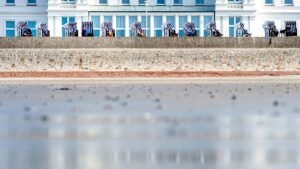
They would have struggled to find a place that was more of a contrast with the hectic and diverse English capital. Blairgowrie is sleepy, soft and sandy. Its best features are its two coastlines, the calm waters of Port Phillip Bay on one side and the vast Bass Strait on the other. Locals know them as the front beach and the back beach.
In summer, Port Phillip’s shores are dotted with children building sandcastles and parents sitting under colourful umbrellas. If you swim out far enough you’ll find yourself at the edge of the reef, where the sand falls away from beneath you and the aqua water quickly turns to a deep blue. Even in winter, you’ll see retirees taking their dogs for morning walks along the coast, sipping coffee and wearing a puffer jacket to stay warm.
The back beach is a different beast. Instead of cabanas and sunbathers you’ll find steep dunes and crashing waves. On Sundays my family would walk our Airedale terrier here – six of us weaving through thick brush and moonah trees then climbing over the sand.
The water here is almost always too cold or too rough for a swim. My sisters and I would instead spend time collecting sea glass and cuttlefish, and play in the rockpools, being careful to watch out for the tide. If we were extra lucky, we might spot the pearly shine of a nautilus shell.
Once I made the mistake of leaving my favourite sandals on a rock, and a big wave swept them away. I watched them bob out into the ocean, despite Mum’s best rescue efforts, and had to trek home barefoot.
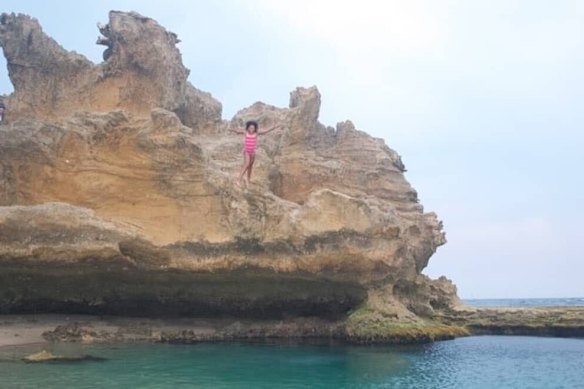
You might have heard about the jumping rock at nearby Bridgewater Bay. At low tide you can climb up a sandstone cliff before launching yourself into the deep water seven or eight metres below. Not long ago the spot was a local secret (I went there to celebrate my 11th birthday party), but the word is now out, and it’s all over Instagram and travel guides.
Speaking of popularity – we need to talk about the summer holidays, when my home town becomes unrecognisable. City folk travel down in a procession of SUVs over December and January, and unlock the doors of holiday houses that have sat empty for months. Blairgowrie grows too big for its own good as main roads fill with traffic and the locals and tradies are swept away at the local cafe by long queues of families in bathers and beach hats.
It’s not all bad. The crowds of new faces bring Blairgowrie alive. At our local beach, childhood friendships with out-of-towners would blossom before abruptly being put on pause at the end of January (often to be picked up where they left off the following year).
And many small businesses depend on summer, which more than makes up for the longer wait to order a morning latte or difficulties finding a park that’s close to your favourite swimming spot.
Away from the foreshore, Blairgowrie’s main street is small – there are a couple of cafes, an IGA, some restaurants and a post office. There’s a big concrete marina filled with boats, and a yellowing football oval next to a weathered asphalt tennis court. A few streets over is the red-brick community hall that looks like a relic from the 1970s. My sisters and I attended taekwondo lessons here, bowing diligently upon entering and exiting as if training at a dojang in South Korea.
But for most things – save for small martial arts academies – you’ll need to travel further afield in these parts. Friends were scattered across the peninsula, and by the time I was in year five, school was a 40-minute bus ride away.
And good luck getting anywhere without a car. The only real public transport option is the once-an-hour 788 bus to Frankston station, which has been shamelessly christened the “7-8-late”.
My dad did a pilgrimage to our neighbouring suburbs every weekend for his “big shop” while Mum spent countless weekends ferrying us to netball games or basketball tournaments, often in Melbourne or further.
I feel immensely privileged to have grown up down here on the ’Ninch, as locals call it. While most Blairgowrie dwellers will shun the glitzy stereotypes of Sorrento or Portsea, it’s a suburb that benefits from wealth, facilities and its natural beauty.
It’s also remarkably white. No non-Western country ranks in the top five for an individual’s ancestry or parent’s ancestry, according to the latest census. Only 5.8 per cent of households in the suburb speak a language other than English, compared with the statewide 30.2 per cent average. I would be lying if I said this didn’t occasionally play on my mind while growing up.
But the periodic isolation is more than made up for by the proximity to one of Victoria’s most beautiful coastlines. There’s water everywhere you look in Blairgowrie. That’s what I miss the most now that I live up in the city. Here, the pubs are open late, major events are right on your doorstep and there are more cuisine options than I know what to do with.
But every time I’m sweating in my Melbourne share house on a 40-degree day, I’ll close my eyes and think of Blairgowrie’s blue water. Occasionally, my phone will buzz with a text from Mum.
“Off to the beach for a dip now! Hope you’re doing OK in this heat xxx”
Gemma Grant is a reporter at The Age.
The Opinion newsletter is a weekly wrap of views that will challenge, champion and inform your own. Sign up here.


From our partners
Read the full article here