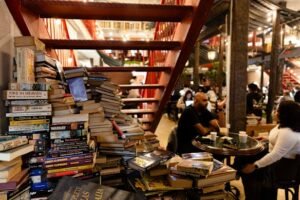





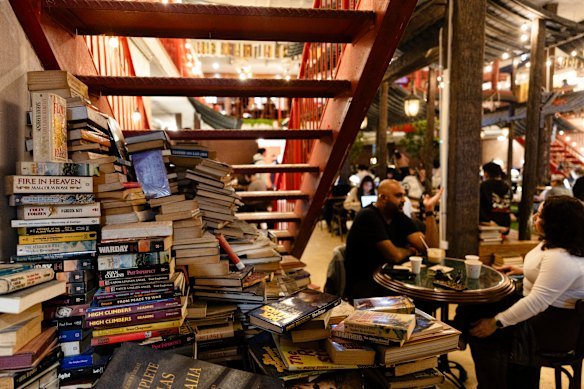
When a 24/7 study cafe took over the site of the former Gould’s Books on King Street, transforming the space into the new home of their fledgling business came with multiple hiccups along the way. Chief among them was the painstaking task of sorting, cleaning, and wiping mould off 10,000 old books that had been left behind and would have otherwise gone straight into landfill.
After five months of work, the result is “a little bit of Hogwarts, and a little bit of Ghibli”, said the founder of O3 Space Luca Yang.
Yang and his team are leasing the site formerly home to Gould’s Book Arcade – a local institution founded in 1967, famed for its sprawling, chaotic stacks of millions of second-hand books, records and manuscripts.
As Sydney evolves and old makes way for new, this tiny pocket of Newtown is serving as another example of a generational changing of the guard.
In 2017, Gould’s was priced out of their former location, shut its doors and moved further south on King Street, a 20-minute walk away. The place languished without a tenant for years, until Yang identified it as the perfect canvas for the “best study cafe in the world”. Following a whirlwind few months wrangling heritage building regulations, council development applications, and tedious paperwork, O3 Newtown opened in mid-July – joining three existing outposts in Auckland and Melbourne.
Where possible, Yang retained elements of Gould’s original charm and spirit, including the bookshop’s original paintings and small stacks of books. O3 has also kept the bookstore’s historic street facade, though that is where the similarities end.
The Studio-Ghibli inspired decorations, which feature a vermilion Japanese torii gate, tiled roofs custom-made from China and softly lit lanterns, reveal how O3 has imbued the space with their own distinct identity, resulting in a refreshing mix of old and new.
“Just because we’re young doesn’t mean we don’t respect the memories here. We’re really proud we’ve done what we can to preserve this piece of history,” the 27-year-old said.
“But we also have our own vision here, and we’re very proud of that, too.”
While coworking spaces or cafés are nothing novel, they “didn’t really solve the problem beautifully”, as Yang put it. The last thing he wanted was a space reminiscent of a corporate office.
“The beauty comes from making work or study fun, and not making work feel like more work. We design these spaces in a way that caters towards young people and their fantasy worlds.”
It has resonated with O3’s core demographic – Gen Z customers under the age of 30 – who tell Yang they feel “transported to a magical space”.
When the Herald visits on a weekday afternoon, O3 is at full capacity, with many more people queueing outside. The crowd attracts curious stares from passers-by, who chatter among themselves about whether they, too, should enter.
To pass through the turnstiles, users scan the O3 app on their phones. But some have reservations about the price of memberships. While everybody has access to three free hours a week, to stay for longer, there are three weekly subscription tiers: $10, $20 or $50 a week.
“We’re not trying to make everyone happy,” Yang said. “If you have a genuine third space open for every single person – as a public project, that is fine. As a business, you will get nowhere because you are trying to appease everyone, and in doing so, you appease no one.”
Yang was inspired to create O3 after observing the gradual disappearance of in-person third spaces for young people to connect. Now, he says, human connection is increasingly shifting online, driven by the internet and social media. The proliferation of short-form video content shortening attention spans and diminishing capacity for genuine connection means, in his words, “our generation is cooked”.
“But if you’re in a place like this, you are naturally more open. You’re more confident, you’re open to talking to other people. It’s an invisible feeling.”
The atmosphere made it easy to naturally strike up conversations with people from wildly different walks of life, Owen Wu said.

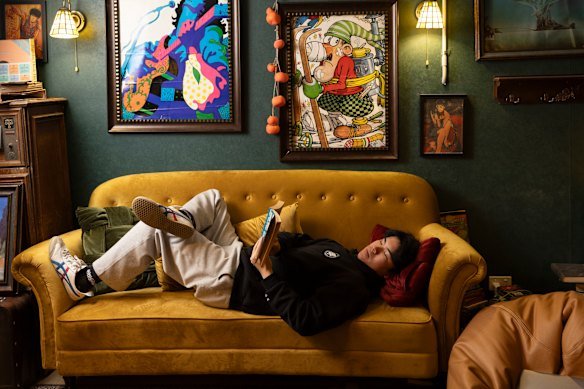
“You’d otherwise just never come across them on the street,” the 18-year-old university student said.
Wu has spent hours almost every day of the winter break at the cafe. In a single afternoon, he befriended a social media influencer, a musician and a start-up founder.
City of Sydney deputy mayor Jess Miller, who has pushed for idle buildings to be revitalised, said O3’s revamp of the space immediately caught her eye.
“The more that could be done to encourage people to make use of land and buildings that are just sitting there empty, the better,” she said.
“I really like that there are options like this. For young people, there’s this weird time of day between 3.30pm and 7pm where there aren’t many places where you can just hang with your mates.”
First-year university student Jocelyn Ngu recalled the challenge of finding study spaces during her HSC year – most of the time, it meant picking between packed, silent libraries or warding off distractions at home.
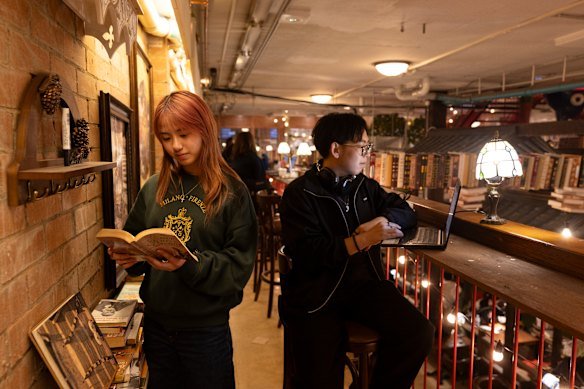
“The study cafe here is cool because everyone’s doing it together; it’s not like you’re doing it alone. Anyone can also do anything here, I saw people making bracelets and knitting too,” Ngu said.
Yang acknowledges the space isn’t for everyone. But he hopes those who do resonate with the concept feel welcome enough to come back, time and time again.
“At the end of the day, it’s about feeling comfortable and feeling like this place is yours,” he said.
Start the day with a summary of the day’s most important and interesting stories, analysis and insights. Sign up for our Morning Edition newsletter.
Read the full article here