






I’ve bought too many dog toys more often than I care to admit.
Over the years, I’ve brought home three rescues, Mingo, Margot and Gloria, and I got the big things right, but it seems like at least one of the small things was wrong every single time.
Now it’s just Mingo and me.
What all of this taught me is that the shopping you do in the week before a pet comes home decides how the first month goes, and that the mistakes are almost never the expensive ones. They’re the bowl that slides across the kitchen, the harness that doesn’t fit or the expensive toy they never even play with.
The timing matters more than it used to, too. Shelter Animals Count reported 5.8 million dogs and cats entering U.S. shelters and rescues in 2025, roughly 3 million cats and 2.8 million dogs.
That same report laid out that about 4.2 million were adopted, a 1% bump over 2024, while intake actually dropped 2%. The gap is closing, but it’s anything but closed. Adoption season isn’t a day or a month on the calendar; it’s whenever you’re ready.
So, as the go-to absolutely obsessed pet parent expert among my friends and colleagues, this is the list I’d hand them before they were even finished asking.
What do you actually need before bringing a new pet home?
These are the seven things you cannot improvise on day one:
- Food formulated for their life stage
- Bowls for food and water
- A bed or crate in a quiet corner
- A collar, ID tag and leash for dogs or a litter box and litter for cats
- A carrier, which many shelters require you to bring to pickup
- Flea and tick prevention, which needs a vet appointment to start
- Pet insurance, enrolled before any condition exists
Everything else on this list makes the first year easier, but these seven make the first day possible.
What is the best food for a new puppy or kitten?
Life stage is what actually matters most here. Puppy and kitten formulas have higher calories, protein and DHA than adult food because a growing animal is building a brain and skeleton at the same time. Look for the AAFCO “complete and balanced for growth” line on the bag or can. If it isn’t there, then it hasn’t been formulated for puppies and kittens.
Pros:
- Human-grade standard
- Chicken or beef listed first
- DHA and probiotics
- Buy 1-pound bag to try before you commit
Cons:
- Costs roughly triple most kibble per dry pound
- Some owners report wasted powder at the bottom of the bag
Human grade is the phrase doing the work here, and it’s a legal definition, not a marketing one. The Honest Kitchen makes this in facilities that follow human food safety standards, which means no meat meals, no GMOs and no corn, wheat or soy. Cage-free chicken or ranch-raised beef is the first ingredient, backed by nutritious ingredients such as chicken liver, oats, carrots and broccoli, plus DHA for brain development and probiotics for the digestive mess that is a new puppy. The clusters are gently baked rather than extruded, so they crumble easily if you want to soften them for a young puppy (or a dog with no teeth, like mine) or use them as training rewards. It works for every puppy size, which spares you the small-breed versus large-breed decision in week one.
Pros:
- Vet-standard formula
- Texture wins over picky kittens
- High moisture
Cons:
- Per-ounce cost adds up
- Kittens go through cans fast
This is the can vets hand out, and the thin-slices-in-gravy texture is the reason. Kittens who turn their nose up at pâté usually eat this. Each can has a minimum of 10.5% crude protein, plus vitamins E and C for immune support and prebiotics for the digestive chaos of a new kitten. It’s recommended that a 4-month-old kitten around 5 pounds eat roughly three cans a day, so buy the case.
You’ve picked out the food bowls, toys and dog bed, but there’s another thing that should be at the top of a new pup’s welcome-home checklist: joint care. Wuffes is a premium pet supplement brand that makes it easy to look after your new best friend’s comfort and happiness from the start. Instead of waiting until joint issues become a concern, the vet-recommended Hip & Joint Support Chews are designed to make proactive joint support part of a dog’s daily routine, with eight clinically tested active ingredients working together to support mobility and comfort.
For new owners of large-breed dogs, the formula provides higher concentrations of glucosamine, MSM and chondroitin to help address the unique joint-support needs that come with a bigger frame. Best of all? They taste like pork liver, something dogs love, making these a simple and rewarding addition to you and your new fur baby’s daily routine.
What is the best bed for a new dog or cat?
I swear by two rules: First, buy for the sprawl, not the curl, because dogs sleep bigger than they look. Second, if the cover doesn’t come off and go in the machine, you are buying a disposable bed.
Pros:
- Works for both species
- Cheap enough to buy two
- Bolster design cats like
- Available in five sizes
Cons:
- Shag mats over time
- Some owners report wear after repeated washes
One bed, all the pets. A new animal wants to tuck into something with walls, and the shag faux fur gives them a place to hide that isn’t under the couch. According to reviews, cats take to the smaller sizes immediately. Dogs, however, need you to size up more than you think, because the whole point of a donut bed is the curl, and a dog who hangs over the bolster won’t use it twice. When we had our three, each one 20 pounds or less, we bought the biggest we could so they could all cuddle up together. Medium and up have removable, washable covers, which is the minimum size I’d start with for just about anything.
What are the best bowls and water fountains for pets?
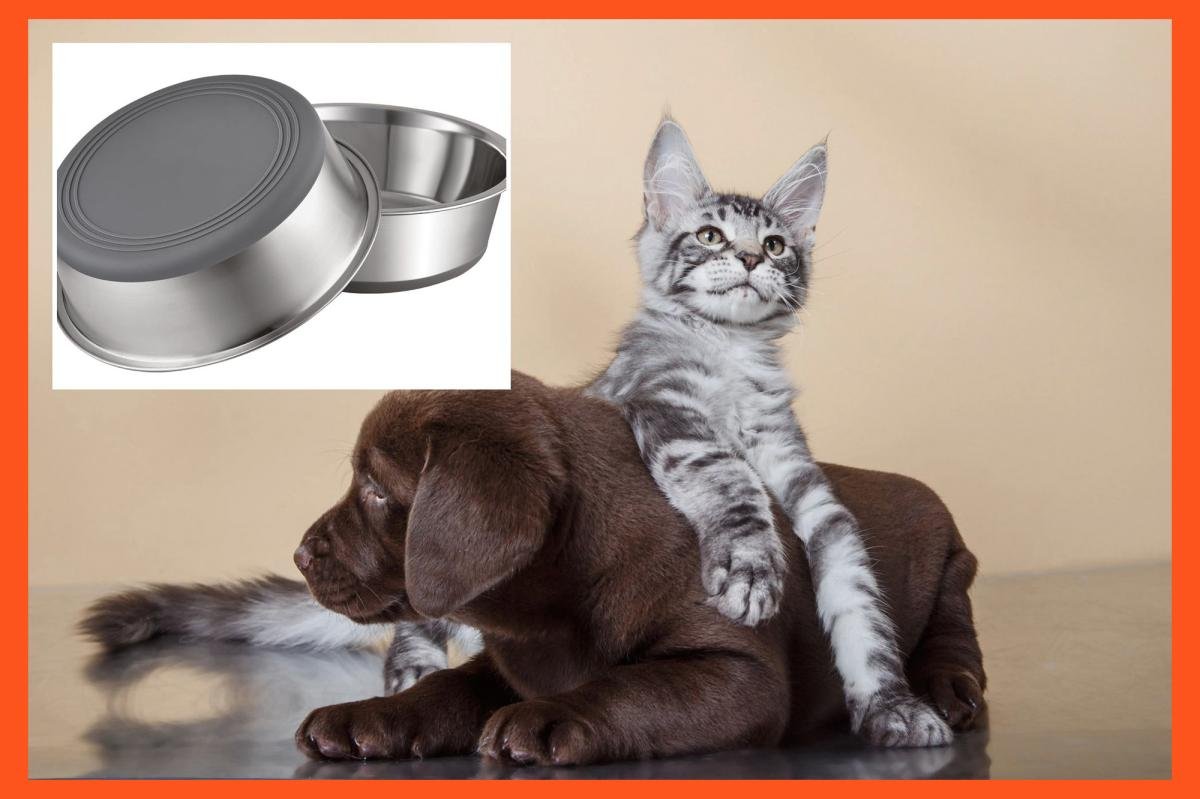
Always go stainless steel over plastic. Plastic scratches; scratches hold bacteria, including E. coli, Salmonella and MRSA, which can be transferred from pets to their parents. Additionally, consider putting your cat’s water bowl somewhere other than right next to the food. Water bowl placement is a hotly debated topic, but it is often thought that keeping the two separate mimics their primal instincts.
Pros:
- Silicone base really stops sliding
- Flat rim is easier on a cat’s whiskers
- Dishwasher safe and stackable
- Lower price than designer sets
Cons:
- Plain steel with no color options
- No matching mat included
These non-slip bowls are food-grade stainless steel, rust-resistant, BPA-free, with a silicone ring molded into the base so the bowl stays put instead of chasing your dog across the floor, which is the single most common complaint about cheap metal bowls. Deep sides keep food in and the rim is flat rather than rolled, which actually matters because a rolled lip is what a cat’s whiskers hit. Maybe most importantly, they are dishwasher-safe, and they stack, so the spare set is easy to store.
Pros:
- Big capacity
- Multi-pet friendly
- Stainless is easy to sanitize
Cons:
- Louder than compact fountains
The 360-degree design means multiple pets can drink at once without a standoff, which matters in a dog-and-cat house or the week you’re fostering. The stainless bowl beats ceramic and plastic fountains for cleaning, and the 128-ounce reservoir is the largest in its class, so you top it off every few days instead of daily. It hums a little, which the quieter capsule-style fountains don’t, so that’s something to keep in mind.
Pros:
- Weighs portions to the gram
- Intake charts catch appetite changes early
- 24-hour battery backup
- Stainless bowl
Cons:
- Dry food only
- No camera on this model
- App setup takes a minute
Most automatic feeders dispense by rotation and call it a portion, which drifts as kibble size changes. This one weighs what it drops to within one gram, then charts intake in the app, so you’ll find out your new dog stopped finishing meals before you’d notice by eye. Two modes: scheduled portions, or Smart Refill, which tops the bowl up and suits a cat who grazes. The 5-liter hopper holds about a month of food for a cat. It has a stainless steel bowl, a 24-hour rechargeable battery backup so a power cut doesn’t automatically mean a skipped dinner, and it takes kibble from 2 to 15 millimeters. To state the obvious, this is designed for dry food only, and worth saying plainly: this model has no camera. If you want to watch them eat, Petlibro sells the Granary 2 Vision starting at only $10 more.
What is the best leash and harness for a new dog?
If you plan on walking your dog (which, if you plan on getting a dog, you should be), go for the harness, not a collar. A collar is designed to hold the ID tag, whereas the harness is designed to hold the dog. Every puppy pulls for the first months, and a harness spreads that force across the chest instead of the throat.
Pros:
- Everything you need in a single order
- Nothing goes over the head
- Mix and match colors across all three pieces
Cons:
- No XL size
- Lightweight leash is rated to 90 pounds of pull, so it isn’t the choice for a large power-puller
Buying the three pieces at once is the point. New owners forget the bag carrier, then spend six months with poop bags balled in a coat pocket. The step-in design is the one I’d pick for a rescue: nothing goes over the head, which matters enormously for a dog who doesn’t know you yet and isn’t sure about hands near his face. It’s also the right call for a small breed with tracheal issues. If your dog turns out to be a serious puller, Wild One’s cushioned harness gives you more body coverage and more control, but start here.
Pros:
- Genuinely hands-free
- Bungee takes the shock out of a lurch
- Pouch replaces carrying anything
- Dual handles for close control
Cons:
- Waist belt tops out at 48 inches
- Not the choice for a dog that constantly pulls
This leash runs on a ring that glides around the belt as your dog moves side to side, so you aren’t constantly rotating to keep up, and a bungee section absorbs the lurch when it spots a squirrel. Two padded handles sit close to the clip for the moments you need to reel it in fast, at a crosswalk or past another dog. The zippered pouch holds a phone, keys, training treats, and a poop bag roll, with a built-in dispenser, so the whole walk can happen without even worrying about a pocket. These are sized by dog weight, so make sure you measure before ordering.
What is the best flea and tick prevention for dogs and cats?
There are two camps when it comes to flea and tick prevention. The vet-prescribed camp and the over-the-counter (OTC) camp. The strongest products are prescription-only, which means booking an appointment now rather than the week you notice a tick. But nobody should go unprotected while they wait for a slot that works with their schedule, and plenty of people adopting their first pet do not have a vet yet. So I recommend starting OTC, then switching if you think it’s worth it. Ticks don’t take winters off in the Northeast anymore, and neither should the prevention – but it’s never recommended to double up for extra protection. Pick one or the other.
Best Flea and Tick Prevention Without A Prescription: Seresto Collar
Pros:
- No vet visit required
- 8 months on one collar
- Kills and repels by contact so fleas don’t have to bite
- Works on dogs and cats
- Cheaper per month than most
Cons:
- No heartworm coverage
- Drops to 5 to 7 months if your dog swims often
- Some pets get skin irritation at the collar line
- Check the safety release
The collar releases imidacloprid and flumethrin in low doses across the coat, so it kills and repels fleas and ticks by contact. A flea doesn’t have to bite your dog for it to die, and flea bites are what transmit any disease and can even trigger flea allergy dermatitis.
What it does not do is prevent heartworm, and heartworm is the one that kills. If a collar is your whole plan, you still owe your dog an annual heartworm test and preventive from a vet. Treat this as coverage for fleas and ticks, not as a reason to skip the appointment.
The cat and small-dog versions have a predetermined breaking point so a snagged collar comes off instead of trapping the animal. And I know what you’re probably thinking. Aren’t they dangerous? When the EPA finished its multi-year review of Seresto, it found that deaths it could connect to the collar were mostly mechanical strangulation or trauma tied to that release mechanism failing, rather than the insecticide. I consider these safe for my dogs, and I live in upstate New York.
Pros:
- Five-parasite coverage in one chew
- Puppy-safe from 8 weeks
- Bulk pricing available
Cons:
- Prescription only
- Price jumps at higher weight bands
Six weight bands from 2.8 pounds up to 132 pounds, so it grows with a puppy. The prescription hassle is worth it for consolidation: heartworm, fleas, ticks and two intestinal worms in one monthly chew instead of a topical plus a separate heartworm pill you forget on the second month. Buying 12 doses at once drops the per-dose price by about 20% over singles.
Pros:
- Six-parasite coverage
- Kitten-safe from 8 weeks
- Topical avoids giving cats a pill
Cons:
- Prescription only
- Cat needs to stay dry and unpetted while it absorbs
Indoor cats need this too, which surprises new owners every year. Fleas ride in on a dog, on a pant leg, through a window screen. Revolution Plus goes on the skin behind the neck once a month and covers six parasite categories, including the ear mites that half of shelter kittens arrive with. Killing the fleas also prevents flea tapeworm, which is the actual reason your cat gets tapeworm.
What is the best pet carrier?
Call your shelter before pickup day. Many require you to bring your own carrier, and a cardboard box doesn’t count. The split here is simpler than the marketing suggests: hard-sided for cats, soft-sided for dogs. A cat is a flight risk, and a hard shell with a top door means you lower them in instead of shoving them in nose-first. A dog going under an airline seat needs something soft-sided that gives.
Pros:
- Top loading is far easier on a scared cat
- Ventilation on all sides
- Comes apart for cleaning
- Cheap and basically indestructible
Cons:
- Bulky to store
- Not soft for under-seat air travel
- Handle hardware is a weak point in reviews
Anyone who has tried to push a cat through a front-facing opening knows how that goes; you lower them in from above instead, which takes the fight out of the vet trip. Two doors also means you’re not tipping the carrier on its end to get them out at the other side. It’s made in the U.S. from recycled plastic, with ventilation on all four sides and a design you can take apart for cleaning.
Pros:
- Widely recognized by airlines
- Spring frame compresses to fit
- Mesh on three sides
- Machine washable liner
Cons:
- 16-pound ceiling
- Less protective than a hard shell in a car
- Sizing runs tight
This is the carrier airline gate agents recognize, and Sherpa’s Guaranteed On Board program is why it costs more than the no-name version. A spring wire frame in the rear lets you compress it to fit a tighter under-seat space without crushing your dog, and mesh panels on three sides keep air moving. Check your airline’s published under-seat dimensions before you fly; every one of them is different and always seems to be changing.
What is the best way to clean up after pets?
Cats are particular about three things: where the box is, how clean it is and what’s in it. Get all three right, and I would bet you’ll never have to think about this again.
Pros:
- Sifts after every use
- Weight tracking flags health changes early
- Small footprint
- 90-day trial
Cons:
- $599 is hefty
- Two-cat ceiling
- No litter-level sensing or night light
- Some cats need weeks to accept it
This is the model to buy if you have one or two cats and a normal-sized apartment, which describes most people adopting their first cat. It sifts after every visit instead of once a day, so odor never gets a chance to build, and the SmartScale logs your cat’s weight every single time they use it. The EVO is the compact one in the lineup, about 21 by 24 inches of floor, with a built-in carpet tray and an LCD screen on the front so error codes are readable without your phone.
Pros:
- Hard clumps that scoop clean
- No fragrance
- Made of what most shelter cats already use
Cons:
- Heavy to carry
- Clay dust tracks more than wood or corn options
Bentonite clay is widely considered to be the best litter due to its tight clumps and low odor. Shelter cats are usually already using clay, so matching what they know removes one variable when everything else is new. Unscented is the way to go because perfumed litter is for you, not for them, and a cat who dislikes the smell will find somewhere else to go, and that smell is worse than anything in a litter box. Guaranteed.
If you want to do your part to save the world (and who doesn’t?), get Earth Rated Poop Bags for about $0.07 a bag. If you need to save your wallet (and who doesn’t?), Amazon Basics is the way to go, with bags running about $0.02 apiece.
Earth Rated makes its bags from 65% certified post-consumer recycled plastic, which the company says keeps more than 5 million pounds of plastic out of landfills a year. They’re made from recycled materials, and they are extra-long and extra-thick, so they don’t weld themselves shut in the cold. One nice attention to detail: every refill roll has a sticker three bags from the end so you’re warned and won’t have to go without.
Amazon Basics holds poop and costs a third as much. Leak-proof, 13 by 9 inches, and the 900-count box includes a dispenser and a leash clip, the only accessory that matters. For a first-year puppy going out five times a day, the savings can add up faster than the poop can.
Pros:
- Actually removes the smell instead of covering it
- Safe on most surfaces
- Gallon size is cost-effective
Cons:
- Set-in stains need repeat treatment
- Always spot-test before
Pro tip: Buy it before you need it. This enzymatic formula breaks down the uric acid crystals rather than masking them. That’s why a dog re-marks a spot you cleaned with regular carpet spray. He can still smell it. Saturate the stain, let it sit 5 to 10 minutes, blot. On an old set-in spot, you may need two passes. A gallon sounds excessive until a month of house training.
What are the best grooming tools for new pet owners?
Start grooming early. Even if they don’t need it yet. If you get your pup comfortable getting their nails trimmed or hair cut early, it loses its scariness. This is the single piece of advice I’d go back and give myself.
Pros:
- Safety guard is the right training wheel for a first-time owner
- Sharp stainless blades
- Nail file included
- Non-slip grip
Cons:
- The guard needs adjusting as nails grow
This is the pair to hand a newbie thanks to the safety guard. It’s a stop on the back of the blade that physically limits how much nail can pass through, so the worst-case outcome of a nervous first trim is a cut that’s too short rather than one into the quick. This design features sharp stainless blades, an ergonomic non-slip handle and a nail file tucked into the handle for smoothing the edge afterward. Take one nail a day if that’s what it takes at first.
Pros:
- Pets tolerate it better than a brush
- Five-finger design reaches where brushes can’t
- Works wet or dry
- Machine washable
Cons:
- Struggles on thick double coats
- Peeling the fur off gets annoying
For an animal who hasn’t been groomed much or at all, this is the gentlest way in, because from their side it just feels like a good petting. You can work around ears, down legs and under a chin the way a rigid brush can’t. Fur collects on the 255 silicone tips and peels off in a sheet. It works wet, so it doubles as a bath mitt (which is how I love to use it).
Pros:
- 2 calories each
- Soft and fast to eat
- Resealable pouch
- Several proteins
Cons:
- Dry out if the pouch is left open
- Too small to work as a real chew
Training can mean dozens of rewards in a session, and it’s a sure bet any vet will tell you treats should stay under 10% of daily calories, so at two calories a pop, these work. They’re soft, so a dog swallows one and looks back up at you instead of spending time crunching, which is the whole rhythm of a training session.
What are the best toys for a new dog or cat?
Toy budgets are where new owners almost always overspend and under-deliver. Buy a few cheap, easy toys and watch what they actually pick up. Then, lean into that type of toy to keep them happy and stimulated. Every dog has a taste for texture. Every cat has a preference for prey.
Best Dog Toy Subscription: BarkBox
Pros:
- Cheap way to learn your dog’s preferences
- Super Chewer tier for aggressive chewers
- Annual pricing is a real discount
Cons:
- Month-to-month is the worst value
- Plush toys don’t survive some dogs
The real value isn’t the toys; it’s the sample size. You find out in two months whether your dog is a squeaker dog or a rope dog or a dog looking to disembowel anything stuffed. That tells you what to buy for years to come. If your dog kills a plush toy in under five minutes, skip Classic and go straight to Super Chewer. Boxes follow a monthly theme, which is more for you, not the dog, and that’s fine.
Pros:
- Covers every play style for $10
- Wands and mice are the consistent hits
- Catnip in several of them
Cons:
- Small parts can come unglued
- Needs supervision for string toys
Twenty toys for $10 is the fastest way to find out what type of toy your cat wants. Some cats are bird cats and want the wand. Some are mouse cats and want something small to carry around and hide in your shoe. You’ll know within a week, and then you can buy the good version of the one thing they love. The pack covers wands, balls, catnip mice, rattles and feather toys.
Pros:
- No batteries ever
- Balls won’t get lost
- Quiet enough for overnight
- Safe for kittens from 12 weeks
Cons:
- Cats can lose interest without a second toy in rotation
Three stacked circular tracks, six balls, zero batteries and zero noise save for a little rattle. Your cat sits on the floor and stays interested for months because the balls can’t be lost under the couch. Featuring a non-slip base and a safety bar over the tracks keeps balls from escaping. Pro tip, thanks to reviews: remove one ball from each level, leaving one per track. They spin better with room, and you get three spare balls to replace later.
Pros:
- Built for large cats where most towers aren’t
- Real sisal posts
- Heavy base that doesn’t wobble
- Hammock and covered condo
Cons:
- Assembly takes a while
- 36 pounds is not a move-it-around-the-room piece
A cat that can get above the room is a cat that feels safe, and that matters most in the first month when everything smells like strangers. This tree has a substantial weight, so a hefty cat landing on top at speed won’t move it. The posts are wrapped in natural sisal, not carpet, which is what cats actually want to shred and the reason a tree like this earns its money by keeping claws off your sofa arm.
Pros:
- Treat toss plus 360 view
- Emergency and security alerts
- Two-way audio
Cons:
- Subscription required for full features
- Adds $96 to $120 a year
Furbo now gates some of its best features behind a Nanny subscription, which is a bummer. But what you get for it still feels worth it, if you ask me. You get alerts that ping you if your dog is barking nonstop or something’s wrong at home, plus the health tracking that shows you what separation anxiety actually looks like. The treat toss is the fun part, but it’s the safety alerts that make this worth the money.
What is the best pet insurance for a new pet?
Enroll now. Before anything happens. Like, enroll on the way home from the shelter. This is the one item on this list with an expiration date, because every insurer excludes pre-existing conditions, and a condition becomes pre-existing the moment it’s noted in a chart. A pet you adopted yesterday has the cleanest record they will ever have.
Pros:
- Unlimited annual payout option
- One simple plan
- Covers alternative and end-of-life care
- 24/7 telehealth with no waiting period
Cons:
- The annual limit you pick at signup can never be increased (which is common)
- No wellness or routine-care add-on
- No multi-pet discount
Healthy Paws’ unlimited annual payout is the reason to pick it, and the reason to choose it now rather than in three years. Healthy Paws lets you choose a $5,000, $7,000 or unlimited annual limit and the best part? Whatever limit you select at enrollment can never be raised for the life of that pet’s policy. A healthy eight-week-old puppy is the cheapest that unlimited tier will ever be. With this particular pet insurance for new pet owners, there’s one plan, no confusing tiers and it covers alternative therapy, stem cell treatment and end-of-life costs, plus always-on vet telehealth with no waiting period.
For context on why this is worth budgeting: an emergency vet visit can run up to about $1,290 for a dog and between $215 and $1,615 for a cat, and routine annual care runs $610 to $3,555 for dogs and $180 to $870 for cats. Healthy Paws or not, I just want you to start saving now, so check out our expert-backed breakdown of the best pet insurance companies.
Frequently Asked Questions
How much does it cost to set up for a new pet?
Using the picks on this list, a starter kit for a dog (food, bowls, bed, walk kit, carrier, poop bags, enzyme cleaner, first month of flea and tick prevention) lands in the $350 to $600 range. A cat setup runs lower unless you buy an automatic litter box, which is $599 on its own. Insurance sits on top, averaging about $62 a month for a dog and $32 for a cat. Why that really matters is because a single emergency vet visit can run as high as $1,615.
What should you buy first for a new pet?
Food, bowls, a bed and a carrier, in that order, because the carrier is often required at shelter pickup and the other three are needed within an hour of walking through the door. Everything else can wait a week.
Do indoor cats need flea and tick prevention?
Yes. Fleas travel on dogs, on clothing and through window screens and treating an active infestation is far more involved than monthly prevention. Ear mites are also common in shelter kittens and are covered by the same prescription products.
When should you buy pet insurance?
On day one. Insurers exclude pre-existing conditions, and anything a vet documents before your policy starts, or during a waiting period, is likely excluded for the life of the policy. Pick your annual payout limit carefully at signup, because several insurers will not let you raise it later.
Should I get a hard or soft carrier?
As a general rule: hard-sided for cats, soft-sided for dogs. A top-loading hard carrier lets you lower a cat in instead of pushing them through the front, which can make a bigger difference than you realize. Soft-sided carriers compress and fit under an airline seat.
How many toys does a new pet need?
Fewer than you think, in more variety than you think. Start with three or four different textures and play styles, see what they gravitate towards, then buy more of those. Rotating toys weekly keeps them interested more than tossing out 20 at once.
Is an automatic litter box worth it?
For a multi-cat house or anyone traveling regularly, yes, mostly because it sifts after every use instead of once a day. For one cat and a daily scooping habit, a standard box and good clumping litter can handle the job for a lot less.
For over 200 years, the New York Post has been America’s go-to source for bold news, engaging stories, in-depth reporting, and now, insightful shopping guidance. We’re not just thorough reporters – we sift through mountains of information, test and compare products, and consult experts on any topics we aren’t already schooled specialists in to deliver useful, realistic product recommendations based on our extensive and hands-on analysis. Here at The Post, we’re known for being brutally honest – we clearly label partnership content, and whether we receive anything from affiliate links, so you always know where we stand. We routinely update content to reflect current research and expert advice, provide context (and wit) and ensure our links work. Please note that deals can expire, and all prices are subject to change.
Read the full article here