



At least 25 New Jersey towns blew millions in opioid settlement money, reportedly spending the massive windfall on lavish purchases like an electric Mustang, custom monogrammed jackets and splashy concerts — instead of vital addiction services the funds were supposed to support.
The Garden State, which has lost an estimated 30,000 to opioid deaths and left 150,000 addicted over the last decade, settled a groundbreaking national lawsuit in 2021 against Big Pharma — Purdue Pharma, Johnson & Johnson, CVS and 10 other painkiller manufacturers — that was initially praised by experts, addicts’ loved ones and cash-strapped nonprofits as a measure of restitution and pathway out of the crisis, NJ.com reported.
But the $1.1 billion payout — set to be distributed through 2040 and half of which has funneled directly to towns and counties since 2022 — has largely been used on pricey wish lists instead of beefing up addiction services, drug prevention efforts and treatments across the battered state, an investigation by the outlet found, citing experts, advocates and some state officials.
“This is blood money,” said former New Jersey assemblyman John Armato, who tragically lost his son Derek to a fatal overdose in 2020.
“Hundreds of thousands of people are dying because of this,” Armato, 78, fumed to the publication.
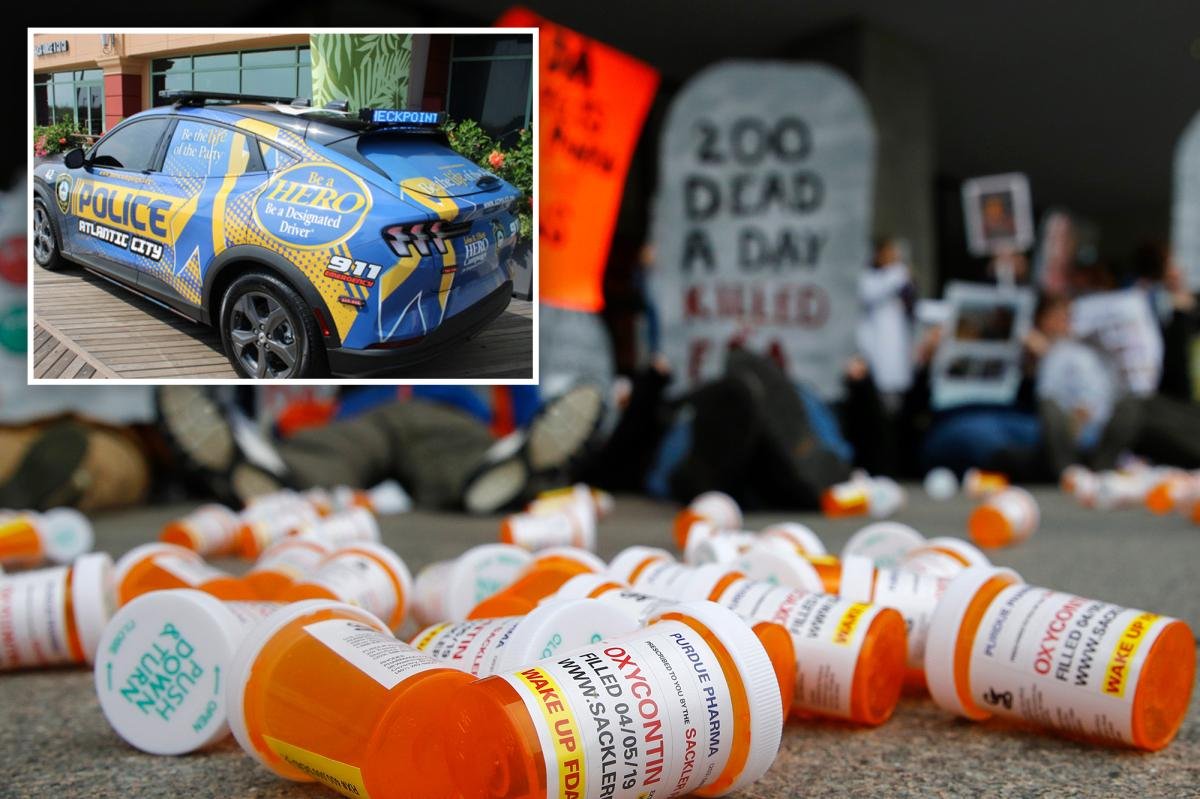
Among the most extravagant purchases was a $73,000 custom vinyl wrapped 2022 Mustang Mach-E for the Atlantic City Police Department; $600,000 for two awareness concerts in Irvington, and nearly $150,000 to a non-profit in Camden to identify broken street lamps.
Atlantic City received over $2.3 million from the settlement and has since gone on a shopping spree — splashing the cash on 30 monogrammed jackets and around $140,000 on clothing, backpacks, consulting services and a city homeless workforce program.
Meanwhile, Irvington “wasted” over $600,000 on two opioid awareness concerts in 2023 and 2024, according to a blistering July 2025 report by the state comptroller’s office.
“None of the billboards, promotional materials, or T-shirts that Irvington provided to the Office of the State Comptroller included information about obtaining treatment or avoiding abuse of opioids,” the report said.
New Jersey municipalities have spent about $2.3 million of the total opioid payout by exploiting vague settlement language and ambiguous guidelines — which violates the 2021 national agreement, a 2022 state attorney general’s memorandum and the 2023 state Opioid Law, according to NJ.com.
Camden forked over $148,000 to a non-profit to identify and document broken streetlight, which city spokesperson claimed was aimed to “impede the drug trade and prevent open drug use.”
Manchester Township spent $57,000 on a new car for a school resource officer to “combat drug addiction and overdose related issues (in the) school system,” and Lindenwold, which received $166,000 in the settlement, planned to build a trailer where kids could play video games.
“I’m trying to think of words that I would be willing to say in a newspaper, and I can’t think of ones that are safe to use,” Sandy Gibson, addiction researcher and counselor at The College of New Jersey said of the outlandish expenditures.
“But that’s sort of everything that’s wrong with there being no oversight with this.”
While some municipalities have spent the money frivolously, others have come under fire for sitting on it — with more than $53 million collecting dust in municipal accounts for as long as three years, NJ.com reported.
As of June 2025, Summit had nearly $1 million in the bank — but hadn’t spent a cent.
Summit Mayor Elizabeth Fagan said the city hadn’t doled out any of the funding in the 2025 reporting period because it was doing “due diligence on appropriate management of these funds so that our process is compliant with all laws and standards.”
A strategic plan was formed this year and officials are working with local nonprofits to determine how the money is spent, Fagan told the outlet.
“They’re not doing what’s intended. It’s just sitting there unspent,” Gibson urged.
“You’re telling us what your priorities are. Your inaction tells us that is not a priority to you.”
Similarly, Aberdeen Township also reported spending nothing, despite receiving just shy of $130,000 in settlement funds since 2022.
Gibson slammed that while she’s “upset that these things are happening,” she’s “even more upset that there’s no accountability.”
“Is there no accountability built into this process?” she questioned.
Meanwhile, state Assemblyman Cody Miller (D-Gloucester) said he plans to draft legislation to regulate use of the opioid money, calling for tighter oversight and transparency.
“When (Armato) initially told me what these funds were being spent on, I was pissed off,” Miller said.
“There’s so much ambiguity with the settlement information … that it’s open to interpretation.”
Miller, whose older brother and sister have struggled with addiction, said municipalities and the state “can learn from it” and that he hopes “it can help us make sure that we’re doing things more appropriately and that funds are being spent for their intended purpose.”
Read the full article here