



Richard Whitington
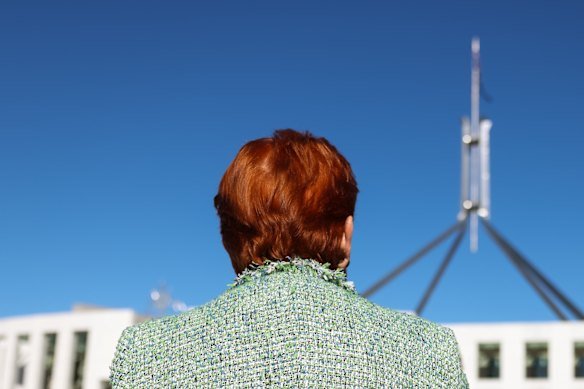
The prospect of Pauline Hanson becoming prime minister of Australia is zero, with a capital Z. Notwithstanding opinion polling and some isolated election results feeding a frenzy of speculation that Hanson is a credible chance to lead her party into government, the feat requires One Nation to win a minimum 39 seats (up from the current two – only one of them gained at an election).
Consider this reasonably simple maths: a prime minister must command a majority of the 150 seats in the House of Representatives – a minimum of 76 seats. That majority can be gained outright, or by forming a coalition partnership of two (or more) parties, as the Liberals and Nationals usually do.
Discarding the possibility of One Nation winning 76 seats in its own right, the “Pauline as PM” scenario, implausible as it is, assumes that One Nation becomes the majority partner in a coalition – presumably with none other than the Liberals and Nationals. Using bare-minimum figures, that would require One Nation to win 39 House of Reps seats, and the Libs/Nats 37 seats between them. That would drop the Libs/Nats down from their current, historically low 41. (Thirty-eight each for One Nation and the Coalition mightn’t work! Who’d take the reins?)
Leaving aside where One Nation would win those seats – that is, from the Libs, the Nats or Labor – the bare-minimum primary vote to win any electorate is about 25 per cent, looking at the results for the teals in North Sydney in 2022 and Bradfield in 2025. That would still need to be followed by a favourable flow of preferences from the candidates you’ve outpolled and who have been eliminated.
It’s true that if the current average of opinion poll figures for One Nation – 27.8 per cent – was replicated in any single seat on election day, One Nation might possibly win that electorate, with enough Liberal/National preferences. But is 27.8 per cent realistic, 39 times over?
The same polling has Labor at 26.8 per cent (compared with 34.6 per cent at the 2025 federal election), the Coalition at 21.5 (compared with 31.8 in 2025), and the Greens at 13.5 (12.23 in 2025).
My following hypothetical contest does not accept those opinion poll average figures, partly because they are so wildly divergent from the results just 14 months ago but chiefly because of the practical challenges of actually winning seats, on the day.
But if an electorate is to be won by One Nation, the primary votes would need to look something like this: Labor 30 per cent (about halfway between current polling and its 2025 result), Coalition 29 per cent, One Nation 26 per cent, Greens 9 per cent and another right-leaning party sympathetic to One Nation – let’s call it Palmer United – at 6 per cent. First, PU is eliminated. Assume 75 per cent of its preferences go to One Nation with most of the rest to the Coalition, and a dribble to Labor. Round figures, the standing is now: Labor 30.5 per cent, One Nation 30.5 per cent, Coalition 30 per cent, and Greens still on 9 per cent.
Now, the Greens are eliminated and their preferences distributed, with most of them – about 75 per cent historically – going to Labor. That would take Labor to 37.5 per cent. But the remaining Greens preferences are split between the Coalition and One Nation, leaving: Labor 37.5 per cent, One Nation 31.5 per cent, Coalition 31 per cent. Now the Coalition is eliminated, with nearly two-thirds of its preferences going to One Nation, for a final result of One Nation 51.5 per cent to Labor’s 48.5 per cent.
But – and here’s the very big BUT – all of the above depends on one in four people casting their first-preference vote for One Nation (not to mention what vagaries there might be in preference allocation). And, don’t forget, this scenario has to materialise in 39 electorates for Hanson to become prime minister.
It’s unlikely that many commentators who are entertaining this possibility have ever immersed themselves in an electorate-level campaign for long enough to appreciate the demands involved. Perhaps the required campaign budget, typically several hundred thousand dollars per electorate, will be covered by Gina Rinehart or Clive Palmer, but what about the volunteers typically required? Nobody comes from near-nowhere, as One Nation must, and wins an electorate without many hundreds of people “on the ground”.
I speak from the experience of volunteering in the electorate of Bradfield, won by community independent Nicolette Boele in May last year with a primary vote of 27 per cent. She won by just 26 votes, on her second attempt, after more than three years of campaigning (and the Liberals having held the seat for 75 years). Nearly 1500 people worked for her in Bradfield for months, waving placards on street corners, letterboxing tens of thousands of residences, and handing out leaflets at shopping centres, train stations, pre-polling booths, and on election day, then scrutineering at vote-counting centres.
Not even the Exclusive/Plymouth Brethren (who swamped Bradfield on behalf of the Liberals) could supply enough troops to do that for Pauline Hanson in 39 electorates.
Sure, more than 18 months out from the next scheduled election, many voters are saying “One Nation” to opinion pollsters. There can be no doubt that people are interested in an alternative to the parties of the traditional political establishment.
The simple question remains: regardless of what people are telling pollsters, and noting the massive logistics required to win a single seat in the House of Representatives, will one in four Australians walk into the privacy of a polling booth in May 2028 and vote for One Nation? In 39 electorates? As Pauline Hanson once put it: “Please explain.”
Richard Whitington was a Whitlam government staffer and communications consultant.
From our partners
Read the full article here