





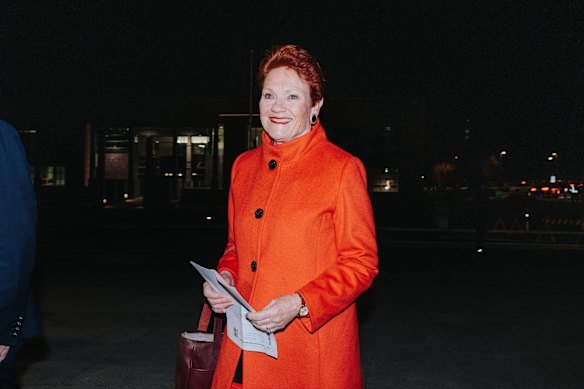
I was wrong about One Nation. The party waited 30 years for Australia to come to it; I thought that meant it would persist unchanged. Instead, since leader Pauline Hanson appeared at the National Press Club, the party has transformed at lightning speed.
I didn’t think that was possible, or likely. In February, when One Nation was hovering around 23 per cent according to the Resolve poll for this masthead, I wrote that the party would hit its limits as the nation turned its mind to fixing a foundering economy. That has turned out to be wrong.
I’m not the only one to have been mistaken. There is a lot of history currently being rewritten by sages conveniently forgetting their sermons. The internet remembers what they predicted better than they seem to remember themselves. But unrectified errors are a sludge that gums up the entire predictive engine. Wrong just gets wronger. Reflecting and refining is something analysts shouldn’t be afraid to do. As a new political dynamic takes hold of the country, it’s crucial we try to accurately understand what’s going on.
Evidently, I overestimated the ability of the demoralised Coalition to capitalise on the obvious economic opportunity to make a comeback. The government has sustained more damage from its own improvised exploding economic devices than the Coalition has been able to inflict on it. It took independent senator David Pocock to force a backdown on the “widow tax” that would have ended grandfathering on existing investment arrangements in the event of divorce or death of a spouse.
I also underestimated the professionalised machine One Nation has become. Hanson likes to say that she hasn’t changed – that the rest of the country has just caught up with her. She might not have changed. But since the National Press Club address, it’s clear that her party has changed considerably. And it will do what it takes to win.
Hanson’s attempt to explain what she means by monoculture is interesting for that reason. It was typically inelegant. But more relevant than style is the fact that she offered a clarification at all – and the definition she gave.
The ethnically diverse Socceroos football team is an example of a monoculture, she said. Because they are “people from different backgrounds and cultures and nations all wearing green and gold, and representing one nation, under one flag, and succeeding under the same set of rules”. In the end, her version didn’t differ significantly from the way the 2024 Multicultural Framework Review defined multiculturalism. Except she only took a sentence, where the review needed a full page.
And with that, in an instant, the woman who started her parliamentary career warning about ghettoisation and a lack of assimilation when immigration is too rapid, who has prosecuted that view consistently since, suddenly aligned herself with the melting-pot-half-full view of a multi-ethnic Australia.
Paid parental leave became another flash point. Hanson said at the press club: “If women take time off and they are not paid their wages because they’re not working, fair enough. Why should business pay?” It is a position she’s expressed before. In 2017, she said women would get themselves pregnant to access the scheme, claiming it’s part of a “welfare handout mentality”. But in 2026, that’s not a hill her party is willing to die on. Claiming she was misinterpreted, Hanson told Nine: “There’s no way, shape or form that I am actually saying to get rid of it. I’ve seen it’s been very beneficial to women to get back in the workforce.”
Now, as I’ve acknowledged, we are all wrong sometimes. Admitting and correcting an error is, at the very least, a matter of self-respect. So no shade on One Nation for updating its positions. What I find more intriguing is what happens from here.
One Nation is polling around 30 per cent, ahead of Labor on primary preferences, according to some polls. To increase that support – and to move into an election-winning position – One Nation needs to attract additional constituencies. The trick is to secure them while trying to hold the supporters it already has. We are witnessing a party grasping for the mainstream.
But that’s not a straightforward process. With economists warning we’re teetering on the edge of a recession, there is a real question as to whether a party without economic expertise can style itself as a plausible economic manager. It will have to develop and defend policies in a hurry. And haste is the enemy of credibility, as the ongoing discovery of landmines in Labor’s rushed budget attests.
Another question is whether Hanson’s protest party can become a party of government without losing voters who have stuck with her for years, cheering for her unyielding stances. The same goes for voters who have more recently embraced her for her perceived consistency. And voters who were attracted, particularly in the wake of the December 14 terrorist attack at Bondi, by the fact that she has spoken plainly for years about the incompatibility of political Islamism with the Western liberal democratic way of life.
Basically, can a party whose main appeal is conviction change and evolve without losing support? Or would it be better off not changing?
Former Liberal leader Peter Dutton’s experience was a harsh lesson on that front. Ahead of the 2025 election, voters were giving the Coalition what might be described as grudging respect for policies that weren’t necessarily popular at the time, such as bringing nuclear energy to Australia. For as long as he clearly delineated an alternative vision, Dutton looked like a contender. Voters turned against him when he started matching Albanese like for like in an effort not to alienate voters during the election campaign. In the end, disappointment in Dutton’s lack of conviction handed Anthony Albanese a mudslide election: shallow, but all-engulfing.
Pauline Hanson’s One Nation is standing on the precipice of a momentous judgment: whether voters will reward or punish moderation. Right now, it looks like the lady who was not for turning is pivoting to the middle ground.
Parnell Palme McGuinness is an insights and advocacy strategist. She has done work for the Liberal Party and the German Greens and is a senior fellow at the Centre for Independent Studies.


From our partners
Read the full article here