





Recent mill closures have been “gut-wrenching” as the forestry industry faces tough market conditions, the chief executive of Canfor Corp. said Thursday.
The Vancouver-based company announced earlier this week it’s permanently closing its Fox Creek sawmill in northwestern Alberta because there is not enough fibre in the region to sustain it long-term. U.S. tariffs and weak markets have further eroded its viability, it said.
The Fox Creek sawmill, destroyed by a fire in 2008, was rebuilt in 2011 to process an increase in available timber due to the Alberta government’s strategy launched in 2007 to reduce the amount of mountain pine beetle-susceptible forests.
The strategy, coupled with consecutive deep freezes, led to a drastic drop in the destructive insect — it was decimated in Jasper National Park by 2022 and province-wide, reduced by 98 per cent.
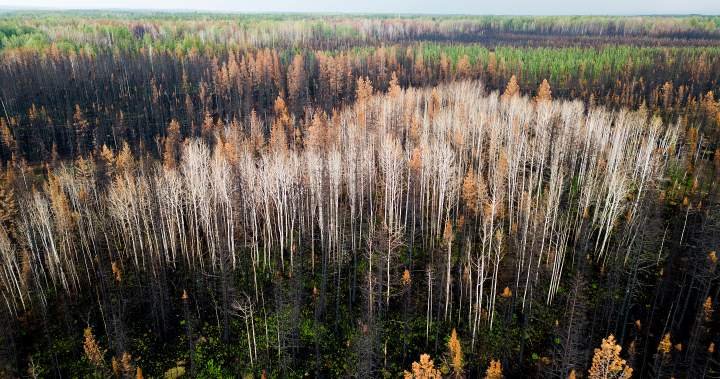
The province then ended its pine beetle management strategy, which Canfor said paired with wildfire-damaged timber now largely exhausted, means there is insufficient fibre in the region to sustain the Fix Creek mill’s operations over the long term.
A prolonged weak market and punishing duties and tariffs was the final blow to the mill’s viability, Canfor said.
“This decision reflects the challenges facing our operation and does not diminish the dedication and contribution of our Fox Creek team,” said Canfor president and CEO Susan Yurkovich.
She said Canfor has operated in Alberta for more than 70 years and the company is focused on strengthen operations, including at its Grande Prairie and Whitecourt sawmills, as well as its Spruceland manufacturing facilities and its newly acquired PinkWood building materials supplier in Calgary.
“Our goal is to ensure these operations can run fully and successfully compete in the global marketplace, while generating jobs and supporting communities across the province,” Yurkovich said in a statement.
The mill in the town of 2,4oo people is expected to be wound down and closed by late summer.


Get daily National news
Get daily Canada news delivered to your inbox so you’ll never miss the day’s top stories.
The news comes two weeks after Canfor said it would shutter its pulp mill in Prince George, B.C., citing a market oversupply that has depressed prices.
In May, it announced the permanent closure of two sawmills in southern Sweden due to an imbalance between fibre availability and production capacity.
“These are incredibly difficult decisions that impact our employees, their families, and our local communities,” chief executive Susan Yurkovich told a conference call Thursday.
“We’ve made changes across our platform that are gut-wrenching, but we are putting our business on a more sustainable footing.”
The remarks came after Canfor reported its second-quarter loss narrowed to $18.5 million from a loss of $202.8 million a year earlier. The loss amounted to 16 cents per diluted share for the quarter ended June 30 compared with a loss of $1.71 per diluted share in the same quarter last year.
Sales for the quarter totalled $1.53 billion, up from $1.38 billion in the second quarter of 2025.
The financial impacts of the mill closures are expected to show up in Canfor’s third-quarter results.
It’s anticipating about $30 million in restructuring costs in its pulp segment related to the mill in Prince George, along with an asset writedown and impairment charge of about $35 million linked to Fox Creek.
Canfor shares were trading up about three per cent on Thursday.
Meanwhile, another Canadian lumber company, West Fraser Timber Co. Ltd., is continuing to assess the impact of the Trump administration’s latest tariff volley.
The U.S. government announced a plan earlier this month to impose a 50 per cent tariff on hundreds of categories of Canadian goods, including several varieties of plywood, paper and other wood-derived products.
The tariffs are slated to take effect on Aug. 19 and would be imposed using an obscure legal tool dating back to the Great Depression.
The Canadian industry had already been dealing with long-standing duties on softwood lumber when, last year, an additional 10 per cent tariff was imposed on certain softwood lumber products using a different legal mechanism than the latest barrage. In that case, the U.S. invoked a law that allows tariffs to be imposed in the name of national security.
West Fraser said its medium-density fibreboard is not directly subject to tariffs and indirect effects are “not fully determinable at this time.”
Year-to-date, three per cent of its plywood and 20 per cent of its laminated veneer lumber would have been affected by the latest tariffs, had they been in place during that time.
“We continue to monitor developments relating to the scope and implementation of these tariffs and any potential impacts on our business,” West Fraser said.
The company’s shares were trading down more than six per cent on Thursday, a day after it reported a wider second-quarter loss.
West Fraser booked a loss of US$61 million, or 78 cents a share, compared to a loss of US$24 million, or 38 cents per share, during the same period a year earlier.
Sales dropped to US$1.43 billion during the quarter from a year-earlier US$1.53 billion.
With files from Karen Bartko, Global News
Read the full article here