





In early 2020, Tom Cosm noticed something strange. He started getting a series of Instagram messages from people he didn’t know. Many of them mentioned someone named Kevin.
“How do you know Kevin?” one asked.
Cosm had no idea who or what they were talking about. He thought he may have been pranked. Then his partner at the time did a bit of digging and discovered that another Instagram account with millions of followers had started following Cosm. She turned to him and said, “I’m pretty sure they’re talking about Kevin Parker from Tame Impala.”
Cosm, a New Zealander, had never met Parker, who is from Fremantle in Western Australia. But, of course, he was aware of Parker’s music, which he releases under the name Tame Impala.
By early 2020, it was difficult not to know who Parker was: the fourth Tame Impala album, The Slow Rush, was about to be released (it ended up being critically acclaimed, while also reaching No. 1 in Australia and
debuting at No. 3 on the US Billboard 200).
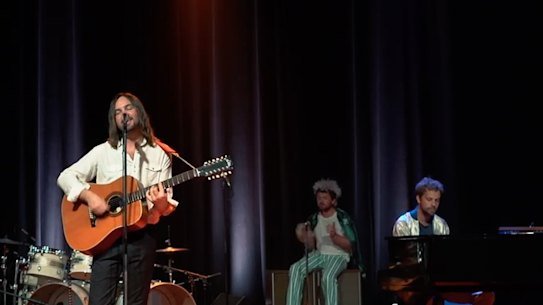
Although Parker tours with a band, he largely writes, plays, records and produces Tame Impala’s music himself, genre-hopping from trippy psychedelic rock to spacey indie pop to R&B-infused dance-floor bangers.
So Cosm reached out to him. He made a light-hearted joke, asking if Parker wanted to listen to his latest mixtape. And the response surprised him for two reasons. The first was because Parker not only knew who Cosm was, but he was a fan, and had been for some time.
Cosm is a 43-year-old who used to call himself an audio mad scientist but now prefers the terms prototyper, educator and sonic tinkerer. His real surname is Lewis, but at the suggestion of his sister a couple of decades ago, he adopted Cosm as a stage name. It’s short for Certified Organic Sound Machine.
He learned classical piano as a kid, then moved to jazz piano in high school, going on to study it for two years at a tertiary level. “I loved jazz because my neurodivergent brain loves patterns and transpositions,” says the bearded, man-bunned Cosm, speaking from a home studio in his apartment in Christchurch. “But then I discovered electronic music and that opened up a whole new world of patterns and numbers and music for me.”

He threw himself into it and began sharing educational videos about performing and recording electronic music on YouTube, mainly using the digital audio workstation Ableton. His videos became so popular that Ableton took notice, and hired him in 2009 as an official certified trainer.
And that’s how Parker knew about him. He’d watched and learned from many of Cosm’s tutorials.
The second thing that surprised Cosm when Parker responded to him? Parker asked for his help. He had an idea, and he wanted to know if Cosm could make it a reality.
“He said he wanted a chord-generating keyboard that wasn’t complicated,” says Cosm. “He wanted it to be very portable, and he wanted it to be all about having an idea and being able to get that idea down as quickly as you could, no matter where you were, whether that was on a bus, in a plane, or at a mate’s house.
“And he wanted to make it something that anyone could use, without being restricted by their lack of musical theory or technical knowledge.”
It wouldn’t be easy, “because this was something new and original, and I would have to develop new tools from scratch and learn a lot of new skills”.
But Cosm was up for the challenge. And, besides, Parker just wanted one of these machines. Right?
The pair corresponded for a year, exchanging ideas and developing the concept. Finally, Cosm felt he was ready to make it.
“I had a mate who owned a machine that could bend aluminium,” Cosm says. “I got some Perspex cut, I found all the hardware bits and pieces I needed, and I took out my soldering iron and got to work. The prototype I ended up sending Kevin didn’t look beautiful, but it did what he wanted it to do.”
In fact, Parker loved it. And then he said the thing that would change Cosm’s life: “Why don’t we try to make some more of these?”
“Some more” was an understatement. With Parker as creative director and Cosm as technical director, they formed Telepathic Instruments with CEO Charl Laubscher, marketing director Sophie Lawrence Parker, operations director Chris Adams, and design chief Ignacio Germade. The new device, which they called the Orchid, debuted in late 2024 and landed on Time magazine’s list of the best inventions of the year in 2025.
‘Parker wanted to make it something anyone could use, without being restricted by their lack of musical theory or technical knowledge.’
Tom Cosm
At this point in the story, non-musicians may be wondering what is so different, or special, about the Orchid. The simple answer is in what it achieves for the user, drastically lowering the skill bar for music creation and shortening the distance between idea and execution.
If you want to play a chord, you just choose the type of chord from a bank of eight buttons on the left: anything from a major to a minor to a suspended 4th and more. You have no idea what any of that means? Don’t worry – you don’t have to. While depressing one of these buttons with your left index finger, use your right hand to press a key on the one-octave keyboard. Pressing the C key while holding the major button results in a C major chord. Press the 7th button at the same time and you get a C7. And so on.
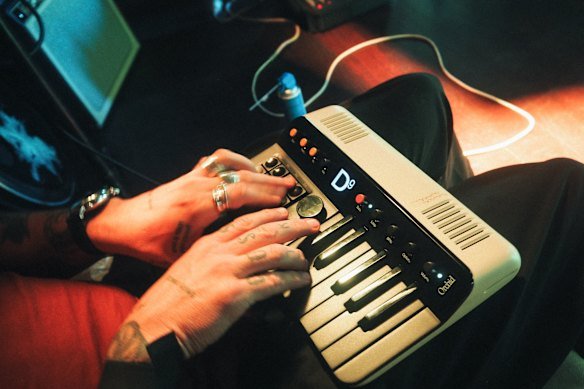
That’s just the start. There are 70 different preset sounds available, from buzzy synths to gliding strings, all of them designed by Parker. And each of those sounds can be manipulated by other wheels and knobs, including performance settings (arpeggiated, strummed and so on) and effects (reverb, phaser, chorus). There’s also an in-built beat machine and a looping function, so you can record a section of music and a beat for a number of bars, save it and replay it on repeat, then experiment with overdubbing melodies.
And the Orchid is no longer the not-so-pretty aluminium-and-perspex prototype Cosm came up with. With designer Germade on board, it is now a curved, tactile, eye-catching piece of equipment, taking cues from 1960s Olivetti typewriters, 1970s Polaroid cameras and 1980s Casio keyboards. It’s no surprise to learn that Germade made his name as a designer for Polaroid.
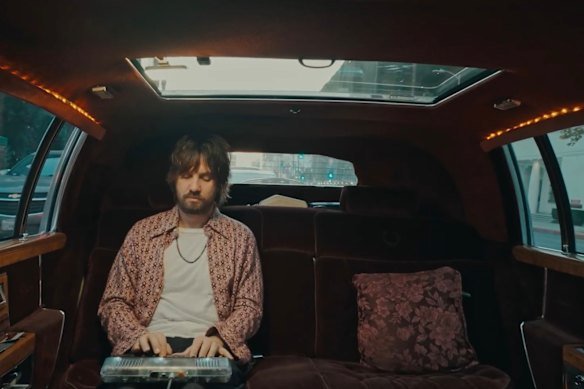
The advertising campaign has been another important factor in the Orchid story. It was introduced via a very funny video featuring comedian Matt Berry, with Jemaine Clement from Flight of the Conchords as narrator, in a parody of 1980s videos for synthesizers and electronic equipment. There’s also a series of clips where well-known musicians are filmed in the back seat of a limo being driven through Los Angeles, playing a song using the Orchid. One of the most popular features Kevin Parker playing and singing a cover of Cat Stevens’ Wild World.
Orchid, which retails for $899 (or $975 with an eye-catching orange carry-case), has struck a chord commercially as well as musically. The first drop of 1000 units in December 2024 sold out from the Telepathic Instruments website in three minutes. Its second drop of 3000 in May 2025 took 20 minutes to disappear. The latest drop is a lot larger. Cosm won’t give an exact number, but “it’s big enough that it won’t sell out for a while yet”.
And he and Parker are constantly refining Orchid, with buyers able to get the latest updates (more sounds, quality control adjustments) via the Telepathic Instruments website for free.
Cosm also created a forum called The Garden, where users can talk about their experiences, point out any issues, share how they’re using Orchid and make suggestions for future upgrades. In the early days, Cosm would monitor these comments and respond to them himself. With the runaway success of the instrument, he has had to hand that over to someone else in the company. But the concept is in keeping with his long-held philosophy.
“I’ve always liked being open source and sharing information with people,” he says. “I’ve done that all my life, whether it’s through my music or my production or my work with Ableton. I just get satisfaction from teaching people how to build software or how to make electronic music or how to be more creative.”
As for who is using Orchid, at the big end of town it has already infiltrated the charts. Kid Cudi’s Submarine and Don Toliver’s Call Back both feature the Orchid, while artists such as Janelle Monáe, Diplo, Gracie Abrams, Fred Again and Ryan Tedder were all early adopters.
But for Cosm, it’s the other end of the spectrum that interests him most. “I’ve watched six-year-old kids play with one of these and get so much out of it,” he says. “And I’ve given them to people who have no musical background as far as playing an instrument is concerned, but they’ve always wanted to make music.
“I know of a couple of people who even started crying after they used it, because they never thought they’d be able to create something musically up until now.
“For me, the joy of providing tools to help people get creative ideas out of their brain …”
He pauses for a moment to put his thoughts into words. “Well, let’s just say that I love my job immensely.”
Get the best of Good Weekend delivered to your inbox every Saturday morning. Sign up for our newsletter.
Read more from Good Weekend:
Read the full article here