





Updated ,first published
The United States lobbied the Albanese government over concerns with Australia’s plan to force American tech giants to pay for local news just days before the prime minister sought a tariff exemption in a call with President Donald Trump.
Trade Minister Don Farrell spoke with his counterpart, US trade representative Jamieson Greer, on Tuesday to make Australia’s case on the 12.5 per cent tariffs and America’s recent decision to scrutinise lamb imports, which could affect Australian farmers.
In that call, this masthead has confirmed that Greer raised Australia’s News Bargaining Incentive.
The White House has previously called the scheme, which threatens to charge firms including Meta and Google if they do not voluntarily strike deals with media companies to pay for local news, “foreign extortion”.
Prime Minister Anthony Albanese has taken on a number of fights with digital platforms and AI firms in the name of protecting Australian news businesses and creatives.
Labor’s tech regulation agenda complicates the government’s attempt to get out of Trump’s latest round of tariffs, which are underpinned by questionable claims of modern slavery failures.
It is not clear if Trump raised the News Bargaining Incentive in his overnight call with Albanese and the prime minister did not mention the topic on Friday morning. Albanese did confirm that he and Trump discussed economic policy and the future of the AUKUS pact in a “very warm and productive” phone call.
The Trump administration’s 12.5 per cent tariff on Australia and a slew of other countries was applied for allegedly failing to take action to prevent slavery, a move Australian officials insist is unjustified.
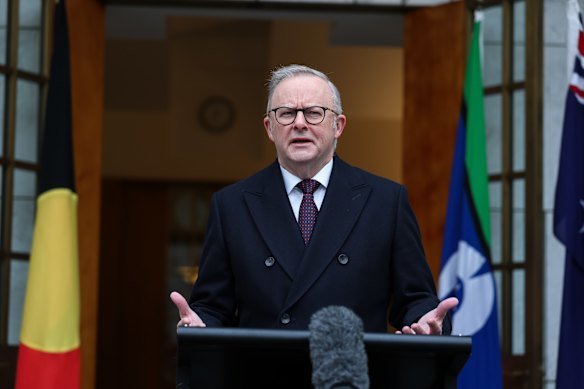
Albanese told reporters at Parliament House on Friday that he raised the issue of tariffs with his US counterpart and that Trump agreed to “give consideration” to his request for a full tariff exemption or – at the very least – no increase to the existing 10 per cent rate.
“I informed him about our record when it comes to dealing with issues such as modern slavery, the strengthening that we have put forward … [to] hold companies accountable for the supply chain process,” Albanese said.
“We have a different position when it comes to tariffs. But I did ask that Australia’s position as a friend of the United States be considered, and the president agreed that he would give consideration to my request.”
Albanese hinted at further meetings with Trump in which tariffs could be negotiated, flagging two visits to the United States before the end of the year.
Fifty-four countries including China, Vietnam, Japan, the United Kingdom and New Zealand have been hit by the same 12.5 per cent tariff.
Six economies – Canada, the European Union, Ecuador, Indonesia, Mexico and Pakistan – were hit with a lower 10 per cent tariff because an investigation by Greer found they were the only countries that had “not failed to impose a forced labour import prohibition”.
Albanese confirmed the two leaders used the phone call to discuss the AUKUS pact, following a briefing on Thursday from Pentagon official Elbridge Colby, a former pact sceptic, who said he was pleased with progress on the deal.
“We reviewed the significant progress that has been made under AUKUS, which remains full steam ahead. We agreed it was a project that is and will continue to deliver benefits for the United States, for Australia, and for the United Kingdom,” Albanese said.
“We discussed the progress on pillar two of AUKUS, where we have agreed our first signature project focused on joint development of cutting-edge payloads and enabling systems for uncrewed undersea vehicles.”
Trump signed a presidential memorandum overnight on bolstering US Navy and shipbuilding capabilities, which included a provision for the establishment of a fifth public navy yard. The new development is directly linked to a plan to increase nuclear-powered submarine capability, a signal that could bode well for the provision of vessels to Australia.
The prime minister also used the call to advocate for an end to the war in the Middle East, saying he had received an “extensive update” from Trump on the state of play that would largely remain confidential.
“It is having an impact on Australia and indeed on the global economy. The president expressed his confidence going forward,” Albanese said.
Shortly after Albanese spoke, US Treasury Secretary Scott Bessent said the Trump administration would apply measures that have “never been seen” on Iran.
“It will be a combination of economic isolation like the world has never seen before, and the continued blockade in the Strait of Hormuz that will keep anything from going in or out of the Iranian ports,” Bessent said in an interview with American media.
Albanese described the phone call as “very warm and productive” and said the pair discussed artificial intelligence, critical minerals and Australia’s recent deals in the Pacific.
“I was able to pass on my best wishes to the United States on their 250th birthday, as well as my personal best for the president’s 80th birthday.”
Cut through the noise of federal politics with news, views and expert analysis. Subscribers can sign up to our weekly Inside Politics newsletter.


From our partners
Read the full article here