





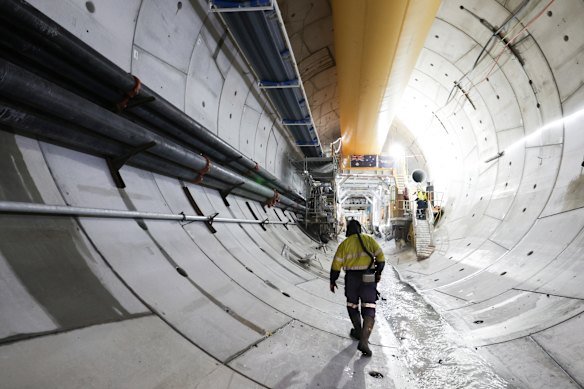
Torrents of water have been seen gushing through a tunnel and a cavern deep underground on the troubled Snowy 2.0 pumped hydro project, as two incidents within days of each other illustrate the challenges contractors face.
Videos obtained by this masthead show dramatic scenes as water rushes at high pressure through a tunnel carved out by a 205-metre-long boring machine known as Kirsten, which has been grinding through rock uphill at a 47 per cent gradient.
In another incident late last month, a temporary fault with pumps caused a backlog of water, creating what resembled a waterfall over part of a large cavern excavated for the project.
The leaked videos starkly illustrate the obstacles the multibillion-dollar project is encountering beneath the Kosciuszko National Park, and away from the public’s eye.
Snowy Hydro, the Commonwealth-owned corporation charged with delivering the project, said the water ingress was the result of naturally occurring geological conditions and was expected during tunnelling.
“While the volume was higher than usual for a short period, the water flow depicted is being actively managed on-site by principal contractor Future Generation Joint Venture,” it said in a statement. “Underground work is continuing on the project.”
NSW’s workplace safety regulator, SafeWork, said it was aware of “an issue” with water entering a section of the Snowy Hydro 2.0 project, and it would continue to monitor the status of the site. “There were no reported injuries to workers from this incident,” it said in a statement.
Italian construction company Webuild, which is the lead contractor on the project, directed questions to Snowy Hydro. Webuild is also constructing a multibillion-dollar metro rail line to Sydney’s new international airport, and is involved in a high-stakes stoush with the NSW government on that project.
Another boring machine named Florence was an earlier high-profile example of the challenges of the Snowy 2.0 project. The machine became stuck in soft ground in September 2022, less than 100 metres into a 15-kilometre tunnel, opening a sinkhole to the surface.
Florence was stuck for nearly all of 2023, was freed in December and made slow progress until February 2024 when it became wedged in hard rock while excavating a curve in the tunnel. A team of contractors with high-pressure water jets took seven weeks to blast it free.
Since then, it has continued work on excavating the headrace tunnel that will connect the Tantangara reservoir, at the high point of the project, to the powerhouse and electricity-generating turbines.
Former prime minister Malcolm Turnbull commissioned Snowy 2.0 in 2017, declaring a completion deadline of 2021. His initial price tag of $2 billion, announced before a feasibility study was complete, climbed to $6 billion when the report was completed.
The official price tag was changed to $12 billion in 2023, and the deadline extended to 2028.
Then in October last year, Snowy asked the Webuild-led joint venture constructing the project to undertake another cost assessment, leaving many observers to expect another blowout. However, Snowy recently said its 2028 construction deadline remained on track.
Inflation pressures are raising the construction costs and financing the project, while tunnel workers in September secured wage rises of 26.5 per cent over four years, raising their individual salaries to more than $300,000.
Climate Change and Energy Minister Chris Bowen remains committed to the project, having described it as a crucial element of Australia’s transition from a coal-powered grid to one dominated by renewable energy.
Snowy Hydro uses surplus electricity to pump water from a reservoir at the bottom of a hill to the top, from where it will be released to flow down and spin turbines.
The project is a massive upgrade to the existing Snowy scheme – taking total generation capacity to 375,000 megawatt hours, or enough to power 3 million homes for a week.
Start the day with a summary of the day’s most important and interesting stories, analysis and insights. Sign up for our Morning Edition newsletter.


From our partners
Read the full article here