




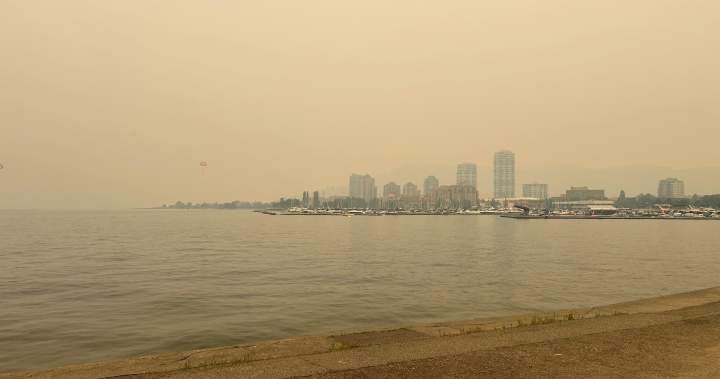
Thick wildfire smoke shrouded Kelowna, B.C., on Thursday, obscuring the city’s signature lake views, disrupting tourism and prompting public health officials to urge residents to limit their exposure.
What is typically a postcard-worthy view of Okanagan Lake was barely visible as smoke settled over Kelowna and surrounding communities.
“It’s awful, I can’t see anything,” said Gina Hill, who is visiting from Ontario.
The smoky skies were a dramatic contrast to the much clearer conditions seen just 24 hours earlier.
“I wasn’t really expecting this this fast, though, because yesterday I had a couple friends here and they said it was pretty nice,” said Edmonton resident Robyn Papirny.
The sudden deterioration in air quality also forced some visitors to change their plans.
“We cancelled some of our plans to go up to the trestles to ride bikes,” said Darryl Dreger, visiting from Alberta.
The smoke is also taking a toll on local businesses.
Sandra Ng, owner of the Aloha Okanagan food truck, said fewer people are visiting beaches and parks because of the poor air quality.

Get daily National news
Get daily Canada news delivered to your inbox so you’ll never miss the day’s top stories.
“We’re going to have to possibly shorten our hours, possibly close early, maybe not open some of the days,” Ng said.
“This is our season. This is like when we do the most business, so if we’re reducing the number of days that we’re working, obviously we are majorly impacted financially.”
The smoky conditions were reflected in the region’s air quality readings.
On Thursday, the Air Quality Health Index reached 10+, the highest risk category on the scale.
“At that level, that’s when the general population should be reducing their strenuous outdoor activities,” said Dr. Andy Delli Pizzi, medical health officer with Interior Health.
Interior Health is also reminding residents that limiting exposure to wildfire smoke is especially important for seniors, young children, people who are pregnant and those living with chronic medical conditions.
“Things like lung disease, COPD or asthma, or for people who have heart disease — wildfire smoke can make those illnesses worse,” Delli Pizzi said.
“If people are feeling unwell with shortness of breath or chest pain, then that’s a reason to either call 9-1-1 if it’s an emergency or you can call 8-1-1 for advice otherwise.”
According to Global meteorologist Peter Quinlan, the smoke is expected to linger for several days.
While mornings may bring temporary relief, wildfire activity typically intensifies through the afternoon, causing smoke conditions to fluctuate throughout the day.
For many residents, however, smoky summers have become an unfortunate reality.
“It’s expected,” said Kelowna resident Steve Montgomery. “Nothing new about it.”
Read the full article here