



 Markets
  Weather
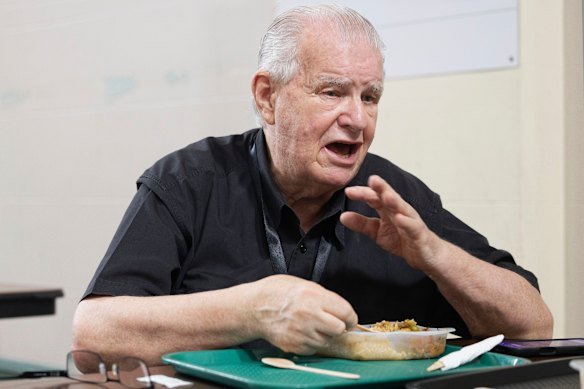
For more than 50 years, Bill Crews has extended a loving – and practical – hand to the most marginalised and forgotten people in society.
The 80-year-old Uniting Church minister has walked alongside countless individuals who are in often unimaginable pain. So you could forgive him for becoming at least partly inured to the suffering – for developing a callus over his emotions. As a means of self-preservation, if nothing else.
Yet, here we are sitting over lunch at Loaves and Fishes, his free restaurant in Ashfield, with about 40 other diners and he is tearing up. A deep compassion has momentarily overwhelmed him as we talk about the people he helps. He still feels. As deeply as ever.
It must be exhausting to live that way? “It is,” he agrees. “It’s continually day one.”
To meet Crews is to be struck immediately by his authenticity. In an era of public figures so conscious of massaging their image to their own advantage or of leaders who peddle cruelty and bitterness masquerading as authenticity, Crews is one of those unicorns whose actions are motivated by deep-held beliefs and who, literally, wears his heart on his sleeve.
And, almost unwittingly, he inspires the same in others. I can’t remember the last time, if ever, that I felt the prick of tears myself during an interview, but it happened, not once, but twice engaging with this simple, yet complicated, man.
Earlier, arriving at the Ashfield Uniting Church, home to Loaves and Fishes and a host of other services, I sat in the sunshine to wait. About a dozen guests gathered out the front waiting for the doors to open, some listening to music, others chatting and many sitting silently.
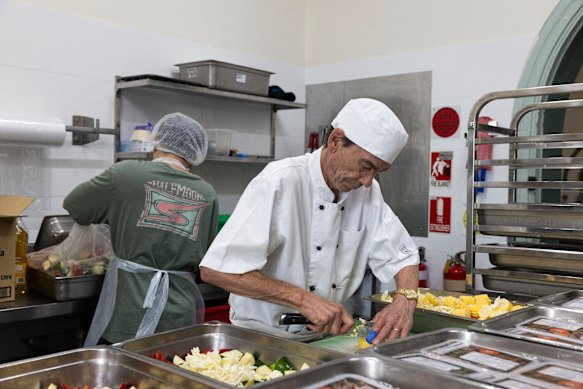
Volunteers in blue “Bill’s Crew” T-shirts buzzed around getting ready for lunch service in the church hall in what was obviously a well-practised routine.
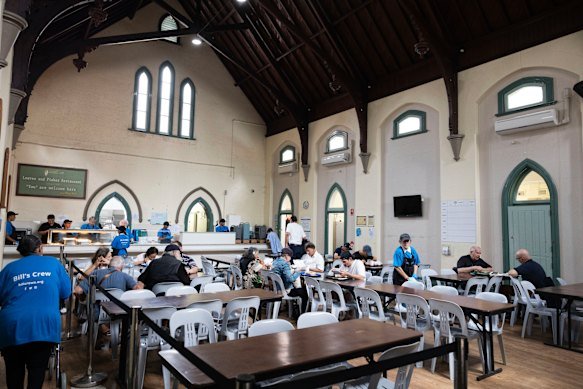
Crews leads the way through the busy kitchen amid a chorus of “G’day Bills” and “Hi Bills” to the restaurant, where about 40 diners are seated. Most are intent on the food in front of them but greet Crews warmly when they spot him.
The choice today is veggie pasta or chicken casserole with rice. We both opt for the latter, served with a generous smile, and settle down to eat the simple but good food and yarn.

The genesis of Loaves and Fishes goes back to Crews’ long-time mateship with former adman and arch larrikin John Singleton. One day in the mid-1980s, Singo turned up at the Ashfield church.
“He’d won all this money on the horses,” says Crews. “And he said, ‘What would you do if I gave it all to you?’ I said, ‘I’d open a soup kitchen’.
“He hands me the money and goes, ‘Call it Loaves and Fishes.’”
Singo had evidently paid attention during Bible studies.
“John is wealthy, but people don’t become millionaires by giving their money away,” Crews writes in his 2021 book Twelve Rules for Living a Better Life. “A lot of them are mean bastards, but not Singo: he gives. He will give away a million dollars, just like that, if the cause is good and true.”
Bill Crews was born in Britain in 1944 and came to Australia aged three with his mother and father, who had been an engineer in the RAF. The family ended up in St Marys, near Penrith, where Crews went to school. He remembers those years fondly.
“St Marys at that time was where all the refugees from Europe came,” he says. “You had these hessian humpies in the bush where all these families lived. I grew up with a whole hotchpotch of kids of different backgrounds. It was Germans and Russian and Yugoslavs and me in the middle of all of it, and I just loved it.
“We used to climb trees and steal birds eggs and wander through the bush. And to me, it was like nirvana with all these kids. Most of them couldn’t even afford shoes.”
That all came to a crashing halt when Crews was dispatched to Townsville Grammar School. “It was quite militaristic. You had army cadets, and I was never really good at all that. I was quite dorky and every now and then I’d do the wrong thing and get bashed up by the sergeant major or whatever. It was pretty brutal and it went on for years and years. It was beyond dreadful. I begged my parents to take me out of the school and they wouldn’t. It robbed me of my self-esteem.”
Many years later, he was invited back to speak at the school. He refused the speaking invitation but eventually attended a dinner where he found himself seated next to one of his main tormentors. “He said to me, ‘Wasn’t it dreadful, Bill?’ And I realised he had been as unhappy as I was. He’d been a victim himself and was suffering as much as I did. Everyone was trying not to be bullied.”
‘I can’t understand a word. And I suddenly realised misery speaks all languages.’
Bill Crews
Crews’ situation at home was also difficult, particularly with his father, to whom he was a “mystery”. A man brought up in the shadow of the Depression and then who had been to war, he valued hard work, self-reliance and making money. “I was a bit of a dreamer and didn’t worry about money at all,” Crews says.
A chance meeting led Crews to the Wayside Chapel in Kings Cross where he began volunteering and then, at the age of 27, the seminal moment of his life occurred.
“One night, I was going to manage the coffee shop there. I walked up the stairs to the landing and honestly, it was like time stood still. It must have been a millisecond, but it felt like forever. It wasn’t a voice, it was a knowing, and it said, ‘You got to leave your job. You got to come and work here. You got to work with the poorest of the poor. The work will be long and hard and arduous, but don’t worry about that because I’ll be with you. You’ll become well known, but don’t worry about that’.
“‘And, by the way, your personal life won’t be that happy’ … And that last bit has helped me through most of all because every time life gets terrible, I think of that voice and I think, ‘Well, it warned me’. ”
Much to the disgust of his father, Crews quit a promising job as a researcher with AWA and threw himself into his work with Wayside Chapel. He became ordained in the Uniting Church in 1986 and went to work at Ashfield Uniting Church the same year.
He’s been a minister ever since but has had an at times strained relationship with “head office”, frustrated at bureaucracy that slows or prevents his practical compassion.
“Look at the Good Samaritan,” he says. “Look at that. The two priests who went past wouldn’t touch him [the traveller who had been robbed] because then they wouldn’t be able to go into the temple. Bullshit. Bullshit. You get caught up with the bullshit when the real thing is the loving kindness.”
The word “love” comes up a lot, and he tells a story from 10 years ago to illustrate the simple, yet devastating power of love, especially when yoked together with a determination to genuinely meet someone wherever they happen to be.
He was visiting a refugee camp in Calais, northern France. He saw a hand-lettered sign with an arrow saying NA (Narcotics Anonymous) and entered the tent. “There’s maybe 10 people, from different countries from Uyghurs to Middle Eastern people to Africans sitting in the thing. They all have the same problem and are telling their story in their own language. So I can’t understand a word, but it’s all on their faces. And I suddenly realised misery speaks all languages.
“At that time I was going through a really hard time and my marriage was busting up and all of that and my kids were suffering. And I suddenly got up and I said, ‘I’m Bill from Australia, and I’ve had two stuffed marriages, and I’m feeling really bad today because of all of that, blah, blah, blah’ and they all got up and they all hugged me. All these people just hugged me. People who have got nothing and they gave me my life back.”
After more than 50 years, Crews still wants to throw his own arms around the world and even now he is still learning the lesson that he can’t fix everything and everybody.
“In the end, the only thing you can fix is yourself,” he says. “I’m learning a really hard way to give people back their own power to either fix themselves or not. Often, when I’m trying to fix someone I’m really trying to fix something up in myself.
“The thing I keep saying to people now is when somebody comes to tell you their story don’t drown them out with yours. It’s amazing what happens when somebody knows they are really being listened to.”
Not of which stops him railing against society-wide inequity and how the cards are stacked against those least able to deal with their problems.
“If you’re disadvantaged, society doesn’t make it easier for you,” he says. “It actually disadvantages further the disadvantaged. A lot of these people have to be a better banker than a banker. They have to be a better lawyer than a lawyer. They have to have more time because they have to queue up for everything.
Even entering his ninth decade Crews is showing no signs of slowing down in his mission, and he intends to keep on going until his final breath.
“I’ve still got more to do,” he says. “And I hope that on my deathbed, I’ll still be thinking I’ve got more to do.”
A free, one-off screening of Bill Crews’ new documentary, Best of The Best – Stories From The Edge, will be held on March 10 at Event Cinemas, George Street. You can make a tax-deductible donation to the Rev Bill Crews Foundation here.
Read the full article here