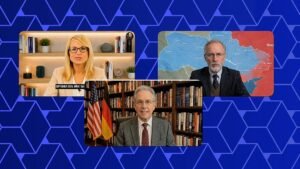





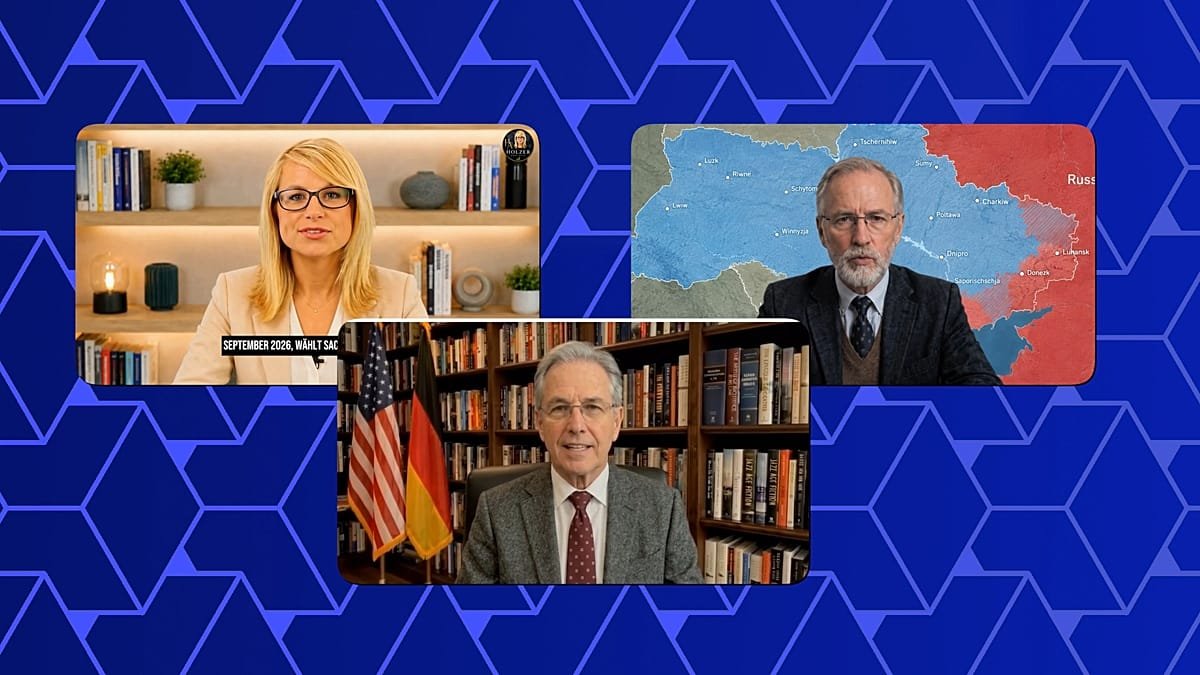
At first glance, a woman speaking in a widely shared video online appears to be a German political commentator analysing the election in Saxony-Anhalt.
Another presenter discusses the war in Iran and China’s role in the conflict, while a supposed expert on a different channel explains changes to the global order.
However, these presenters are not real, but generated using artificial intelligence. They appear across a collection of German-language YouTube channels investigated by the non-profit Centre for Monitoring, Analysis and Strategy (CeMAS).
The organisation identified 47 channels using AI-generated presenters to discuss political and geopolitical issues. Researchers were able to analyse 38 of them, documenting 1,876 relevant videos published between December 2025 and August 2026.
Taken together, the channels attracted more than 66,000 subscribers, with their videos recording around 7.55 million views and nearly 30,000 comments, despite being fake
Some conversation in the comment sections of the videos indicated genuine users were engaging with the content, with some believing it to be real.
“You repeatedly have people who go like, ‘Oh, this is AI, guys, don’t you see that?'” Lea Frühwirth, a senior researcher on disinformation at CeMAS, told Euronews’ fact-checking team, The Cube. “And then there’s others replying, going like, ‘I don’t care.'”
A coordinated network?
Several signs suggest the accounts were part of a concerted campaign, according to CeMAS.
“We have multiple markers of coordination in this activity,” Frühwirth said. “We have similarities in what they’re talking about, how they are presenting it, the registration dates, the time frame in which most of the activity goes down in terms of months.”
“We have accounts switching avatars over the course of time,” she added. “We have accounts that keep the same avatar, but switch the voice, and we have avatars appearing on multiple channels.”
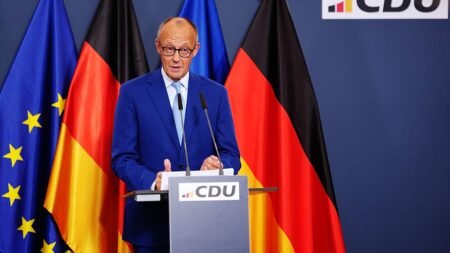
German domestic politics appeared in 795 of the videos analysed. CeMAS said these videos portrayed Germany as experiencing a profound political and economic crisis and criticised Chancellor Friedrich Merz’s government.
This coincided with hotly anticipated state and local elections in Germany, where the Alternative for Germany (AfD) came out on top in elections in the eastern state of Saxony-Anhalt and is projected to come out narrowly on top in the state of Mecklenburg-Western Pomerania.
In contrast, Merz’s Christian Democratic Union (CDU) is expected to fall just short of the 5% threshold needed to keep a seat in the regional parliament in the latter state. The Left, meanwhile, emerged as the strongest force in Berlin.
Despite the timing, “I wouldn’t expect this to be a campaign targeted specifically at the elections,” Frühwirth said. Despite this, she added that narratives attacking the federal government remained relevant to the wider debate surrounding the votes.
A separate investigation by social media analysis company Graphika identified a similar pattern involving artificial presenters discussing world affairs in English, French, Korean, Portuguese and Spanish.
Graphika was unable to identify the operators or confirm that all the accounts belonged to one network. However, it found signs that they likely shared means of creating content and ways of amplifying it.
CeMAS believes the German-language channels could form part of the same broader pattern, although a direct link has not been conclusively established.
Harder to identify
Many of the YouTube videos include a disclosure stating that the content has been altered or synthetically generated.
According to Frühwirth, this label is small and does not immediately explain if AI has been used for one element of a video or to generate the entire presenter.
“It’s not designed in a way that makes sure that whoever sees this is informed that this is entirely the product of AI generation,” she said.
On closer inspection, the videos themselves have indications they are AI-generated. Researchers found translation errors, changing voices, and thumbnails featuring a different avatar from the one in the video.
But these signals are becoming harder to detect.
“The thing with AI-generated content is it’s getting better by the minute,” she said. “If we were to talk to each other in three months, we would have an entirely new level of quality that we’re looking at.”
YouTube did not immediately respond to a request for comment.
Read the full article here