



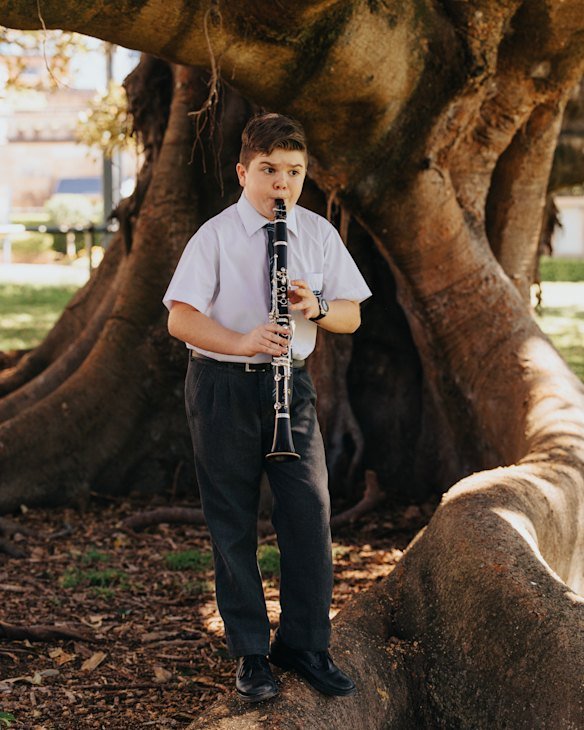
It’s recess time at Conservatorium High School on an unseasonably warm September morning and a small crowd of students gathers around a painted blue piano parked outside on the playground. A student tinkles and bashes away, and the resulting melody can be heard in the botanic gardens nearby.
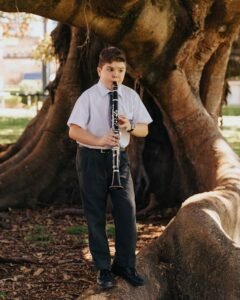
“We usually have little piano battles,” explains year 7 student Luca Squire.
School scenes like these sometimes prompt Luca to scratch his head.
“When I got here, I was awestruck, really,” he said. “I was blown away and I questioned myself. How am I here? How did I get here? Because the students here are just … they’re immaculate and incredible. Just like nothing you’d ever seen.”
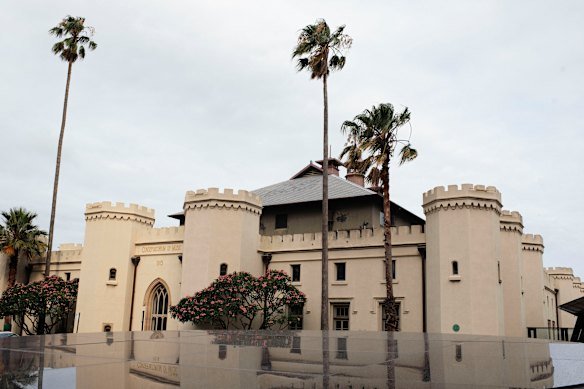
The Conservatorium High is nestled on one side of the Royal Botanic Garden and is one of the smallest high schools in Sydney with just over 120 students. It has produced some of the country’s top classical musicians and every year is a standout performer in the HSC.
The school’s castle campus, housed alongside Sydney University’s conservatorium of music, is renowned within the music world. But Luca discovered the school thanks to some internet research in year 3 when he was on a mission to determine which high school might best align with his passion for clarinet, piano and singing.
“I spent the next three months researching the Con within every inch of its life. I knew all the teachers, I knew all the faculty, I knew all the facilities,” he said.
Then he told his parents. “I said, ‘Mum and Dad, I really, really want to go to this school.’ And they were like, ‘we don’t know anything about it yet’.” But they were happy for the Beacon Hill Public student to give it a shot.

When the time came to audition, Luca had nerves. The audition panel made “you feel like they want you to be here”. But they were also clear: we cannot take everybody.
Entry might appear ultra-selective – about 300 students initially apply every year. There were general ability tests, aural tests, video auditions and in-person auditions.
“Every time I felt like, ‘Oh, I’m not going to get through this,’ knowing what I was up against,” Luca said.
Last September, he was told he was one of 22 students accepted for the year 7 intake.
There’s ensemble practise on Mondays and Tuesdays and a private clarinet lesson with his tutor. Wednesdays are relatively quiet before Thursday’s musicianship lessons and Friday’s all-school choir practice.
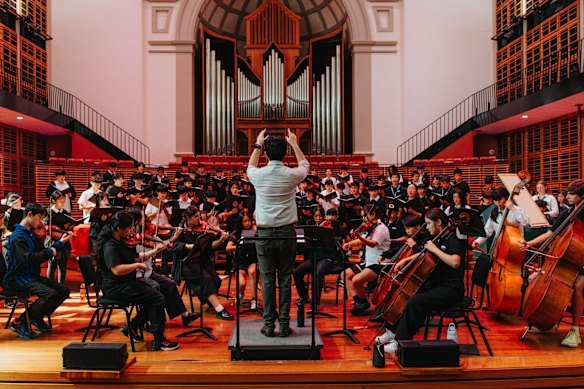
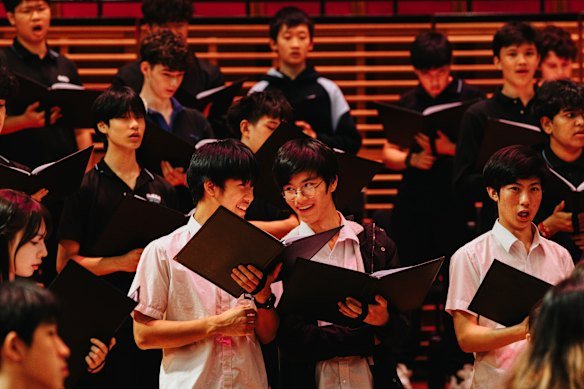
Just after 11am, inside the campus’ Verbrugghen Hall, rehearsals for the important end-of-term concert are under way. A chorus of students is singing Vivaldi’s Gloria.
Zikang Zhan is the fill-in choirmaster today, and between renditions, he’s telling the students they “need to imagine it in a different colour”.
“Can we lean into that?” he asks. Normally, he would sing to demonstrate, but on this day he’s just getting over a cold.
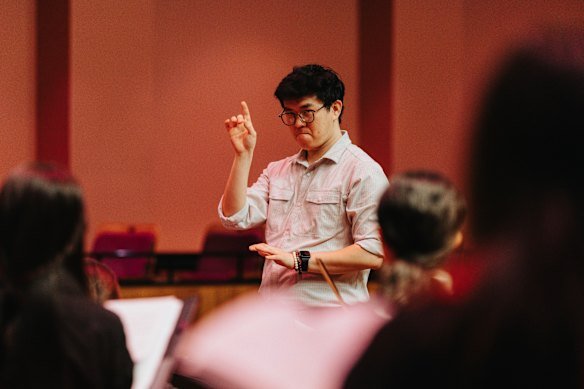
The notes aren’t tricky to sing, and the students are capable, he says. His job is to think “about what’s happening in the music” to interpret beyond the notes on the page.
On the sidelines is Sebastian Ho, a graduate who has since returned to teach. His focus is training the students on the mechanics of moving some musical instruments safely – including a large, heavy and probably very expensive black Yamaha concert grand piano sitting on the stage. “It is one of the most unique yet most rewarding places to work as a music teacher,” he says.
Vivaldi is paused as students commence an odd humming noise in unison or a “brain break” – an opportunity for students to reset their voices and their minds before moving on to the next piece.
The timetabling of musical activities like choir, orchestra and ensembles between normal lessons mean days at the Con start early and finish late. It can be competitive and high pressure, and the workload is intense.
Principal Ian Barker recently spoke to a group of 50 prospective students and their parents who have the “potential to flourish” at the school. He gave them a warning of sorts.
“We have big days. We work very fast. There isn’t a lot of time for homework.” This school does not offer team sports or activities like snorkelling or ski trips. If they were happy to sacrifice that, they could offer an environment for those “mad, crazy about music” and “prepared to work really, really hard because you love music”.
In addition to the athletics and swimming carnival, the school’s three houses participate every year in an annual concert, which can be very competitive.
In response to the potential for pressure, the school embraces the concept of the whole musician – promoting respect, integrity, compassion and ensuring students are equipped with multiple musical skills. For example, every student plays at least two instruments. Practice should not exceed one hour for their main instrument and not more than 30 minutes on their secondary one.
“We know it’s competitive. We know that in the music industry you’re really only as good as your last audition, or as your last performance – and that can be quite hard.”
Year 12 student Dee Dee Cheong Foo entered in year 9 with a background in musicals but says her years at the school exposed her to multiple modes of music, working across genres and styles and making music with her classmates.
“We’ll practise in our recesses and lunch,” she says.
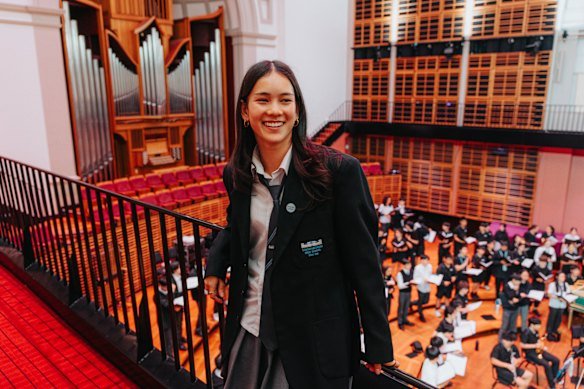
Her playground repertoire so far with her friends includes baroque canon and art songs from the 1900s. Sometimes near her locker, her friends perform makeshift percussion and sing some Ed Sheeran.
“I found that made me a 10 times better musician than I was when I was a soloist.”
Students also work with musicians at the Conservatorium as well as the Sydney Symphony Orchestra.
Sydney Symphony Orchestra second violinist Monique Irik attended the school from 1998 to 2003. She credits its focus on developing a wide range of skills, including learning piano as key to her later professional career.
“When I was at the school, I found choir and piano a little bit of a drag. And yet, those two things are probably the things that I look back at which I’m most grateful for,” she said.
She said one of the best things about the school was its proximity to Sydney Symphony musicians. “I looked up to those people so much as if they were superstars, and then now that I’m in that position, we’re really not,” she said.
In recent years, she has sat on the audition panel, giving her an opportunity to recognise in students what examiners might once have seen in her.
“I was a very conscientious, confident student, but I wasn’t somebody that was playing a Tchaikovsky violin concerto at the age of 10 – which you do get, and it’s absolutely amazing,” she said.
“I learnt a lot throughout my time there because I had a lot to learn.”
Get the day’s breaking news, entertainment ideas and a long read to enjoy. Sign up to receive our Evening Edition newsletter.
Read the full article here