





 Markets
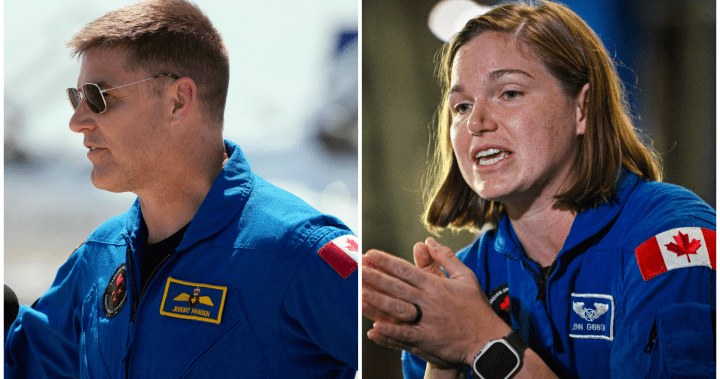
Two Canadian astronauts are set to play important roles in getting NASA back to the moon if all goes well this week.
Jeremy Hansen and Jenni Gibbons are members of the Artemis II mission, a 10-day lunar fly-around and the first crewed mission to the moon since the Apollo missions more than 50 years ago.
Hansen, 50, of London, Ont., will serve as the mission specialist and become the first non-American to travel beyond low Earth orbit. He will be joined by veteran NASA astronauts Reid Wiseman, Victor Glover and Christina Koch aboard the Orion spacecraft.
Gibbons, 37, of Calgary, Alta., will serve as Hansen’s backup in the unlikely event he can’t fly; she has gone through years of the same training as those on the rocket and during the mission Gibbons will serve as a voice link to space from Earth.
NASA has targeted an April 1 launch for Artemis II, with a six-day launch window running through April 6.
Here is what you need to know about Hansen and Gibbons:
Hansen’s journey into aviation began at the age of 12 when he joined the 614 Royal Canadian Air Cadet Squadron in London, his biography on the Canadian Space Agency’s website reads.
He eventually earned his pilot licenses and wings and graduated from the Royal Military College of Canada in Kingston, Ont., in 1999.
Between 2004 and 2009, Hansen served as a CF-18 fighter pilot with the 441 Tactical Fighter Squadron and the 409 Tactical Fighter Squadron, as well as the combat operations officer at 4 Wing Operations, where his responsibilities included effectiveness of NORAD operations, deployed exercises and Arctic flying operations.

Get breaking National news
Get breaking Canada news delivered to your inbox as it happens so you won’t miss a trending story.
Hansen, who achieved the rank of colonel, was recruited into the Canadian Space Agency in 2009; he graduated from astronaut candidate training in 2011, and six years later, he became the first Canadian to lead a NASA training astronaut class.
Three years ago, he was assigned to Artemis II as a mission specialist; the objective of the mission is to test Orion’s systems, perform various science and operational tasks, conduct a lunar flyby and take photos of the moon’s surface before returning to Earth.
While the commander and pilot will take care of the launch and landing operations, the whole crew will split all the other operations, the Canadian Space Agency said.
A decade ago, Gibbons was working as an assistant professor in internal combustion engines at the University of Cambridge. She was recruited into the Canadian Space Agency just a year later and graduated in 2020.
That same year, she managed the Mission Control Capcom Console as International Space Station Lead Capcom and supported the on-orbit crew and their families during Expedition 63, the Canadian Space Agency said.
In 2022, she was assigned to mentor the 2021 astronaut class through their spacewalk training and was named Hansen’s backup on Artemis II a year later.
During the mission, Gibbons will be part of a team coaching Hansen and the other astronauts on key mission objectives.
The Canadian Space Agency added Gibbons will be a key contributor to defining and validating crew training requirements and processes for future moon missions. Gibbons will also train to act as a capcom (capsule communicator) to support future missions to the moon and as an astronaut support person, who buckles the crew into Orion and prepares them for launch.
Once the Artemis II mission is complete, Artemis III will test rendezvous and docking capabilities between Orion and commercial spacecraft needed to land astronauts on the moon.
NASA is scheduled to announce specifics on the Artemis III mission design and crew closer to launch in 2027; it plans on returning humans to the lunar surface in early 2028 as part of Artemis IV.
— With files from The Canadian Press
Read the full article here