




 Markets
Mohammed Alastal has been waiting for someone to call, waiting for someone to care. Waiting for someone from the outside world to ask: what is life like now in Gaza?
This tiny patch of earth that dominated global headlines for two years has largely faded from view, swept aside by the United States’ and Israel’s war against Iran and, to a lesser extent, Israel’s war against Hezbollah in Lebanon. “We are living in a state of no war and no peace,” Alastal, 32, says. “The situation in Gaza is still extremely fragile.”
The doctor, who works in a hospital in the southern city of Khan Younis, described a sense of euphoria last January when Israel and Hamas stopped fighting. That ceasefire collapsed two months later when Israeli Prime Minister Benjamin Netanyahu began bombing Gaza again. The current ceasefire has lasted longer; it will reach six months on April 10. But today, there is no euphoria in Alastal’s voice, just exhaustion. “The crisis has not stopped, it is still ongoing,” he says.
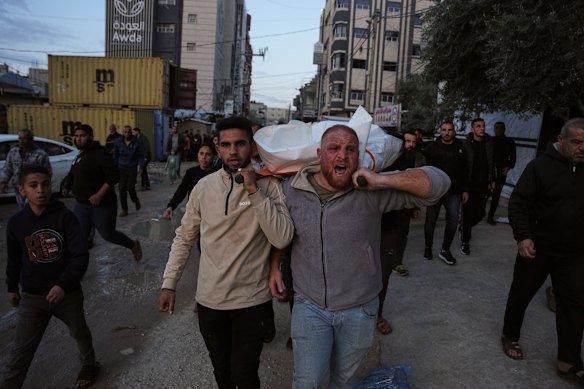
Here’s what he wants the world to know. Yes, the large-scale bombing has ended, and the daily death toll has decreased. But Israel still conducts regular strikes on Hamas targets in the strip, often by drone. An estimated 713 Gazans have been killed, and almost 2000 have been injured, since the ceasefire began.
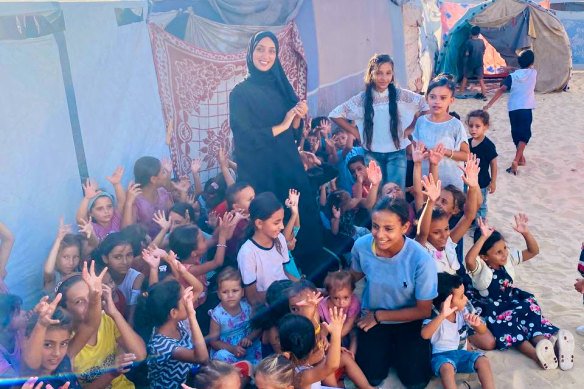
Alastal and his wife live in a tent, exposed to the heat, rain and wind. Later this month, they are due to have their first child. He estimates eight in 10 homes in his city have been turned into rubble. The Alastals’ home was destroyed in December 2023, and they have not been able to rebuild. Strict Israeli restrictions on the amount of concrete and other construction materials – which are classed as dual-use military technologies – that can enter Gaza mean few homes have been rebuilt since the ceasefire.
As for food, some products like chocolate and Coca-Cola now enter Gaza, but it is still extremely difficult, if not impossible, to buy fresh meat, fish and vegetables. Prices have surged since the war in Iran began. It now costs $20 to buy a kilo of meat, Alastal says, in a strip where 80 per cent of people are unemployed.
The most dire crisis is water and sanitation, he says. “Most people are relying on groundwater, and it’s contaminated, not safe for drinking,” he says. “There are rising cases of aerial illness, infection and disease like hepatitis A. At our hospital, we are seeing people with acute kidney injury and dehydration.” The United Nations’s main aid agency in Gaza, UNRWA, reported last week that rodent infestations had become a growing concern across Gaza.
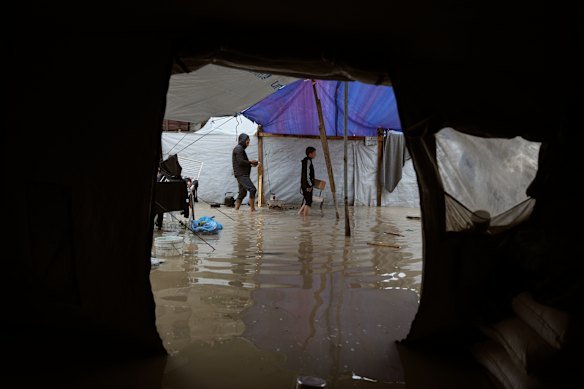
In what is already one of the most densely populated places in the world, most of Gaza’s 2 million residents are now crammed into an area comprising less than half the strip. Some major cities like Rafah – once home to almost 200,000 people – no longer exist.
“Life here is living in a tent filled with insects, mosquitoes, flies,” says Asmahan Abdalraheem, 25. “You wake up in the morning bitten by insects; rodents attack children and the elderly.” The accounting graduate and her family fled their home in Beit Lahia, in northern Gaza, when the war began and they now live in a refugee camp in Deir al-Balah, in central Gaza. Summer is approaching, which will make things even worse. Like many desperate people in Gaza, she has opened a crowdfunding site to try to attract donations. “No matter how much I explain, I won’t be able to paint a picture of the suffering here,” she says. “How can we forget what is happening in Gaza?”
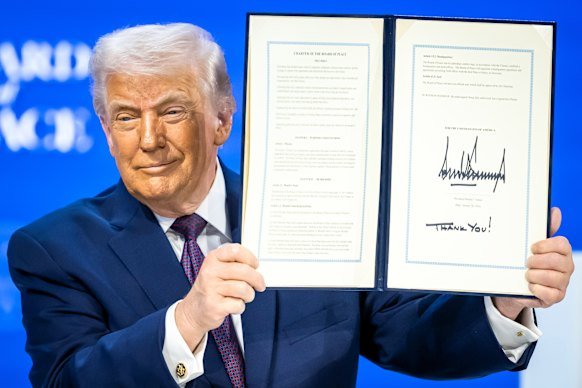
As well as improving Gazans’ daily lives, the ceasefire was supposed to mark a new political dawn for the strip. There was plenty of cynicism about US President Donald Trump’s 20-point peace plan when he announced it last October, but there was also cautious optimism. Regardless of one’s opinions, it was the only realistic plan on the table. Both Israel and Hamas, the militant group that has governed Gaza for 20 years and which launched the October 7 attacks, signed on.
Under the plan, Hamas was supposed to hand over control of the strip to a committee of Palestinian technocrats overseen by Trump’s Board of Peace. An international stabilisation force would take control of security, and Hamas would hand over its weapons. Israel, in return, would withdraw from almost all of Gaza, except for a narrow security buffer around its border.
Mkhaimar Abusada, an associate professor of political science at Gaza’s Al-Azhar University, says: “There was a lot of enthusiasm, a lot of encouragement, among Palestinians two months ago when the Trump administration launched the Board of Peace in Davos. There was a lot of hope we were about to turn a new page.” Trump used the launch to announce the US would contribute $US10 billion to the reconstruction of Gaza. Other countries committed a total of $US7 billion. Indonesian President Prabowo Subianto pledged to contribute 8000 troops for an international force that would also include Muslim-majority nations Morocco, Kazakhstan, Kosovo and Albania.
On February 20, the National Committee for the Administration of Gaza, the technocratic body intended to manage daily life in the strip, posted advertisements for a new Gaza police force. Thousands of people applied in just a few hours. There were hurdles to overcome, to be sure, but also real signs of progress.
A few days later, the US and Israel launched a blizzard of strikes on Iran, killing Supreme Leader Ayatollah Ali Khamenei. Iran responded by attacking nearby Gulf states and effectively closing the Strait of Hormuz, crippling the global oil trade. “After the eruption of the war with Iran, Gaza has been put on the backburner,” says Abusada, who fled the strip when the war broke out in 2023 and is now based in Cairo. “It’s not a top priority for the US. It’s not a top priority for the international community.”
The war in Iran has fractured goodwill and sent nations looking inward as they scramble to secure their energy supplies and, in the case of influential Gulf states like Saudi Arabia and the United Arab Emirates, to protect themselves from Iranian attacks. Angered by Trump’s decision to go to war with Iran, Prabowo has announced Indonesia was suspending participation in the Board of Peace and has flagged he could quit the body. The second stage of the ceasefire – in which Hamas and Israel are supposed to relinquish power to the new technocratic committee – is stuck in limbo.
Jaser AbuMousa, a senior fellow at the Middle East Institute, a Washington DC think tank, says the Gazan people are collateral victims of the war in Iran, even though they are not directly involved in the conflict. AbuMousa knows that personally. He fled Gaza in 2023 after an Israeli bomb destroyed his home. His wife and two sons died in the December 2023 airstrike. Last year, his mother and his sister were killed in an attack. “Gaza is being marginalised and pushed away from the scene,” says AbuMousa. “This is the perfect situation for both Hamas and Israel.”
With the world’s attention focused elsewhere, Israel has been quietly expanding the territory it controls in Gaza, known as the area beyond the “yellow line”. Under Trump’s peace plan, Israel is supposed to withdraw to 40 per cent, and then 15 per cent of the territory. Instead, it now controls up to 58 per cent of Gaza, according to Foreign Policy, and it is showing no desire to step back. “The yellow line is a new border line, serving as a forward defensive line for our communities and a line of operational activity,” the head of the Israeli military, Eyal Zamir, told troops at the end of last year.
As for Hamas, it is a shadow of its former self in military terms and its key patron, the regime in Iran, is battling for survival. But the group remains in control of the territory where most Gazans live. Meanwhile, the new technocratic committee is based in Cairo and it does not have any physical presence in Gaza. AbuMousa says Hamas is “taking the opportunity to re-establish themselves on the ground. Their police force is collecting taxes, they are controlling the traffic to show they are in charge.”
Igal Shiri, an analyst with the Meir Amit Intelligence and Terrorism Information Centre, an Israeli think tank, wrote in March that Hamas is exploiting the war with Iran “to tighten its security control using violence and force against those who are critical, labelled ‘collaborators’ or members of militias receiving Israeli support”. He says “as long as Israel and the United States focus their attention on the wars in Iran and Lebanon against Hezbollah, Hamas will continue to entrench its dominance in the Gaza Strip”.
Still, the efforts to turn Trump’s peace plan into reality continue. Last week, the high representative for Gaza on the Trump’s Board of Peace, former Bulgarian defence minister Nickolay Mladenov, addressed the United Nations Security Council to lay out a plan for Hamas to disarm, starting with “the most dangerous weapons, rockets, heavy munitions, explosive devices and assault rifles”.
“The laying down of arms by militant actors would represent a decisive break from cycles of violence that have defined life in Gaza for decades,” he said. The world faces a choice, he said, between “a renewed war, or a new beginning”.
Hamas has not officially responded to the disarmament proposal, but it is expected to reject it and propose new conditions, prolonging the stand-off.
For Abdalraheem, living in a cramped tent city full of rats and insects, any talk of a grand vision for post-war Gaza feels abstract and remote. She fantasises about having enough food to eat and a roof over her head. After graduating from university with excellent grades but with no prospect of work, she wishes she could escape and begin a new life. She feels her youth slipping away, and her hopes being ground into dust, like most of the homes in Gaza.
For AbuMousa, now on a fellowship at Yale University, he writes through grief, publishing deeply researched papers on how to create a new political reality in Gaza. Even with the wars in Iran and Lebanon raging, he says the world cannot afford to look away.
“Gaza should not be the file everyone returns to once the ‘larger’ crisis ends,” he says. “The Gaza Strip is where the meaning of the moment will be decided.”
Cut through the noise of federal politics with news, views and expert analysis. Subscribers can sign up to our weekly Inside Politics newsletter.
Read the full article here