




 Markets

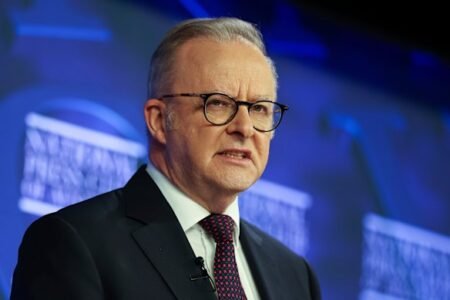
Anthony Albanese’s Wednesday night address to the nation was widely panned for being short on detail, long on motherhood statements and contradictory at times. That criticism was fair, but at the National Press Club on Thursday Albanese defended the three-minute address – which was livestreamed and broadcast nationwide – as a chance to provide factual information to the growing number of people who don’t usually get their news from mainstream media.
He also provided some of the details that had been missing on Wednesday.
Albanese’s press club speech was significant because it underlined the step change in the federal government’s communications over the US-Israeli war on Iran. He has adopted the role of explainer-in-chief. That shift has been partly driven by Labor national secretary Paul Erickson becoming more involved in handling the crisis (though Erickson has told colleagues little has changed on that front).
A week ago, Albanese was being criticised for not being front and centre during the crisis. No one is making that claim now. Albanese held press conferences last Friday, Saturday and Monday, he hosted a meeting of national cabinet, took questions in parliament, on TV and radio, and then he addressed the nation before the press club.
He also benefited from the fact that US President Donald Trump addressed his nation in the half-hour before his press club appearance. In a rambling and contradictory monologue, Trump spent 20 minutes insulting, cajoling and threatening Iran, demanding a ceasefire, claiming the objectives of the war had been just about met, insisting the Strait of Hormuz be opened so oil shipments could restart, and then insulting some of America’s closest allies and arguing it was up to them to reopen the strait.
There was no sense of a plan and little reassurance for Americans (or anyone else for that matter) that he cared at all about the grievous impact fuel shortages are having on people’s daily lives. It might have been titled: “I broke it, you fix it”.
The contrast between Trump and Albanese’s press club address was stark, to put it politely.
The prime minister again outlined everything his government has done to date, including the 26¢ cut in the fuel excise, cutting the heavy vehicle road user charge to zero, a national fuel security plan and a GST deal with the states to return some of that tax’s windfall to motorists. He also announced $1 billion in interest-free loans for manufacturing and fuel businesses dealing with the economic costs of the conflict, and a substantive plan to tackle problem gambling. That plan will not please every anti-gambling advocate, and arrives more than a 1000 days overdue, but it will wind back the volume of gambling ads Australians are subjected to. That is welcome.
So why the shift in tone and messaging? A senior government source, who asked not to be named so they could detail internal deliberations, explains it like this. In the first two weeks of the war, the federal government was primarily focused on helping repatriate thousands of Australians from the Middle East. From the middle of March, the focus shifted to a new main question: how to deal with the fuel shock and the huge surge in demand for petrol and diesel, which had led to shortages and panic buying.
As the government keeps reminding people, Australia has more fuel in storage now (about 38 days’ worth of petrol and 30 of diesel) than at the start of the war. And fuel shipments that were cancelled have been replaced. Supply will be fine at least until the start of May.
So voters are switching their focus from the short to medium term and asking what the next few months could look like. “And at about this time last week, having done the short-term work it needed to do, the government had more solid answers to give to the public about the medium term, and the prime minister has taken the lead in providing those answers,” the senior source in government said. “There is a hunger for reliable information about what the short, medium and long-term implications are of this war, which is why Wednesday night’s address was the right thing to do.”
And, the Labor source adds, don’t forget the vomit principle: that is, to cut through with voters who aren’t much interested in following the news, a message has to be repeated over and over again until it reaches the point where the deliverer of the message (and the journalists reporting it) are just about ready to vomit. It’s at that point when the message is beginning to cut through.
Wednesday night’s address was a shock for those conditioned by years of COVID lockdowns and lengthy press conferences. They expected a major announcement, such as fuel rationing, work-from-home mandates or even the dispatch of an Australian naval vessel. But Albanese promised again on Thursday that there will not be “a repeat of the social dislocation of COVID”. And he means it.
He was, however, softening up Australians for what could come next. Some of Australia’s neighbours, including South Korea and Indonesia, are already rationing fuel, while others, including Thailand and New Zealand, are preparing to do the same. There is a reasonable chance this will happen in Australia, depending on the course of the war.
Policymakers and economists are debating scenarios in which the war continues, the Strait of Hormuz stays shut, and oil pushes past $US150 ($218) a barrel, triggering recessions. Only this week, former Treasury secretary Martin Parkinson warned there was even a possibility of stagflation – high inflation and high unemployment at once – taking hold for the first time since the oil shock of the 1970s.
Australia is currently only at stage two of the new national fuel security plan. It isn’t until stage three that more stringent measures, such as petrol rationing or work-from-home requests, could kick in.
Between now and the start of May, Albanese and his team have a federal budget to prepare and a global fuel crisis to respond to, with the latter severely disrupting the former. The prime minister vowed on Thursday the government’s plans for its most ambitious, reforming budget to date will not be knocked off course because “international uncertainty is not an excuse to delay or hold back reform”.
Much like releasing the response to the gambling review, the message on the budget is that the government can walk and chew gum at the same time.
Albanese sidestepped several opportunities on Thursday to comment on Trump’s handling of the war and the president’s address. But the contrast between Trump’s word salad of blather and braggadocio and Albanese’s earnest, almost boring style did the heavy lifting for the prime minister.
The shift in strategy, message and tone has been notable, necessary and overdue. It might not inspire, but it’s infinitely preferable to the bombast of the current occupant of the White House.
James Massola is chief political correspondent.
Get a weekly wrap of views that will challenge, champion and inform your own. Sign up for our Opinion newsletter.
 James Massola is chief political commentator. He was previously national affairs editor and South-East Asia correspondent. He has won Quill and Kennedy awards and been a Walkley finalist. Connect securely on Signal @jamesmassola.01Connect via X or email.
From our partners
Read the full article here