





 Markets

Alberta Premier Danielle Smith said Tuesday her long-term goal is to be able to balance the province’s books even with moderate oil prices.
In about 10 years, she said, she’d like Alberta to bring spending in line with revenues that US$60-per-barrel oil would bring to provincial coffers.
“That’s where we have be. But then when you have years where you have a surprise surge and you realize a surplus, then that gives you an opportunity to support particular projects,” she said.
The latest Alberta budget, tabled last month, projected a $9.4-billion deficit in the upcoming fiscal year based in part on the projected price of the North American benchmark West Texas Intermediate averaging US$60.50 per barrel.
Global oil prices have since surged with the U.S.-Israeli war against Iran, at times seeing the WTI peak well above US$100 per barrel.
Smith made the comment while addressing the Rural Municipalities of Alberta conference in Edmonton. She heard concerns from local elected officials on everything from health care access, to rising infrastructure and policing costs and unpaid oil and gas well taxes.

Get weekly money news
Get expert insights, Q&A on markets, housing, inflation, and personal finance information delivered to you every Saturday.
A councillor from central Alberta told the premier that “a lot of” bridges could be washed out in his region, with more snow than expected this year.
Smith said his wish list of increased grants for the strategic transportation infrastructure program was “not possible,” with the province’s budget woes.
“We have to find a way on our end to cut wasteful spending, deliver programs differently, streamline on the spending, so that we can bring our revenues and expenditures into alignment,” she said.
Smith said she would prefer to spend unforeseen windfalls on one-time capital costs like infrastructure projects, but it’s too early to expect any yet.
“Let’s see how this new budget year ends up going, and then we’ll see if we can find additional dollars if we end up realizing some surpluses.”
She added that she hopes the conflict in the Middle East will be resolved quickly.
The Strait of Hormuz, a major shipping artery at the mouth of the Persian Gulf through which about a quarter of the world’s oil passes through, has been effectively closed for weeks — driving up the price of oil and other commodities.
At Tuesday’s conference, Smith also heard that ambulances are too few and far between, hospitals often don’t have capacity, and rural communities need help.
One local leader recounted a harrowing story of his mother experiencing signs of a stroke, but an ambulance wasn’t available and at least one hospital had to turn her away before she finally got treatment.
Smith pointed blame at the centralized structure of the former provincial health agency.
“These kinds of stories are exactly the reason we had to dismantle Alberta Health Services,” she said.
As part of a massive health-care system restructuring, Smith’s United Conservative Party government has replaced AHS with four new governing agencies, overseen by four health ministries.
AHS has been relegated to a hospital operator, and a new entity is in charge of emergency medical services.
Smith said ambulance service is a “a real problem all over the province,” but the government is trying to tailor emergency response resources to each locality.
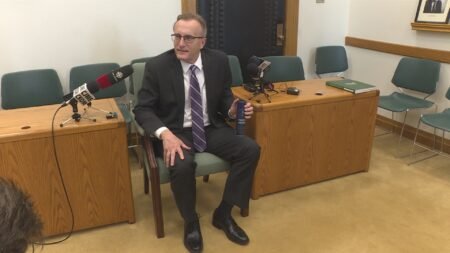
Opposition NDP emergency services critic David Shepherd later told reporters in the legislature that Smith has been in power for more than four years, so her trying to deflect blame is “a joke.”
“All they’ve done is create more bureaucracy, waste more Albertans’ money reshuffling, reorganizing and not delivering any better care – in many cases, worse care than Albertans had before.”
Read the full article here