


 Markets
Updated ,first published
Excise tax will be halved for three months to deliver a 26¢ cut to a litre of petrol, Labor has announced, as economists warn the Iran war could force interest rates up three more times by August and drive the economy into a recession by Christmas.
The dire economic outlook followed the release by national cabinet of a fuel crisis plan, to co-ordinate national response to the international energy crunch caused by the loss of 20 per cent of global oil supply from the Middle East.
Prime Minister Anthony Albanese said Australia’s fuel supply remained secure into May, as the volume of fuel imports was expected to stay at normal levels, and he encouraged motorists not to ditch their plans for travel over Easter.
“People should enjoy their Easter. And it’s important as well that we keep the economy going. Easter is an important time for tourism destinations, for jobs,” he said.
The cut in excise will kick in on Wednesday, April 1, but further relief could come as state premiers consider a possible easing of the 10 per cent GST on fuel sales.
Australia imports 90 per cent of its diesel and petrol, and the fuel plan outlined four steps to keep the economy moving if supply runs short.
The nation is already at stage two of the plan under which the government seeks to boost fuel supplies. That includes releasing strategic reserves, underwriting the cost of importing petrol and diesel and lowering fuel standards.
State and federal governments are consulting industries about how, if the war drags on, to roll out the rest of the plan. That includes fuel-saving measures such as encouraging carpooling and working from home.
Fuel rationing would kick in under stage four if there are “significant” gaps in supply. This could include forcing motorists and non-essential industries to curb their use, with priority given to critical sectors such as agriculture, food distribution, transport and mining.
Panic buying has drained fuel at hundreds of service stations across the country and helped force prices to record levels. Regular unleaded petrol has reached $2.53 per litre, up 40 per cent compared to prices before the war began on February 28, while diesel is now at $3.10.
NSW Premier Chris Minns said he was working with industries about any potential fuel rationing.
“A lot of work is going into these different phases, and level three and level four are still under consideration and consultation,” Minns said.
Albanese, who made a plea to US President Donald Trump for a “de-escalation” of the war, also announced that the heavy vehicle road user charge, which affects companies that supply the nation’s supermarkets and food retailers, would be axed for the three months.
A fuel industry source, not willing to speak publicly, said the national plan would help alleviate panic buying, while spelling out later measures would have made things worse.
“There is nothing the government could have announced that would not have spurred panic buying,” they said.
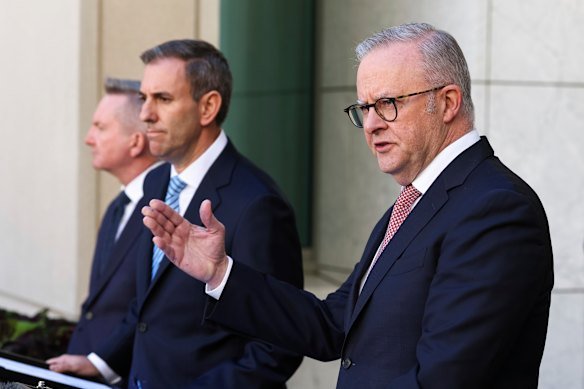
Treasurer Jim Chalmers said reductions in government taxes on petrol were designed to take “some of the sting” out of fuel prices sent skyrocketing by the war in the Middle East. He said it would result in a $19 reduction in the cost of filling a 65-litre petrol tank, and cost the budget an estimated $2.55 billion.
“This is timely. This is targeted. This is responsible cost-of-living relief to help people get through a difficult period,” Chalmers said.
But shadow treasurer Tim Wilson said the government had to take responsibility for an increase in inflation.
“Australia’s persistent inflation fire may be given extra oxygen from international events, but mortgage holders would be breathing easier had the government snuffed the fire before these events,” he said.
High petrol prices could be the least of home buyers’ problems. Westpac chief economist Luci Ellis, a former Reserve Bank assistant government, said the RBA could increase interest rates at its May, June and August meetings to go with its hikes in February and March.
That would take the cash rate to 4.85 per cent, its highest since the depths of the global financial crisis in late 2008, and add almost $300 to the monthly repayments on a $600,000 mortgage.
She said the war in Iran, and the closure of the Strait of Hormuz, would push up inflation and force the Reserve Bank to take action that would result in unemployment reaching 5 per cent.
“It also reflects the surprisingly rapid pass-through of higher fuel and other oil-derived product prices into other prices in Australia,” she said.
HSBC Australia chief economist Paul Bloxham, also a former RBA economist, said the impact of higher oil prices on households – who account for more than half of all economic activity – would result in the economy going backwards in the June quarter.
“Whether it falls again in September quarter – and thus Australia has a technical recession – depends heavily on how soon events in the Middle East de-escalate and oil prices fall, amongst other factors,” he said.
Victorian Premier Jacinta Allan said the states were still negotiating how the GST – all of which is returned to the states – is applied to fuel and discussions were continuing.
Victorian Treasury officials were on Monday modelling the financial impact of GST discounts which would see the amount of tax per litre frozen or capped at pre-crisis levels and deliver a further saving to motorists.
However, Premier Allan was tight-lipped on what was being considered.
“We’ve not resolved as state and territories any changes…to GST arrangements,” she said. “There’s some discussions around what could be considered.”
At the start of the crisis, the national average cost of unleaded petrol was $1.69 a litre, which included 15 cents a litre on GST. If the states agree to charge motorists 15 cents a litre GST from 1 April, it would represent a saving at the bowser of about 6 cents a litre.
Cut through the noise of federal politics with news, views and expert analysis. Subscribers can sign up to our weekly Inside Politics newsletter.
 Mike Foley is the climate and energy correspondent for The Age and The Sydney Morning Herald.Connect via email.
 Shane Wright is a senior economics correspondent for The Age and The Sydney Morning Herald.Connect via X or email.
 Chip Le Grand leads our state politics reporting team. He previously served as the paper’s chief reporter and is a journalist of 30 years’ experience.Connect via email.
 Nick Newling is a federal politics reporter for The Sydney Morning Herald and The Age.Connect via X or email.
From our partners
Read the full article here