




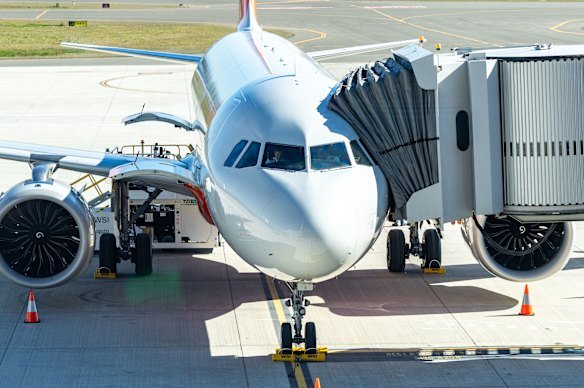
A high-tech air traffic control centre for Sydney’s new 24-hour airport is being kept shut for longer than expected despite cargo flights operating and only seven weeks before passenger flights start.
The closures of the control centre for the nation’s first major new airport in more than five decades have been imposed to free up staff to backfill rosters at Sydney’s Kingsford Smith Airport tower.
The shortage of air traffic controllers at Kingsford Smith is putting pressure on the fledgling operations at Western Sydney International Airport a month after cargo flights started at the $6 billion hub.
The staffing shortage also highlights persistent problems with the nation’s air traffic control body, Airservices Australia, which has been involved in a spate of ground incidents in Sydney.
Under the arrangements, the control centre for Western Sydney Airport is shut for more than half the week, leaving it operating about 18 hours, from shortly after noon to early the next morning, on four consecutive days.
The temporary closures throughout the week are yet to disrupt flights at the new airport because the dedicated freighter aircraft which are flying in and out of the hub are predominantly doing so from Monday to Thursday.
However, it means any aircraft requiring an emergency landing would be unable to use the airport during the shutdowns because of the absence of air traffic control.
“This actually happened because Sydney Tower released controllers to train and then operate WSI,” said one controller, who spoke on the condition of anonymity.
“Then when all the incidents went very public at Sydney Airport with the tower staffing, they decided to claw back controllers to Sydney Airport, leaving the roster critically short at WSI. Typical rob Peter to pay Paul scenario.”
As the first of its kind in Australia, the remote control centre for Western Sydney Airport has been grappling with technological challenges.
The poor quality of digital images beamed from cameras on a tower next to the airport’s 3.7-kilometre runway to air traffic controllers 17 kilometres away at Eastern Creek is forcing aircraft to be kept significantly further apart during landing for safety reasons.
Airservices Australia confirmed it had “temporarily varied the hours of coverage” for the control centre at Eastern Creek to cover limited cargo flights which primarily occurred during the afternoon and overnight.
“The amendment ensures efficient use of qualified staff for the short-term need to increase resilience at Sydney Kingsford Smith Airport,” it said.
The Commonwealth-owned corporation said it would “return to 24/7 coverage” of the new airport’s air traffic control before the start of passenger flights on October 25, adding that any ad hoc flights before then would be serviced after coordination with operators.
The air traffic controllers’ union, Civil Air, played down the implications for the new airport of the lapse in staffing.
Civil Air president Scott Nugent said the centre at Eastern Creek would probably require fewer air traffic controllers, in line with the lower volume of flights into and out of the new airport.
The requirement was not just a question of raw numbers of staff but the mix of qualifications of controllers, intensity of peak workload, airport design and airspace complexity, he said.
Nugent said that once the new airport was fully operational, he expected it “should be fully staffed for passenger flights and for any scheduled freight movements”.
Jetstar will become the first passenger airline to serve the new airport when it launches flights on October 25 from western Sydney to the Gold Coast, a route which has already been increased from four times a week to a daily service to meet demand.
Jetstar chief operating officer Matt Franzi said his airline was confident about the new airport’s air traffic control, adding that the digital tower works “seamlessly [and] that is very much an innovation in the Australian market”.
Nevertheless, he acknowledged the challenges Airservices was having to recruit staff and pledged to continue to work with the organisation.
“We acknowledge it’s been a challenge for them to recruit, but ultimately, we know that when they have any challenges operationally, restricting the flows into Sydney is a safety control in its own right, so we support that position with them,” he said.
Air New Zealand, Singapore Airlines, low-cost carrier VietJet and Qantas have committed to launch flights from the new airport.
Start the day with a summary of the day’s most important and interesting stories, analysis and insights. Sign up for our Morning Edition newsletter.
From our partners
Read the full article here