





 Markets
  Weather
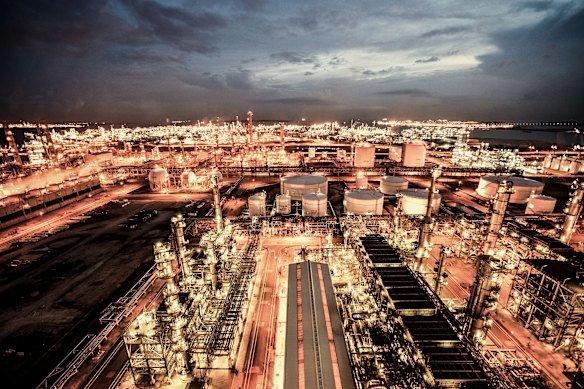
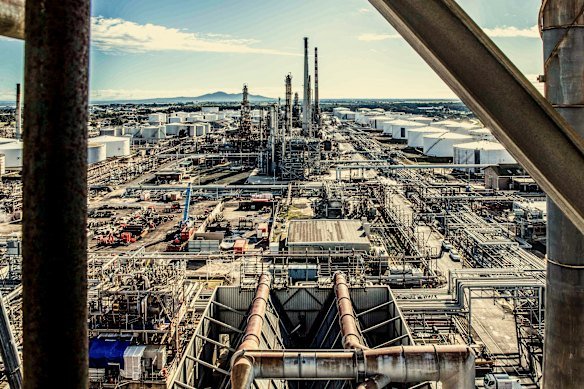
Visiting an oil refinery is nothing if not bewildering. It’s a cat’s cradle of dials and valves and spigots and pipes, fat and thin, some spewing steam; of towering columns and multi-storey cylinders, one topped with that iconic flickering plume of flame. Yet, despite its vast complexity, a refinery is a machine built to do one thing: in this case, to pump oil from tankers berthed at a jetty on its seaward side and pass it through its web of hissing conduits to be boiled, sifted, blended and tested until what emerges are batches of diesel, jet fuel and various grades of unleaded petrol.
The Viva Energy (formerly Shell) refinery, just outside Geelong on Victoria’s Corio Bay is one of just two such facilities still operating in Australia and a survivor from the 1950s, albeit updated with mission-control flat screens and increasingly sophisticated processes. This other worldly place is a major contributor to how we consume petrol in Australia, yet it is still just a tiny piece of the global picture.
While Viva Energy refines some oil here, most of our fuel comes from overseas. And its famously volatile price is largely determined by forces out of our control – both economic and geopolitical – in the Middle East, Singapore and beyond. Embargoes, terrorism and war all affect the oil price, which has surged since US and Israeli strikes on Iran that have killed the nation’s leader, Ali Khamenei, and triggered Iranian retaliation with attacks on neighbouring countries, engulfing the region in turmoil.
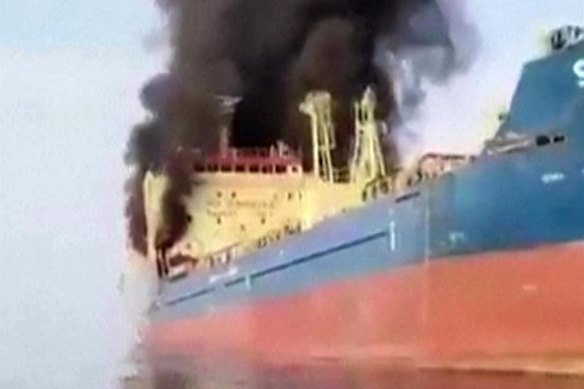
In the midst of the conflict is the Persian Gulf, one of the world’s most plied waterways – where three tankers have come under attack in recent days, including one in the Strait of Hormuz, a choke point at the mouth of the gulf through which a fifth of the world’s oil and LNG is shipped every day. More than 100 tankers have now dropped anchor outside the strait. Oil prices are at their highest in four years.
How will this war affect oil supplies? What might it mean for petrol prices in Australia? And where does petrol come from anyway?
First, where does petrol come from?
The sticky brown or black goop created over millions of years from compressed, decomposed algae and plankton on seabeds is something humans have known about for most of our history. In many places, oil used to just bubble out of the ground, as author Ed Conway notes in his book Material World, in which he analyses the necessity to civilisation of six key resources (oil being one). The ancient Egyptians originally took bitumen from tar pits to help embalm their dead; elsewhere it was used to waterproof the bottoms of boats. But it wasn’t until 1853, writes Conway, that chemists figured out how to process oil into a liquid that would burn strongly: kerosene. Cue a worldwide rush to discover sources of “black gold” to light our world.
Today, petrol, diesel and other products refined from oil continue to dominate everyday life, despite the trend towards renewables. Scots and Norwegians pump oil from the depths of the North Sea; Texans from the ancient Permian Basin; the Russians in western Siberia; and the Saudis from the world’s largest single deposit, the vast Ghawar field, which produces some 3.8 million barrels of oil a day – enough to fill 242 Olympic-sized swimming pools. Worldwide, in 2025 we are on track to consume nearly 105 million barrels daily. That’s about 6600 pools’ worth. “How the world works right now,” Conway tells us from Britain, “is we’re still reliant on fossil fuels for about 80 per cent of all of our total primary energy.”
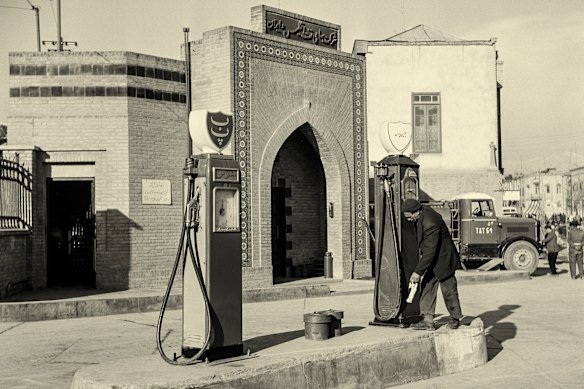
Since it is organic, oil is not a uniform product. It can be light or heavy, “sweet” or “sour”. Oil literally tastes more or less sweet depending on its sulphur content, a component of the organisms that made it in the first place. Sulphur is a pollutant when burned in vehicles.
Oil is the world’s most widely traded energy commodity. While one tanker load of crude oil can vary greatly from the next, crude oil is still typically traded across just a handful of benchmarks, or reference points for prices. The best known, Brent crude, takes its name from Scotland’s offshore Brent Oilfield, named after the brant or brent goose (pictured below) when it was discovered in the East Shetland Basin in 1971. West Texas Intermediate, or Texas Sweet Light, is not a mid-strength ale but rather a benchmark for oil produced in the US, priced at the crude oil trading hub of Cushing, Oklahoma, the self-proclaimed “pipeline crossroads of the world”. The prices of Dubai crude and Oman crude are often averaged to create a benchmark for pricing crude oil shipped from the Middle East to Asia.

To turn it into usable petrol (and other products such as diesel and kerosene), refineries separate crude into its different components by pumping it through a vast network of furnaces, distilling tanks and pressure vessels. The crude is first heated and distilled, the lightest parts (such as the hydrocarbons that go on to form petrol) floating to the top and the heaviest (such as the components of heavy fuel oil) sinking to the bottom.
The next step is typically a method of “cracking”, using a rocket-shaped tower of a machine that employs heat, pressure and catalysts to turn less valuable heavy hydrocarbon molecules into higher value lighter ones. The final stage is to combine the different streams of petrol that emerge from these various processes, like a winemaker blending from different vats, to ensure the product that will come out of the pump has the correct characteristics, such as its octane level (in Australia that’s usually 95 or 98).
Who controls the world’s oil supply?
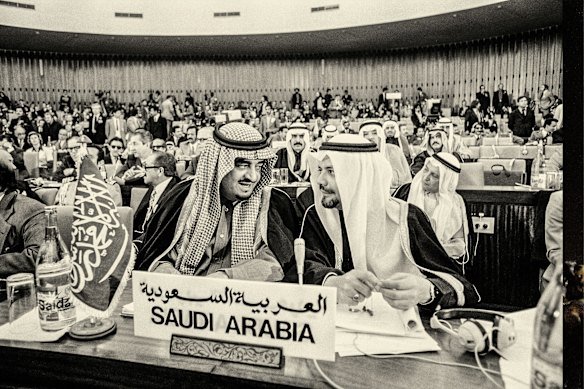
While there are dozens of oil-producing countries – the US, Norway, Britain and Malaysia among them – the cartel now known as OPEC+ holds the most sway over supply. Its members have about three-quarters of the world’s total known crude oil reserves and produce some 40 per cent of the world’s crude.
Originally a group of five oil-rich nations – Iran, Iraq, Kuwait, Saudi Arabia and Venezuela – the Organisation of the Petroleum Exporting Countries, or OPEC, collaborated to essentially seize control of production back from a cartel of seven British and US companies known as the Seven Sisters. By 1975, OPEC had expanded to 13 nations, including Nigeria and Algeria. In 2016, it was joined by an alliance of more oil-producing nations, including the world’s third-biggest oil extractor, Russia, to create OPEC+.
Historically, OPEC has had little hesitation in manipulating supply. “By acting in a cartel manner, they’re able to exercise monopoly power [to] impact the price of oil on global markets,” says macroeconomist Robert Walker, a research fellow at international affairs think tank the Lowy Institute.
Iran provides about 4 per cent of global supplies (most of which are bought by China). But it’s OPEC’s single biggest producer, Saudi Arabia, that is the major player. Critically, says Conway, “they still are able to actually get oil out of the ground and increase their output faster than pretty much any other country in the world – which can influence the global market”.
The day after the US-Israel strikes on Iran at the weekend, OPEC+ agreed to a modest boost in its oil output for April, to help cushion disruptions in supply. Yet agility in production is one thing; getting the oil out to other markets beyond the Middle East is another.
How does war affect oil supply and petrol prices?
Oil has not only fuelled wars but sparked them, as Daniel Yergin writes in his encyclopaedic analysis The Prize. Oil played a fundamental role in both world wars, he writes, not to mention the later Suez Crisis of 1956 when Britain and France saw shipments of oil as one of the key strategic reasons for the canal remaining open.
The first “oil crisis” in which petrol prices spiked was in 1973, when Arab oil-producing nations embargoed the US and other countries that had supported Israel in the Yom Kippur War, causing prices to soar by 400 per cent. Another crisis, and eye-watering price rises, came after the 1979 Iranian revolution, when fear ripped through markets that the social upheaval could spread to the region’s other oil-rich nations. In 1990, Iraq’s invasion of Kuwait – a fellow OPEC member – triggered the first Gulf War and brought on a “mini oil shock” that lasted nine months and contributed to a recession in the US.
These latest US-Israel strikes on Iran happened the day after a round of talks over Iran’s nuclear enrichment program. By then, oil markets and neighbouring countries were already nervous about the effects of trouble in the region for oil supply. Prices were up. Now they have hit the highest level since Russia’s war on Ukraine began in 2022.
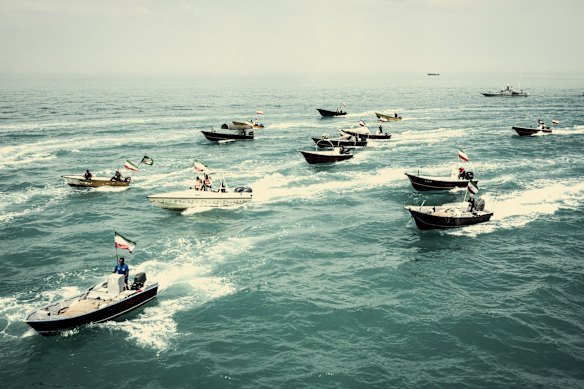
Between Iran and Oman lies the Strait of Hormuz, a slip of water less than 40 kilometres wide at its narrowest, which hosts a small handful of shipping lanes, each less than three kilometres wide, for ships travelling between the Persian Gulf and the Gulf of Oman – and which is one of the world’s vital choke points. While the strait is not formally closed, several governments, including Greece’s, have advised tankers to steer clear of the waterway and the United States has told its commercial vessels in the area to keep a standoff of 30 nautical miles from US military vessels “to reduce the risk of being mistaken as a threat”.
Unsurprisingly, many tanker owners are in “a self-imposed pause”, as news service Bloomberg put it, noting that “an effective closure of the Strait of Hormuz is as seismic as it gets for the global oil market”. Not only are there the immediate dangers, but the costs of insurance. Charles-Henry Monchau, chief investment officer of Swiss private bank SYZ SA, says ships are sitting idle outside the Strait of Hormuz because they cannot obtain or afford the additional insurance now required to enter the hotspot. “This isn’t a military standoff. It’s a risk management standoff. And insurance is the gatekeeper,” Monchau wrote on LinkedIn.
Yet the costs of avoiding the strait can be considerable, too. If a Middle East choke point becomes unfeasible to transit – as did the Bab al-Mandab Strait last year as Houthi militias attacked commercial vessels – vessels have to reroute. Most ships that would have passed through the Bab al-Mandab, for example, to get into the Red Sea and through the Suez Canal, instead went around the southern tip of Africa, the Cape of Good Hope – an expensive long way around.
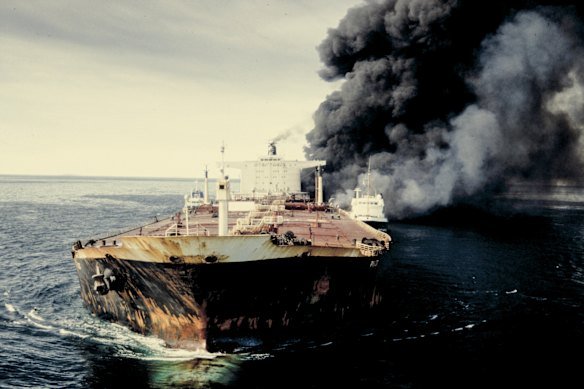
The Saudis and the UAE both have limited workarounds: the Saudis have a pipeline to a Red Sea terminal, for example, from which tankers could get to Europe and the UAE has a pipeline from its oilfields to the Gulf of Oman. But other nations, such as Kuwait, Qatar and Bahrain, rely entirely on the strait to ship their oil. In terms of which importing nations would be most affected, much of the crude oil and liquefied natural gas that moves through the Hormuz Strait went to Asian markets in 2024, according to the US Energy Administration Information Agency. China, India, Japan and South Korea were the top destinations.
“Oil prices are going up on the expectation that things will get worse as the conflict expands,” says associate professor Flavio Macau, a logistics expert at Perth’s Edith Cowan University. “So we will play wait and see. If there is an escalation, nothing will stop prices from going higher. An example would be if Iran starts targeting refineries [in the region] then the prices will go up, up, up.” But he thinks this is unlikely. “The moment they do that, everyone turns against them for real.”
Independent economist Saul Eslake says while nobody knows whether this conflict will last a few days or drag on for weeks, the conventional wisdom seems to be that oil prices will spike to somewhere between $US90 and $US100 a barrel. The oil price reached $US122 after Russia invaded Ukraine. “But since then, oil supply has increased quite a lot, whereas oil demand seems to have flat-lined,” Eslake says. (OPEC increased oil supply to try to claw back market share from rival producers in the US.)
What could be the impact for Australia?
The West Texas benchmark spiked by $US40 a barrel to $US107 in response to the US and Israeli strikes. Each dollar rise adds about 1 cent a litre to petrol prices in Australia. “It would add about 40 cents a litre to petrol prices here,” says AMP chief economist Shane Oliver. “So if we’ve been averaging $1.80, then we’ll go to an average $2.20, with a discounting cycle around that.” This would take $14 out of the average household weekly budget – a dampener on the economy.
Oliver says the Reserve Bank would be watching the conflict carefully to measure its impact on inflation and consumer spending. Inflation is at 3.8 per cent. “I reckon they’d be a bit nervous,” he says. “Another shock, which keeps the CPI [inflation] elevated. And the longer you spend above target, the more people expect it to stay above target, the more wage demands you get, the more companies put through price increases.”
He also says Australia is less exposed to the conflict than some other nations because we rely on coal and gas for heating, rather than oil, and we are a net energy exporter. “If this conflagration leads to not only higher oil prices but higher coal and gas prices, then we actually get a benefit. Our exports go up, and more revenue flows to Canberra, the budget deficit is smaller. But households pay for it, through higher petrol and potentially higher gas [prices],” he says.
Still, Macau says: “Given that 90 per cent of our oil consumption – petrol and diesel and all sorts of things – come from overseas, we are vulnerable to any international crisis that may affect us, directly or indirectly.” While we have our own limited oil reserves, mostly in Western Australia, and the two refineries – Viva Energy’s and Ampol’s Lytton plant in Brisbane – ultimately we have to compete with imports on price.
Australian prices today are also heavily influenced by three other factors: the strength of the US dollar, the margins that overseas refineries make and the wholesale benchmark in Singapore. The dollar matters because oil trades are made in US dollars. (Australia’s dollar is about 71 cents to the US dollar.) Refiners turn a “crude” substance into any number of other products, including petrol and diesel.
Singapore matters because it’s where Australia’s oil mostly gets refined. Singapore is home to three major refineries, including one of the largest plants owned by multinational giant ExxonMobil, one of many petrochemical companies that sprawl over the city-state’s Jurong Island. Because of the volume coming out of Singapore, Australian wholesale prices for petrol are not so much pegged to the price of crude as they are to a Singapore benchmark known as Singapore Mogas 95 Unleaded, or Mogas 95 for short.
Eslake says Australia’s petrol supply is assured so long as Singapore can continue to source oil from around the world. Members of the International Energy Agency are required to have no less than 90 days’ worth of oil stock levels to protect them from severe supply disruptions, he says, but Australia currently has 47 days’ worth. “In the event that the supply of crude oil to the refineries in Singapore, from which we get most of our refined petroleum products, were for some reason to be interrupted – for example, because they couldn’t get them out of the Strait of Hormuz – then that might call attention to the low level of reserves that we have on shore,” Eslake says.
There’s yet another factor that influences what we pay at the pump: the all-important and often mysterious “retail price cycle”.
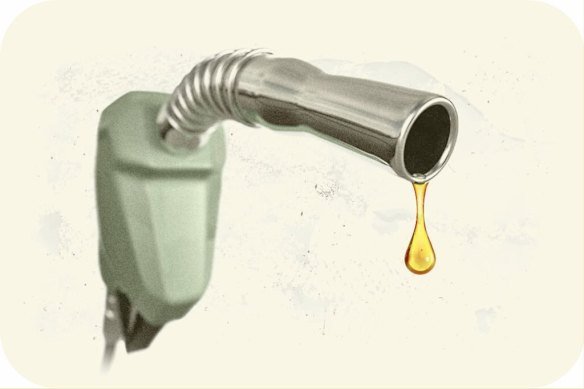
What’s the retail price cycle?
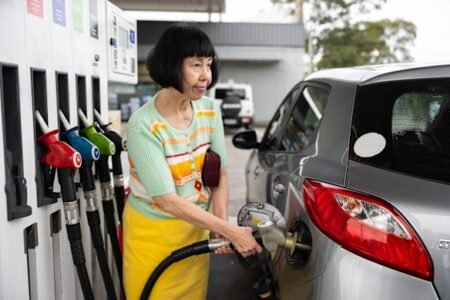
Glance at fuel prices leading into a long weekend and it can be tempting to think service stations hike up the prices when more motorists get on the road. Nevertheless, this is not actually the case, says the Australian Competition and Consumer Commission, which has found that any price increases on public holidays are no larger than at other times of the year.
Instead, it is fierce competition among service stations that drives prices to fall, in little decreases, and then to jump up again over an average of five weeks in most Australian capital cities, before the cycle starts again in a game of discount leapfrog. Economists call it an Edgeworth cycle (named for the economist who described it, in the 1920s). The prices eventually fall low enough to be unsustainable, at least for some. Generally, it’s the larger-volume businesses potentially exposed to bigger losses that will blink and up prices. Average prices can move by up to 45 cents from trough to peak.
“It’s not perfectly competitive but it’s not bad,” says behavioural economist Professor Ralph-Christopher Bayer of Adelaide University. “It’s not that they’re really able to have huge margins.”
In Western Australia, regulation requires fuel prices to be locked in for 24 hours from 6am each day, which has contributed to a seven-day fuel cycle in Perth, where prices are typically lowest on a Tuesday. The cycle is an average 5½ weeks in Sydney, 6½ in Melbourne and six in Brisbane, the competition watchdog says.
The margin on regular unleaded fuel is wafer thin. More than half of pump prices come from production costs, another 31 per cent is government tax, and 11 per cent is industry operating costs and margins, according to the Australian Institute of Petroleum. Fuel remains a service station’s main profit source because of the sheer volume sold, but it’s no industry secret that they make bigger margins on non-fuel items such as chocolate bars and drinks.
Meanwhile, oil’s heyday is not over yet. Indeed, the notion of “peak oil” supply, which once implied a plunge into Middle Ages darkness, has become more complicated with the discovery of new deposits and technologies and the need to ensure continued supplies as new types of energy come online. Says Conway: “We’re trying to compress a kind of period of innovation that when you look back at previous energy transitions would have taken probably a century, if not longer.”
This is an updated version of an Explainer first published in September 2023.
Get fascinating insights and explanations on the world’s most perplexing topics. Sign up for our weekly Explainer newsletter.
Read the full article here