



A right-wing, security-first approach to migration has become mainstream. The mass influx of migrants into Ceuta showed that Spain’s more progressive model has become an exception in Europe, with even left-wing parties adopting securitarian language.
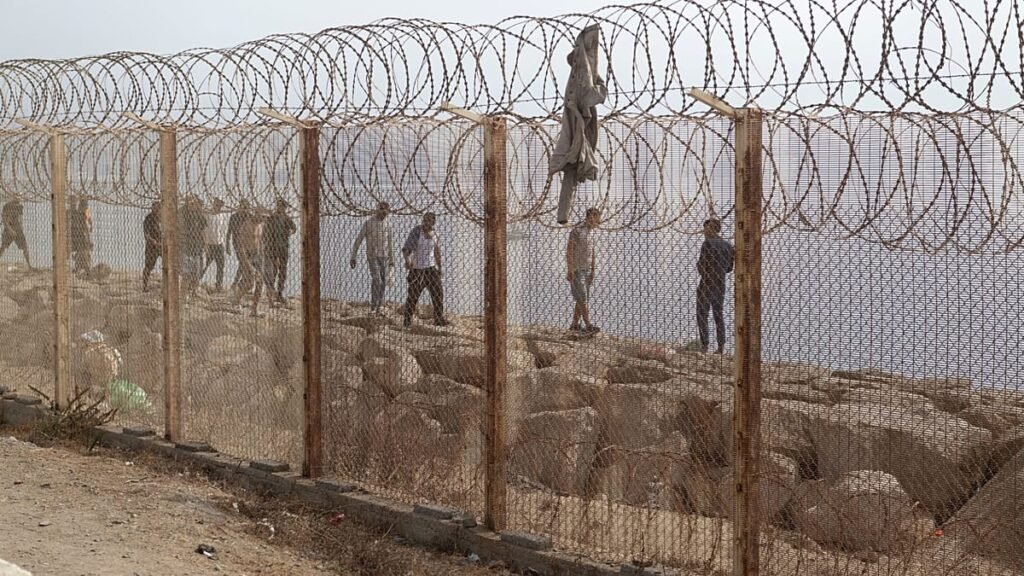
At the end of July, tens of thousands of irregular migrants crossed into Spain’s North African enclave of Ceuta from Morocco, an incident that left around 100 dead and pushed migration policy back to the centre of European politics.
The episode has not only opened a deep diplomatic rift between Rome and Madrid over how migration should be managed, but also exposed Spain’s growing isolation as right-wing political forces come to dominate the debate.
A shift to the right
That right-wing forces have been gaining ground across Europe is no secret. At the last European Parliament elections, right-of-centre parties gained almost 60 more MEPs, with most of the growth driven by far-right, conservative and national-populist parties.
The shift in the centre of gravity was mirrored in the distribution of power within the EU institutions, with the centre-right European People’s Party (EPP) accounting for 14 of the European Commission’s 27 members for the first time.
But the rise of the right has not stopped there. The hard-right Alternative for Germany (AfD) currently polls as the country’s leading party, the far-right National Rally is favourite to win next year’s French presidential race, and even Italy’s conservative Giorgia Meloni faces competition from a new party led by former army general Roberto Vannacci.
Nor is Europe an isolated case: right-wing politicians are finding backing from the US administration, most notably in South America, where President Donald Trump openly endorsed right-wing candidate Abelardo de la Espriella ahead of his election as Colombia’s president.
Migration has historically been a right-wing-dominated issue, so it is no surprise that the Ceuta influx handed ammunition to those pushing for a more restrictive migration policy.
“In the past years, there has been a progressive shift towards a more securitarian language from both traditionally conservative politicians and left-leaning ones,” Chiara Catelli, an advocacy officer at the Platform for International Cooperation on Undocumented Migrants, told Euronews.
“The result of treating migration as a security problem with ever more repressive measures is to foster social exclusion and marginalisation, while also criminalising solidarity towards migrants,” Catelli said.
Spain’s isolation
The most striking consequence of the incident was a diplomatic fallout between Italy and Spain, triggered by Giorgia Meloni’s government reinstating border controls for air and sea arrivals following the irregular inflows into Ceuta.
“I was in contact with both the Spanish and Italian interior ministers today. Both confirmed that the internal border controls are temporary,” Commissioner for Internal Affairs Magnus Brunner wrote on X, in a delicate attempt at mediation between the two member states.
But Rome was far from alone in criticising Madrid: Germany, Denmark, Sweden and Finland also called for the swift restoration of control over the EU’s external borders and floated reintroducing checks within Schengen.
Italy and Denmark led an open letter, signed by 22 EU governments and addressed to the leaders of the EU institutions, calling for “addressing all policies that can serve as pull factors, such as the regularisation of very large numbers of irregular migrants.”
Only Ireland — which currently holds the rotating EU Council presidency — Portugal, Spain’s historic ally, France, which has also criticised right-wing migration policy, and Luxembourg did not sign the letter.
Even before the Ceuta influx, Spanish PM Pedro Sánchez had faced criticism from his EU peers at the last European Council, notably over his plan to regularise around half a million migrants who entered the country illegally.
An alternative model
According to left-wing figures, Sánchez’s government has come under fire from conservative politicians across Europe precisely because it offers the only credible alternative to a discourse that frames migration as a threat.
“At the European scale, the right wing and the nationalist, reactionary attitude towards migration is the prevailing one,” MEP Juan Fernando López Aguilar (Spain/S&D), a former justice minister, told Euronews.
For López Aguilar, Spain’s approach to migration is not only a minority position in Europe — it is increasingly isolated and Ceuta was used to attack it.
MEP Cecilia Strada (Italy/S&D) echoed this, arguing that the Spanish government is regularly attacked by right-wing parties in the European Parliament because Sánchez remains the last bastion of progressive migration policy at an EU level.
What is striking, though, is that even some of Europe’s few remaining centre-left leaders have aligned themselves with the right-wing approach to migration, most notably Danish Prime Minister Mette Frederiksen, who has worked closely with Meloni on the issue.
Sánchez himself adopted security-first language to restore order at the border, suggesting that the EU’s political centre of gravity is shifting rightward as even left-wing governments adopt similar vocabulary.
“The Spanish government will use all the levers of the state, all the resources of the state, to guarantee the security of the citizens of Ceuta,” he said, calling the mass influx a “violation of Spain’s territorial integrity.”
EU migration policy
The right-wing turn in EU migration policy was cemented by new legislation endorsed by European governments and lawmakers in June, which includes stricter surveillance measures, restrictions on the freedom of movement and the possibility to establish “return hubs” in third countries.
Return hubs are a controversial initiative spearheaded by Italy in Albania, to establish facilities for processing asylum requests and repatriation orders outside EU borders. The Netherlands and Denmark are also outspoken supporters of the approach.
In an op-ed published in the German newspaper Frankfurter Allgemeine Zeitung on Monday, EPP leader Manfred Weber called for the swift establishment of return hubs in Africa, pointing to Morocco’s cooperation during the Ceuta crisis, as the country immediately agreed to take back most of those who had crossed the border illegally.
Besides Sánchez, return hubs also face opposition from French President Emmanuel Macron, who has dismissed them as ineffective and contrary to EU values.
Still, at the last EU summit, 19 leaders signed a joint declaration calling to make “full use” of Europe’s new migration rules, an implicit nod to the establishment of return hubs. Senior Commission officials have adopted a similarly securitarian approach to the issue.
In a special committee meeting in the European Parliament, Commissioner Brunner stressed that “we cannot accept such a breach of the integrity of our external borders and a violation also of the security of the Union.”
“From this incident, it is clear that we must do more to further strengthen our borders at critical points, both with vigilant monitoring and the use of physical barriers where needed,” Commission President Ursula von der Leyen wrote in a letter to PM Sánchez.
Read the full article here