

 Markets

Peter Hartcher makes a persuasive case that Donald Trump underestimated Iran’s resilience and willingness to escalate (“Trump has no idea what he’s doing. Now his hubris has put the world on edge”, March 24). What was expected to be a short, decisive campaign now risks becoming a longer and more dangerous conflict. Such miscalculation risks trapping the US in a war it cannot win without severe global economic and geopolitical repercussions. We can only hope Hartcher is wrong. At the same time, Iran’s willingness to strike not only Israel but neighbouring Arab states and key regional infrastructure has sharpened the security thinking of Gulf states. Shared threats may push them closer to Israel. If sustained pressure were eventually to weaken or even bring down the Iranian regime, the consequences could be far-reaching: a reduced nuclear and missile threat, and the weakening of terror groups such as Hezbollah and the Houthis. This might open the way for fuller diplomatic relations between Israel and the Gulf states and mark the beginning of a more stable regional order. John Kempler, Rose Bay
Words of wisdom
The poetry of the 13th-century Persian writer Saadi Shirazi is strikingly relevant to the current war against Iran (once known as Persia). Shirazi was writing during a time of political turmoil and regional wars. The insights in his poems still resonate today and perhaps predict the downfall of Donald Trump and the American empire. In 1258, he wrote: “Governments that pursue prolonged or unpopular conflicts risk undermining their domestic support, weakening their authority and causing their inevitable collapse.” His poem Bani Aadam is inscribed on the wall in the United Nations building in New York. It is often quoted by Barack Obama. British rock band Coldplay featured the poem as spoken text in their song of the same name. Goethe, Voltaire, Emerson and others admired Shirazi, a sophisticated political philosopher who believed in human dignity and the ethical responsibility of authority. Every Iranian schoolchild reads Shirazi’s poem predicting the downfall of rulers who rely on warfare. Perhaps that is why Iranians believe they will beat Trump and his faltering empire. Perhaps they understand that what was true eight centuries ago is still true today. Carol Dance, Wollstonecraft
States of war
Why has the Albanese government aligned Australia, via AUKUS, to a nation whose president simultaneously claims he’s won the war, is currently winning the war, needs help to win the war and needs no help to win the war? All to destroy the nuclear program he claims to have already destroyed. Just imagine what those billions of dollars could do for health, education, social care and infrastructure. Patricia Philippou, Charlestown
True lies
You know you’re living in strange times when you have to wait for news from Tehran to confirm whether the POTUS is lying, again (“Trump backs off from threat to bomb Iran power grid, citing talks to end war”, March 24). Wayne Eade, Mudgee
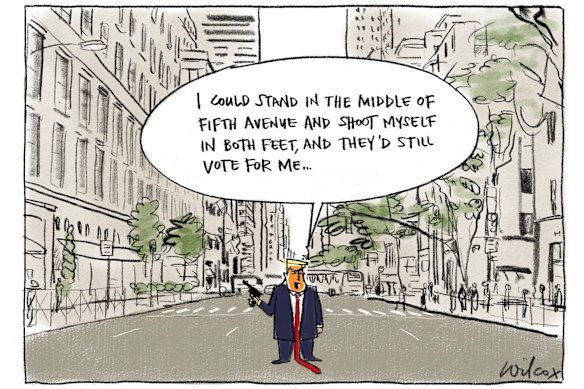
America should turn to Britain in considering how to handle a mentally ill head of state. More than two hundred years ago, King George III was sidelined because he was considered “mad”. The Americans have to do something similar before Trump creates even more havoc for the rest of the world. Joe Weller, Mittagong
Rationale before rations
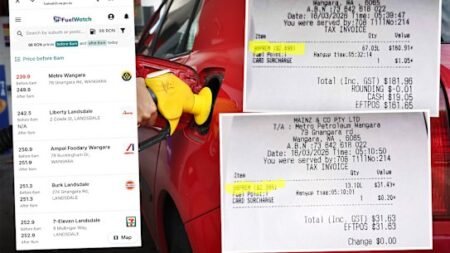
Yes, please, to a consistent national message and plan from the Albanese government on fuel (“States warn Albanese of fuel ration confusion”, March 24). Without a clear national direction, we risk repeating the confusion and fragmentation seen during COVID, when a slow and piecemeal approach only deepened public anxiety. Australia has enough fuel now to meet normal demand; it’s mostly panic buying and price gouging that have driven up prices. Before implementing rationing, the government should encourage practical steps that we can all take to reduce consumption: drive less, walk more, use public transport where possible, use ride-sharing, avoid unnecessary idling and ease up on the brake and accelerator. These measures are healthier for us, better for the climate and easier on our wallets – and they’re far more effective when backed by a single, steady national voice. Maybe “Keep Calm and Carry On” could again become the phrase of the day. Amy Hiller, Kew (Vic)
Perhaps if the media avoided such terms as “fuel crisis” and “panic buying” there would be less of both. I can’t believe that the number of people who might be filling a jerrycan “just in case” are making a significant impact on supply. It’s not as if people are driving around just for the hell of it and using any more fuel than they usually do. Quite the opposite, I suggest. Take a look around you and compare the amount of traffic during your usual commute and think what it was like four weeks ago. And, please, do some fact checking. Twenty per cent of the world’s oil does not pass through the Strait of Hormuz, as is often reported. It’s only international ship-borne oil. Many countries are self-sufficient, and their fuel supply never sees a ship. Kevin Hunt, Kenthurst
Australia’s dependence on fuel from overseas is under the spotlight. This, together with the sad state of affairs in which just about every manufactured item for our daily living requirements is also sourced from overseas, causes me to worry that former Singaporean prime minister Lee Kuan Yew’s 1980 statement that Australia was in danger of becoming “the poor white trash of Asia” is proving to be quite prophetic. It’s time for those showing growing support for One Nation to pause and take a look in the mirror. Tony Denzel, Bonny Hills
Public purse
Every economist is saying the government must cut spending. Where to start? Firstly, I fail to see any justification for the large salaries we pay top bureaucrats. How can the RBA governor earn more than double the pay of the American equivalent, given the sizes of the two economies? And how can any public servant be paid far more than the prime minister? As a token start we could significantly raise their marginal tax rate. Secondly, we could also change from percentage pay rises to a flat amount for all. For example, someone on $500,000 would get a $25,000 pay rise if the CPI-linked increase is 5 per cent, whereas a $40,000 earner would get only $2000. That’s unjustifiable and unsustainable. Under the current system the former’s salary would double to $1 million after 14 years, while the latter’s would rise to just $80,000. Keith Hartmann, Bowral
Criticising RBA governor Michele Bullock for buying a holiday home on the day the bank raised interest rates is unfair (“RBA governor spent $2m on coastal home”, March 24). Judging by the constant harping about politicians’ and bureaucrats’ pay and benefits, Australians are obviously unaware that if we pay peanuts we will get monkeys. Singapore pays its top officials salaries comparable to those of top company executives. That must partly explain why, even though it’s only natural resource is sand, it is one of the most prosperous countries in the world. John Acton, Bronte
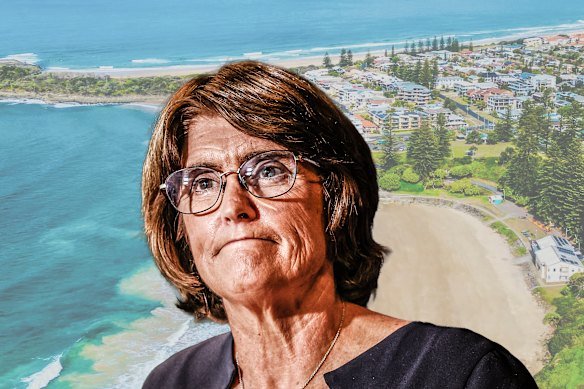
I read that Michele Bullock bought a $2 million property on the same day as the recent rate hike. Well, good for her. She deserves everything she gets for doing a very tough job. Paul Ballesty, Cabarita
Pensioners penalised
As budget day approaches, Treasurer Jim Chalmers and the state government should consider helping retired Australians with accommodation and transitioning to renewable energy. Firstly, pensioners should not be penalised for buying an EV. Owning a car can reduce their pension by a significant amount as it is counted in a pensioner’s assets, even if it’s second hand. Secondly, many older people would downsize their homes or rent out spare rooms if they were not liable for stamp duty on a new home purchase, taxed on rental income and charged CGT on the sale of their property if they have rented out part of it. In Britain, the government allows individuals to rent out rooms up to about $15,000 a year without being taxed and without being penalised on the sale of their property. This also helps younger people struggling to find reasonably priced accommodation. Janet Cook, Waverton
Bad taste
Kyle Sandilands’ lawyers are correct – “the exchange [with Jackie O] was congruent with the style, tone and nature of the show and the robust character that (ARN ) desired” (“KIIS expected me to berate Henderson, Sandilands tells court”, March 24). The show’s remit was clear from the outset. The problem for our society is not how we regard the two presenters who, it would seem, are merely actors on a stage, but rather, how is it possible that a show with such nasty, puerile, misogynistic content can become the most popular morning show in Sydney? This is the very same question to be posed about the rise in popularity of One Nation. Denis Hannigan, Toowoon Bay
Bumpy road
Speed humps with white side markings are not just confusing, they are also dangerous for pedestrians and stressful for drivers (“Confusion reigns at city speed humps”, March 24). Recently, a mother and her two children stepped straight in front of my car in Longueville Road. Though driving at only 30 km/h in a 40 km/h zone, I still had to hit the brakes hard. The woman “gesticulated” at me like I was in the wrong! Clarity around the use of these humps is vital for road safety. Sally Spurr, Lane Cove
From little things?
Much has been written about the “success” of One Nation in South Australia, but the last I checked their best possible result was four seats in the lower house, 20 short of a majority (“One Nation candidate wins SA lower house seat”, March 24). If this is what is now considered success, failure must be dismal indeed. Thomas Shanahan, Lane Cove
Trigger for change
There are still politicians who ideologically reject reducing the number of guns held by the Australian public (“The embarrassing email blunder that revealed NSW Libs’ stance on gun laws”, March 24). We have 4 million licensed guns. Even if every one of our 90,000 farmers has four guns each, that would be about 10 per cent of the total. We have just returned from a holiday in Vietnam, which has a total ban on gun ownership. Their homicide rate is less than a third of ours and a fifth that of America. Gun ownership does not necessarily provide personal security, but it’s a key means for murder and, indeed, for suicide. David Hind, North Sydney
Turning parental tables
The increase in aggression from students and parents towards teachers in our school system should come as no surprise to anyone observing the not-so-subtle power shift these days in families with young children (“Banning aggro parents from schools is a good move. But don’t stop there”, March 24). I am constantly astounded at the new normal parenting regime, where instead of being told what to do by the parent, the child is constantly consulted and offered choices. Little wonder the child develops the belief that they are the authority, has no respect for their teachers and assumes that if things don’t go their way, the parent will go into battle on their behalf. This vicious cycle will only be broken if the old chain of command of who’s rightly in charge can be re-established. Joy Nason, Mona Vale
Metro madness
Closing the Metro from Tallawong to Chatswood over the Easter long weekend must qualify as some sort of insanity (Letters, March 24). As usual, many Metro travellers will avoid the slow rail replacement bus service and swarm onto the direct M2 express buses to the city, creating a headache for regular passengers further down the road as full buses pass them by without stopping. This coming weekend there is the double whammy of no North Shore trains and no Metro services between Macquarie Park and Victoria Cross, and, as of Tuesday morning, no sign on the official Trip Planner site of any replacement bus services for railway stations south of Chatswood. Doug Walker, Baulkham Hills
Steady hands on the till
How many of us nodded knowingly while reading Jo Pybus’ frustrating experience managing her father’s estate (“I lost my dad three years ago. Then I discovered a super annoying extra stage of grief”, March 24)? I’m trying to deal with a large super fund and banks using a power of attorney (PoA) from my 90-year-old mother, who needs help with her finances. A large bank accepted an emailed PDF of the PoA. Good, but I still couldn’t get them to unlock mum’s login. That required getting her personally on the phone and being expected to remember when she had opened the account. On top of this, each call took 20 minutes or more to answer. We got there eventually, but it was torturous. Next, a large industry super fund. I mailed in the relevant forms, certified copy of the PoA and my personal identification. Not good enough. A hard copy of the PoA had to be certified on each page, but I still couldn’t have an online account into mum’s super. That can only be operated by mum. Two big financial institutions, two very different rules about PoA. Why? You’d think they had never encountered people using PoA or probate. Steven Lee, Faulconbridge
Data centre cooldown
I’m assuming water usage by data centres is to keep the system cool (Letters, March 24). Why, then, can the water not be recycled? Unless the water is rendered toxic by the cooling process, surely it can be a closed system? Brett Jack, Bonnyrigg Heights
- To submit a letter to the Sydney Morning Herald, email letters@smh.com.au. Click here for tips on how to submit letters.
- The Opinion newsletter is a weekly wrap of views that will challenge, champion and inform. Sign up here.
Read the full article here