



 Markets
  Weather
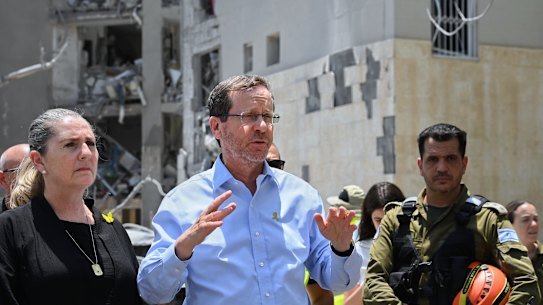
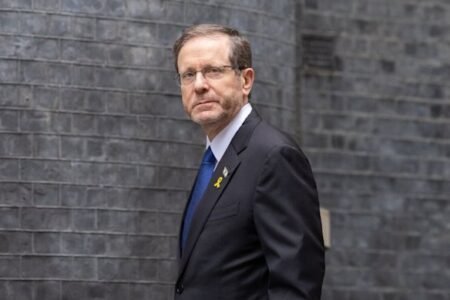
Below is a full transcript of the interview that Israeli President Isaac Herzog gave to this masthead before his trip to Australia. He spoke to political and international editor Peter Hartcher and foreign affairs and national security correspondent Matthew Knott.
Peter Hartcher: Can we start by asking you about your forthcoming visit to Australia?
Isaac Herzog: Of course, that’s the reason why we’re talking. Absolutely, it’s an opportunity to send a message to the people of Australia.
Hartcher: Well, let me ask you, the prime minister and the governor-general invited you, so why did you accept?
Herzog: I was very glad to receive this invitation, and it also came in conjunction with the desire and need of the Jewish community of Australia after the horrific massacre of Bondi Beach. I feel close affinity, both with Australia and with the Australian Jewish community, for years already. And I believe that there’s so much underlying common denominators between our nations that it’s about time that also the Australian people understand and feel the same.
It is so sad that only because of a tragedy, we can bring these relations and these feelings above ground. It is really painful, but I believe that it also shows that, you know, we are both nations who seek doing good, who seek peace, stability in the world, strong democracies, and at the same time, we must fight together evil and terror. Bondi Beach was evil and terror. And I’m also, in addition to that, I am coming to visit my sisters and brothers of the Jewish community to console and pay our respects to the grieving families and to the community.
Matthew Knott: What will be your main message to the Jewish community, first of all, and to Australia more broadly? What do you hope the impact of the visit will be?
Herzog: You have two items here. One is, of course, to pay my heartfelt condolences to the Jewish community and the bereaving families, also the non-Jewish Australian victims. They were all Australians who went to celebrate on the beach in one of the most moving and beautiful sights in the world, in my mind, and they were slaughtered and butchered like, unfortunately, we’ve suffered for many years from terror of this nature.
And the October 7 massacre in Israel, where innocent civilians were butchered, slaughtered, raped, burnt and abducted, is just another very strong example of what terror is all about, and as freedom loving nations, the nations who have a core moral code to obey, and we are obeying it, we have to share together our feelings about combating hate, antisemitism and terror of any kind.
And the other message is, I believe that Israel and Australia have always been very close friends and allies. Little do Australians remember but it is, it is Australians who liberated our land in 1917 and liberated Beersheba, Abraham’s city, and our forefather. And it, I think it was almost a God-given moment in history. And later, Australia was the first nation to recognise the idea of a Jewish state in Palestine of those days in 1947 and thereafter, Australia’s relations with Israel were always bipartisan.
And I’m here to express a message of bipartisanship and friendship, and find a way to reignite this passion and love between our nations. Forty years ago, my late father visited Australia as the president of Israel. He was the first Israeli leader and president to visit Australia. Then-prime minister Bob Hawke and the governor-general hosted him and my mother beautifully, and I hope to revisit that experience.
Hartcher: Can I ask you about antisemitism in Australia? Is it of a different character or intensity as antisemitism in other countries? Or is it of a piece, the same phenomenon, simply in a different country?
Herzog: I’ve alerted about antisemitism in various countries around the world. And following the terror attack on Jews who went to pray on our holiest day, the day of atonement, Yom Kippur, in Britain, in Manchester, where two Jews who went to synagogue were murdered and butchered by another jihadist terrorist, I wrote to King Charles about various nations under [the] Commonwealth, and I included the phenomena of rising antisemitism in Canada, in Britain and Australia. I was very bothered by it, of course … It is antisemitism of the same nature, but it is a wave that was extremely bothering and frightening.
And, in fact, in Australia, which is a nation that has always been very moderate and tolerant, and it is a nation that has received the highest amount of Holocaust survivors outside Israel, and it is a nation that has always been extremely accommodating to the Jewish community, which is a community that has contributed immensely to Australia’s facets of life in so many fields. I’m very disturbed by it.
And I think that Bondi Beach was a culmination of a whole process of attacks all over for years, in campuses, in streets, on encampments and following October 7, very disturbing phenomena that covered religious institutions, synagogues and Jewish schools.
Knott: What was your initial reaction when you heard about the attack? Did it shock you that this would happen in Australia?
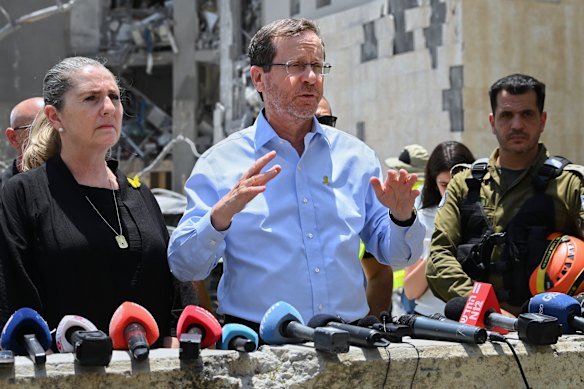
Herzog: So interestingly enough, we were at an event in the president’s home, hosted by me, honouring various Jews who came from English-speaking countries, including Australia. And all of a sudden, during that ceremony, my spokesperson comes to me and says, ‘There was a terror attack in Sydney and the facts are unclear.’ My heart missed a beat. And by the way, the hearts of Jews and Israelis all over the world and in Israel missed a beat. It was apparent soon enough, by evening time in Israel, that this was a terrible massacre. We are a small nation, so we get to know each other. It turns out that some of these people, these innocent souls, had relatives in Israel and or people who knew them. And I immediately wrote to friends in Australia to ask them if they’re OK and if their loved ones are OK. So clearly, it’s something that has been extremely painful and touched our hearts deeply for weeks.
Hartcher: You spoke about the shared history, the goodwill between Australia and Israel. And when the attack of October 7 occurred, the Hamas butchery of Israelis, I think the whole world, for a moment, was more sympathetic and empathetic, supportive of Israel than it had been in my lifetime. That now seems to have reversed. Israel had to defend itself, but was the way that the war was conducted by the Netanyahu government, could that have been conducted better to have preserved some of that upswell of goodwill that followed the October 7 attack?
Herzog: So I’m very much aware of the criticism and the surmounting views against Israel in various corners of the earth, also in Australia, but I believe that a lot of it comes from distorted information. First of all, there’s a huge wave of lies, also about me and my visit and things that I’ve said and done. I’m the head of [the] state of Israel, I’ve been in politics for decades, and I have many, many, many people who know me in Australia, I was even the head of the Australian-Israel parliamentary friendship league. And I’m quite shocked to see how people in Australia who don’t know the facts buy in on so many lies and false information.
We went to defend ourselves, and we operate according to international law. We went to defend ourselves because the Hamas jihadist terror attack, with all the Iranian proxies all around us, was aimed at destroying us. Now we know it, we see it in the information we uncovered from Hamas computers and Hamas archives and so forth. They tried to split, physically split Israel in two, and then cut to the West Bank and destroy the nation of Israel. That was their whole plan, a grand plan which was masterminded also with Iran. Let’s not forget the leaders of the three main terror organisations – Hezbollah, Islamic Jihad and Hamas – met in Iran just two weeks before the attack.
And in order to undermine this capability, you go into a civilian terrain because the whole infrastructure of Hamas is based on civilian terrain, and you find long-range missiles in people’s bedrooms and living rooms, literally. And you find them in mosques and shops and in schools. You find terror equipment, RPGs, bombs, missiles, rockets, the whole thing, literally. So you have to go in physically to take them. And sometimes it’s painful. It is painful, and we tried our best. We alert in advance, we send messages, we send text messages, we tell people to get out so that we can finally clear up the place. And some people, of course, they are fighting, and many of them are terrorists under this guise, and this is what we’ve done. And I know it’s painful, and I know it’s not easy, but we kept on saying it, that it is painful.
Believe me, I care for the people of Gaza. All I want is for them to have a better life. And I believe that the plan that [US President] Donald Trump has now pushed forward, and which was approved by the [United Nations] Security Council, the 20-point plan, and the next phase, is another positive step. And don’t forget: we had hundreds of hostages, from a four-year-old kid to an 85-year-old Holocaust survivor underneath in the tunnels, and now every hostage that came out keeps on describing the horrific torture that he or she went through, including terrible sexual abuse. So that’s what we have to fight against. And let’s not be naive. Had any Australian been attacked like that in Australia, you would act the same.
Knott: Can I ask you, following up on that, Donald Trump has asked Australia, has asked the prime minister [Anthony Albanese], to be a part of his board of peace. Do you think Australia should participate in that?
Herzog: So the board of peace, according to the Security Council resolution dealing with Gaza, will have a key role in rebuilding Gaza. And of course, the prerequisite to that is clearing Gaza of the military capability of Hamas, meaning decommissioning in a vast way. And this is now the big discussion that everybody is dealing with. But there is an international force that has been formed, which is based now in the southern part of Israel in Kiryat Gat, which is dealing with so many questions of the day after. In all of these, I believe Australia should be part. As to the grand political question about other issues that the board of peace will deal with, of course, I’m not intervening in Australia’s consideration, but our prime minister has joined the board of peace, and of course, we support President Trump in his efforts to bring peace around the world.
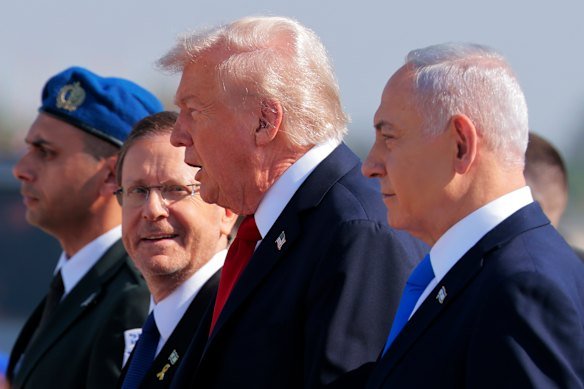
Hartcher: One of the immediate next steps in the Trump plan towards peace is that Hamas must disarm. Can you imagine that Hamas will ever disarm?
Herzog: It’s a very, very challenging issue. The interlocutors and the mediators claim that it will. The proof of the pudding is in the eating, meaning we will have to see it. There will be a deadline. And of course, you know, we are not the ones who want to go and carry out this job, but if we will have to, in order to protect our citizens and also enable a better future to the people in Gaza and our neighbours, the Palestinians, we may be compelled to do so.
Hartcher: Can I just point out to you that, as you said at the outset, Australia and Israel may be committed to the shared goals of stability and peace, but in Australia right now, there’s a fairly widespread impression that Israel is certainly not committed to peace. Let’s set the activists and the extremists aside, can I point out to you that a member of the Albanese government, a backbench member, former minister Ed Husic has said in the last few days that he was deeply concerned about your forthcoming visit. He said it’s hard to reconcile the vision of you as somebody who’s good for social cohesion with the vision of you signing bombs that may have been sent into Palestine. What’s your response to that comment from a member of the Albanese government?
Herzog: So this is another example of the distortion and the falsehoods and the lies that people spread in order to undermine my visit. So I will answer the specific question and I’m happy you asked. I did visit an army unit and I signed a shell, a smokescreen shell. I don’t even know if it was ever launched. In fact, in hindsight, a few months later, I said that it may have been something that was lacking taste. I agree that I may have made an error, but there was no intention, it’s simply a false allegation.
But it also comes as part of a whole campaign and onslaught with many lies and distortions. As the head of state of Israel I am equivalent to the governor-general [in Australia], and I’m very proud of the way my nation has gone through the worst atrocity in its history, since the Holocaust, and I’m very proud of our young soldiers and people all the way up to 96 years old, who went to volunteer and defend and protect those citizens, and the dignified manner in which our nation has endured this terrible, terrible period, including so many casualties who are Muslims and Christians and Druze and part of our beautiful tapestry in Israel, of our society.
And so, you know, people get a distorted image of our very vibrant democracy, which has been an example to so many other nations around the world. And I say to all those who kept on demonstrating and will demonstrate, where are you when tens of thousands of Iranian citizens are butchered. According to the data there are 70,000 now, and the world keeps silent. Where is everybody? Where are all these demonstrators? Why don’t they raise their voices? And I’ll tell you why: because part of the demonstrations and these attacks that are full of lies are all instigated politically, and they are missing the point.
Israel is protecting, by its mere presence and its battle against evil jihadism, is protecting the free world, is defending the values of the free world. If we were not there, Europe would be next, because these jihadists never stopped for a moment. And they spread their wings all over the world, with terror cells all over the world. And of course, there was information in the past about their efforts to reach Australia as well. So what we have done in changing the vision of the Middle East, by eradicating the leadership of Hezbollah and Hamas and attacking Iran is strengthening world security and peace, and I hope will bring peace. I’m a staunch advocate for years and years of peace with our Palestinian neighbours and peace with the Arab world.
Knott: A member of the UN Commission on Palestine, Chris Sidoti, has even said that you should be arrested when you come here for allegedly inciting a genocide with the comments about an entire nation being responsible for October 7. What’s your response to that?
Herzog: So that’s another lie and another distortion of the facts. The fact was that I held an international press conference four days after the terrible massacre, and I was quite surprised that the international press didn’t ask one question about the real pain and agony that Israel is enduring. And I made an example of the celebrations and the joy that was exposed from Gaza, including by so many civilians who broke into Israel and kidnapped and took civilians from Israel, the hostages. And of course, the celebrations again around the hostages, the videos had just come out. But I made an explicit comment that there are many innocent Palestinians and this, of course, is not mentioned by those criticisers. I made it clear, and of course I believe in it, and I know it, and I was involved in procuring a lot of the humanitarian aid to Gaza. But I must say this is part of another frontier that Israel is facing. We are a nation of the rule of law and international law, and we abide by it, but we were attacked by the most barbaric terrorist organisation, and the world order must confront these terror organisations. And, of course, their centre of evil in Tehran, and make clear that the world doesn’t accept this any more, that terror is unacceptable. Terror is what has undermined all efforts for peace in the Middle East in recent decades.
Hartcher: You mentioned the role of Iran in all of this. At the moment, Iran seems to be in a vulnerable state, economically, politically. Donald Trump, of course, is threatening the use of force against Iran. Are we at a tipping point? Is Donald Trump’s hope that the ayatollahs can be forced out realistic?
Herzog: So look, the grand vision of the Middle East, when I say peace, it is based on the whole notion of the Abraham Accords, and you see the incredible co-operation between Israel and its partners in the Abraham Accords. For example, the United Arab Emirates, which has done wonders, both on the humanitarian side in Gaza and also promoting peace and co-operation in the Middle East. And you have other nations, and we hope others will join. Iran’s main aim is to undermine the whole vision of peace, to destroy Israel, to rush to the bomb, and of course, has grand visions, according to its ayatollahs, against anybody who’s not in their own belief, meaning Christians and moderate Muslims, and of course, Jews. They’re spending billions of dollars of their own people’s money on destroying their own society, and torturing their own people, and crushing them while spending billions undermining stability in our region and pursuing terror and rushing to the bomb. So I think President Trump’s stance is of great importance to world stability, and I trust his judgment. Right now, as we speak, there is a dialogue and negotiations between the American administration and the Iranian leadership, and it is clear to all of us that the situation whereby Iran can dictate by terror, dictate a huge, enormous human suffering and pain to its own people and to our region and threaten world stability is unacceptable.
Knott: Prime Minister [Benjamin] Netanyahu has been extremely personally critical of Prime Minister [Anthony] Albanese. He’s called him a weak leader, and said he allowed antisemitism to flourish in Australia under his watch. Do you share those criticisms, and is that appropriate for the leader of one nation to say about another nation that’s traditionally been a friend?
Herzog: I am coming to visit Australia with a message of goodwill and friendship. I have known Prime Minister Albanese for many years, and I look forward to seeing and meeting with Prime Minister Albanese. And of course, I will be meeting also with the opposition leader, and will be a guest of your governor general and meet the various premiers in the cities I’ll visit. So I’m coming with a message of friendship, and I hope my visit will upgrade the relations to where it should be.
Hartcher: So you do or you don’t think Albanese is in some way complicit in the events that resulted in the Bondi massacre?
Herzog: I won’t go into it because I think it’s unfair. I’m coming in order to have an honest and frank dialogue. And I also welcome the fact that a royal commission has been appointed and that it will, of course, investigate and inquire as to all circumstances. It is true that we alerted about the situation of antisemitism in Australia. Even when the synagogue was burnt in Melbourne, the Adass. But I don’t intend to go into this argument, because I want my visit to be a visit of goodwill, and I think it’s about time that the good relations between Israel and Australia will flourish and not [be] taken hostage by radical forces in Australia who have been undermining these relations for a long time on campuses, on the streets, in public discussions, and bring the real truth to the Australian people. The Australian people are incredible friends. We co-operate with them in so many fields of doing good. We can contribute together to the world positively from climate to water to agriculture to science so let’s do that together.
Hartcher: You mentioned earlier the pain of the Israeli people after the Hamas attack. I appreciate you’re not actually in Australia yet, but you have a lot of friends and connections in Australia.
Herzog: Many friends and connections in Australia. I am actually quite an expert in your political system for quite some time.
Hartcher: Well, let me ask you this question. The Jewish Australian community, how is it feeling at the moment, and what impact do you hope your visit can have to help them with their suffering?
Herzog: So I’m the head of state of the only Jewish nation state in the world, the State of Israel, which Australia and the legendary Doc Evatt [former judge, attorney-general and Labor leader] was instrumental in bringing its independence. And I therefore, I’m coming to visit and see my brothers and sisters of the Jewish communities in Australia to express our bond, our connection, our love, our affection, our condolences and I think it is something which is very important to [the] community, which has been harassed and devastated by this terrible, terrible attack and by the ongoing onslaught of antisemitism against the community all over Australia.
Herzog: So this will be the last question, because of time.
Knott: You said before, you’ve been a supporter of peace and a believer in peace. Australia’s position is that it wants to see a two-state solution. Do you think that’s still possible? Could that happen?
Herzog: Part of my visit is also to explain the Israeli perception of things. We’re a tiny strip of land, and the people who were attacked on October 7 were the biggest supporters of peace. The kibbutzim, the moshavim, the towns on the border believed in peace with the people of Gaza, and they were the first ones to be butchered, slaughtered, raped, burnt and abducted. You cannot ignore it. It’s a national trauma.
We are now exiting – following the return of the last hostage two weeks ago, Ran Gvili – we are now exiting from the war. We have to go through a healing process. To come and tell Israelis, ‘Hey guys, divide your land again for a two-state solution’ doesn’t operate on the, I would say, emotional side of a dialogue with Israelis. It’s a big issue in Israel. The question of how do we live with our Palestinian neighbours is discussed day in, day out, and it will also be discussed as a key issue in our elections, which will take place later this year, because we are a very vibrant democracy.
And that is why I’m trying to explain: I believe that we must reach an amicable solution with the Palestinians and with our Arab neighbours, and it’s feasible as you look at the historical trajectory. Fifty years ago, there was not even one Arab leader who shook hands with an Israeli leader. Thereafter, we signed agreements and deals with many of [our] neighbours, including with the Palestinians, but it was violated by terror. So we have to think and think out of the box, and not only be locked into one formula or the other, but to think about a future of peace, and how do we get there. Thank you.
Cut through the noise of federal politics with news, views and expert analysis. Subscribers can sign up to our weekly Inside Politics newsletter.
Read the full article here