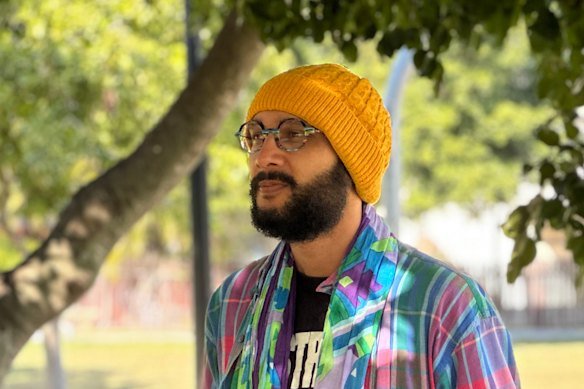
Welcome to CityChats, where Brisbane Times meets our city’s most interesting characters on our most iconic form of transport. This week, activist and former Greens councillor Jonathan Sriranganathan tells us about life on dry land, his rap career, and why he describes Brisbane 2032 as a “supercharged consumerist propaganda machine for big corporations”.
Sriranganathan meets us at the South Bank ferry terminal on a cruisy weekday afternoon. He’s easy to spot in one of his trademark colourful outfits, and he fills us in on the latest details of his life as a new dad while we board the vessel.
What part of Brisbane are you currently living in?
We moved to Holland Park West about one year ago. We were living on a houseboat in East Brisbane for about eight years. I had to move a little bit further out into the ’burbs because we were moving on land. I became a dad [about a year ago], so we thought it was time to get off the boat and get access to hot water and a washing machine.
How do you get around Brisbane?
These days, I find myself riding along the bikeway a lot. We’ve got a cargo bike as well, so we can take our baby son in the front of that. Since becoming parents we’ve spent a lot of time going to the galleries or checking out some of the parks and playgrounds – occasionally, we get the bus. We like bushwalking. We really enjoy getting up to the top of Mount Gravatt, and Toohey Forest is really cool.
Are there public transport routes to those places?
It’s one of my gripes that, although Brisbane has a lot of amazing green-space destinations, you can’t actually get a bus to a lot of them. Even at Mount Coot-tha, which is this phenomenal tourist attraction and destination, there’s not really a lot of public transport up to the lookout, and there’s nothing after dark. I think that really sucks.
What do you love about Brisbane?
I love the pace of the lifestyle, and I think sometimes that’s just simplified to “I love how slow, and calm, and mellow it is”, but there’s some interesting stuff going on in Brisbane, you just have to know where to look. I think overall, there’s a more chatty culture here, where people will stop and have a chat a bit more than the larger capital cities.
I love Brisbane’s green spaces and how much wildlife there still is within the city, and I love the DIY countercultural scene. Every city has its live music and its art galleries, and all that sort of stuff, but Brisbane has a particularly strong tradition of underground arts and music, like people putting on gigs under houses, or pop-up art galleries under a bridge, and I think that’s something that makes this city really special.
One of the cool things about the underground scene is that there’s not really one specific place you can go to find it. You go along to an event and at that event you’ll hear about some other things. But I definitely recommend keeping an eye out for zines and posters and those more offline promo channels as well, because there’s a lot of cool stuff happening that won’t show up on your newsfeed but is definitely worth checking out.
Can you tell me a bit about your music career?
I played sax with quite a few bands. The most prominent one was the Mouldy Lovers, which is like a seven-piece ska punk outfit, and I played a bit of clarinet with a few different bands, and these days, I also rap with my hip-hop band, Rivermouth.
Rivermouth is playing maybe four or five gigs a year. Almost all the band members have had kids now, so we’ve slowed down a little bit, and we’re not making a huge amount of money out of it, but it’s a really awesome side hustle to be able to get along to the occasional festival or put on the occasional gig with your mates. It’s a really fun way to share radical ideas through music and spoken word without ramming a message down people’s throats.
Do you think Brisbane City Council is too big?
I wouldn’t necessarily say the council is too big, but decision-making is overly centralised. Whether it’s a small decision, like “should we install a basketball court in this park?” or a big thing, like “should we rezone this entire suburb for a different kind of development?” there are so many layers of bureaucracy, so many decision makers that often compartmentalise the decision, break it up into little bits, and then no one’s really taking accountability. So, change often happens much more slowly than it needs to, and there’s often no one who’s really thinking strategically or holistically.
So I would say that Brisbane is too hierarchical and centralised, and you often end up with situations where the public servants on the ground who know how things should be fixed are hamstrung because they’ve got five levels of middle management. And then the councillors and the mayor’s office are all micromanaging stuff.
What do you see as the big problem for the Greens right now?
I think the Greens could be doing a much better job of picking up on anti-establishment sentiment. There are a lot of people who are frustrated with both the major parties, and they want a serious alternative. But when the Greens say, “oh, we will work collaboratively with Labor”, that says to a whole bunch of people that the Greens are part of the system and are propping up the major parties rather than challenging them directly.
I think the Greens need to take a more assertive and robust negotiating position in terms of how they relate to Labor and the Liberals. It’s not so much about what policies need to change, but how the Greens use power, and how the Greens apply pressure.
Is the party focusing on the wrong issues?
The Greens are pretty heavily focused on things like climate change, housing policy, taxation reform. From where I sit, those are all important issues to be talking about. I think it’s not so much about what specific issues the Greens are focusing on, it’s more about how you present yourself to the electorate, how your spokespeople engage with the wider vote in public, how you use your power within parliament, and how you use your resources to support grassroots community struggles.
What do you think the key issues are with how Brisbane 2032 is being handled?
The Olympics is an absolute disaster for local residents of the host city, that’s well documented in the research and literature. Every single Olympics, you find that low-income people get screwed over, local small businesses miss out, and then a bunch of property developers and hotel chains and tourism companies make a bit of money. But overwhelmingly, the profits and revenue of the Olympics are sucked out of the host city and the host region, and then the host city has to cover the costs and clean up the mess.
The negative impacts include inflated house prices and the supercharged property market. They include a lot of wasted money on building venues and stadiums that we don’t actually need. They include a major distraction from local decision makers, so instead of politicians thinking about how we are going to fix Brisbane’s vulnerability to flooding, or how we’re going to fix the housing crisis, or how we’re going to shift Brisbane away from dependency on oil and cars, they’re just focused on getting ready for the Olympics.
With Brisbane, we’ve got serious threats to green space, where the government is building, or wants to build, major stadiums on important local public parks, like Barrambin, Victoria Park, but they’re also selling off other parkland and other future parkland sites to pay for the Olympics.
Because they’re running in the red and they’re already seeing major costs, they’re selling off assets left, right and centre, which means that in the long-term, Queenslanders miss out.
There are so many negative impacts to the city at an economic level, and then you’ve got all these environmental and broader social impacts, where the Olympics is basically a supercharged consumerist propaganda machine for big corporations. It’s not like locally brewed Brisbane beers or soft drinks are going to be sold at the Olympics – the International Olympic Committee has already stitched up advertising deals with Coca-Cola. Local businesses get screwed over while multinational corporations just use the Olympics as an advertising platform.
Start the day with a summary of the day’s most important and interesting stories, analysis and insights. Sign up for our Morning Edition newsletter.
From our partners
Read the full article here