



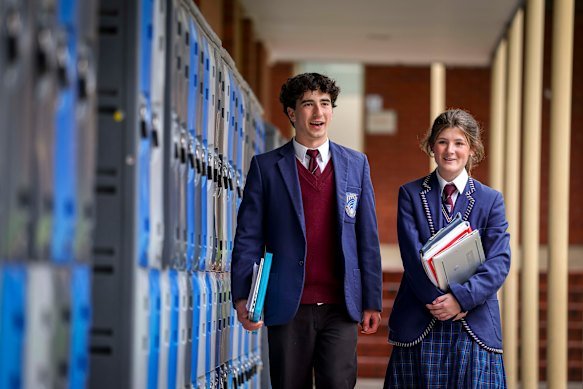
Students walk past emus in the paddock overlooking Corio Bay on their way to class, but after a while another reason for the calm atmosphere at Kardinia International College stands out – there’s no school bell.
Students keep track of their own schedule at the Geelong school, and they’re rarely late.
“It’s handing over that independence to us,” says Sam Carr, a year 11 student. “That’s how it is in the real world, and it sets us up for being punctual.”
Kardinia operates what it calls a “vertical curriculum”, which gives young people a greater choice of subjects than most schools.
Student autonomy is a bedrock of the school, which has been named The Age’s 2026 Schools that Excel winner for regional and rural Victoria category.
The annual series celebrates schools that have achieved outstanding advancement in their VCE results over the past decade.
From year 7, students have a unique timetable and can accelerate into higher grades to do VCE subjects earlier than typically allowed.
“It requires an incredible timetabler,” principal Catherine Lockhart said of tailoring 1300 student schedules.
“We have electives within subjects; in English you can choose your genre, romance genre or a western genre, for example, so it’s even more finite about choices.”
Under the most extreme example of the vertical curriculum’s success, a 15-year-old graduated as dux with an ATAR of 99.8 in 2020.
Thirty years ago, Japanese husband and wife owners Yoshimaro and Kiyoko Katsumata bought the former Morongo Girls College to open a co-educational school with an international outlook; today it hosts 31 students from overseas.
Flags line the quadrangle from dozens of countries where students have attended or visited from, including Egypt, South Korea and Ireland. It represents a school culture designed to teach students that “Geelong isn’t the centre of the universe”, Lockhart said.
Back when the school was founded, the vertical curriculum was groundbreaking and remains unusual.
“It would be really hard to implement retrospectively,” Lockhart said. “Thirty years on we’ve developed it to a point where it is working really well, and it’s paying off.”
The median VCE study score at the school has risen since 2020, increasing to a 10-year high of 33 last year.
Kardinia’s students achieved the most study scores of 40 or above in general maths, biology and psychology.
The opportunities to jump ahead meant year 12 student Zahli Williamson took VCE general maths in year 10, and VCE biology in year 11, and scored 42 and 45, respectively.
“I picked biology and discovered I was good at it in year 8,” she said.
“Because of that, I excelled in biology; I skipped year 9 and went to year 10. You get introduced to all these concepts really early. So in biology last year, there was only one area of study that I hadn’t been introduced to before.”
With two VCE subjects now behind her, Zahli is doing four subjects in year 12 this year rather than the usual five, which allows more time to study.
“I get so much done that I don’t really do much at home. Then I can have that work-life balance.”
Behind some of the strong results has been maths teacher Jill Preston, who pores over scores for insights that help teachers lift results.
“I don’t actually look at the 40s,” she said. “What I look at is if we’ve added value to the student.”
Students are competitive but encourage each other, Preston said. She’s even noticed a trend of students who drop maths but return to it after seeing others perform well.
Zahli said this was the case for her sister.
“My sister’s doing maths as an early year 10 program. She’s a student who wasn’t really going to do maths at all, opposite to me. But I did well in general, and I was like, you should definitely try. She’s loving it.”
The Morning Edition newsletter is our guide to the day’s most important and interesting stories, analysis and insights. Sign up here.
From our partners
Read the full article here