


Updated ,first published
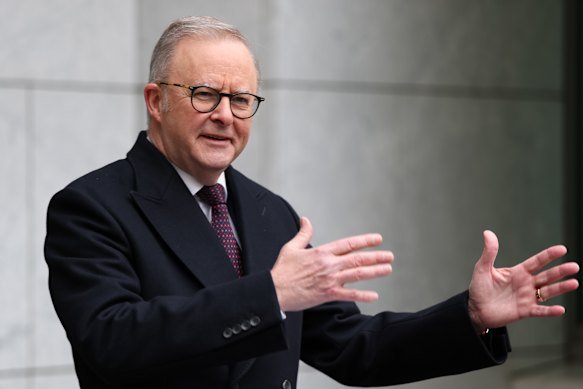
Prime Minister Anthony Albanese has backed the case for new laws to give Australians the ability to block algorithms on social media, as Labor shies away from a ban on AI glasses that covertly film unsuspecting victims.
Days after the prime minister flagged an expansion of Labor’s online safety agenda, Albanese opened a fight with US tech platforms by telling this masthead his government was “considering the best and most practical options to protect people”.
“In response to community concern about the impact of algorithms we are considering options to ensure people have greater control over what they receive on their devices,” he said on Monday.
Albanese’s comments come a day after Social Services Minister Tanya Plibersek floated a proposal to give users the ability to opt in or out of using algorithms, which curate content based on users’ online activity. She claimed algorithms were “playing a huge role” in fostering sexual violence and extremism among young people.
The government is more likely to pursue an opt-out feature among changes that will be put forward in Labor’s digital duty of care laws in October. As it shifts from spruiking its controversial budget, the government is keen to put a spotlight on tech regulation.
The moves risk a bust-up with the US, which looks dimly upon impositions on tech outfits close to the Trump administration. It may also irk voters concerned about government overreach, but Labor believes families have become so concerned about online safety that their tough measures will be backed ahead of a UN trip in which Albanese will talk up Australia’s tech policies.
Independent senator David Pocock backed Labor’s move but said the algorithm “should be OFF by default and people have to choose to opt-IN”.
This week, sexual consent campaigner Chanel Contos will make the case against algorithms at the National Press Club.
Also on Monday, Labor announced consultation on the government’s plan to modernise Australia’s privacy protections.
But Attorney-General Michelle Rowland said a ban on controversial AI glasses was not being considered, even as Privacy Commissioner Carly Kind said all options should be on the table to manage the rollout of the increasingly accessible surveillance devices.
“We see really unprecedented negative public reaction to these new technologies, and with great reason. I share lots of those concerns,” Kind told the ABC.
She said updating the Privacy Act might not be the best way to introduce a ban, but urged the government to consider its options.
“The intention should absolutely be to meet the moment when it comes to public concern around these new technologies,” she said.
Rowland said at a press conference in Canberra on Monday that the government did not want to play “whack-a-mole” with emerging technologies by banning AI glasses.
Labor’s proposed changes include a new “fair and reasonable test” to stop tech giants from harvesting more data than they need, and a “right to erasure” that would allow consumers to request platforms destroy their personal data.
The proposed laws also include stronger standards for consent by cracking down on hidden terms and “take-it-or-leave-it conditions” that allow platforms to exploit user data, and requiring explicit permission for businesses to buy and trade Australians’ personal information, including shopping habits or location data.
Meanwhile, Rowland said it would be up to public swimming pools, childcare centres and small businesses to consider whether they wanted to restrict the use of smart glasses on their premises.
The Coalition and Greens criticised the government response, which Rowland billed as “the toughest and most digital-compliant privacy reforms in this generation”, for failing to tackle the issue of AI glasses as cheap versions fly off the shelves at Kmart. Advocates have sounded the alarm about how much easier the devices – dubbed “pervert glasses” by American talkshow host Jimmy Kimmel – make it to covertly record others. Earlier this month, Rowland demanded the privacy commissioner urgently intervene to protect women and children.
“I acknowledge that there are deep concerns about [AI glasses]. But the notion that this is somehow a quick and uncomplex mechanism to impose an import ban is not correct,” Rowland told reporters.
“An import ban is a matter that would have consequences across government, including across trade, foreign affairs, and other potential legal obligations that can apply internationally.”
Rowland commended Brisbane City Council for banning AI glasses at its public pools, and urged other local governments to consider doing the same at council-run locations such as childcare centres.
Greens digital rights spokesman David Shoebridge said the measures announced on Monday went some way to dragging Australia’s privacy laws into the 21st century, but that there were gaping holes in the regulation of AI glasses.
“There is still no requirement for a prominent light, a recognisable sound, or any outward sign that a pair of glasses is recording or searching online about people the wearer is seeing,” the senator said.
Shadow attorney-general Michaelia Cash said the Coalition was “particularly concerned that this legislation does nothing to address the use of smart glasses”.
Cut through the noise of federal politics with news, views and expert analysis. Subscribers can sign up to our weekly Inside Politics newsletter.
From our partners
Read the full article here