


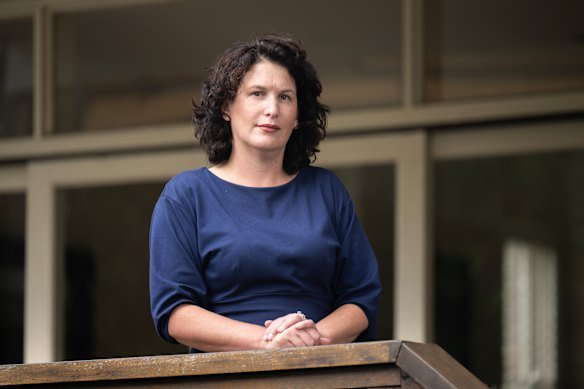
In a week’s time, Melissa Donnelly will take over as secretary of the Australian Council of Trade Unions, replacing Sally McManus who has served in the position for a decade.
Fitz: Ms Donnelly, I do want to talk about the ACTU, AI, ALP, and the CFMEU – WTAF? – but for the moment let’s put the “you” in ACTU, and explore your background. What led you to this extraordinary position?
MD: Yeah, sure. So I was born and grew up in north-west Sydney and still live in Sydney. I’m the fourth of five children, and from an early age our parents instilled values in us about fairness and that you stand up for other people, and you stand up for each other.
Fitz: And the first union you joined?
MD: My first job was as a shop assistant at Target, and I joined the Shop, Distributive and Allied Employees’ Association. I went on after school to do law at Macquarie University and at that time, WorkChoices legislation was being introduced, which took away workers’ rights, removed unfair dismissal protection, cut people’s take-home pay, and that really galvanised me to get more involved in the union movement. And as a young lawyer, I was involved in court cases against the Howard government, which banned public servants from participating in rallies against those laws.
Fitz: I know you then went on to lead the Community and Public Sector Union, at a time of declining union membership overall. Yet membership in your union surged. What did you do to make it surge?
MD: In the CPSU, we have been undertaking a lot of activities to drive our growth. Some of that has been just about making the case in the public domain around the importance of public sector jobs. But I think the most important thing is for union members to feel empowered in the workplace and for unions to be working to deliver the outcomes that workers want to see. People join the union movement when they can see improvements in their working conditions and their rights at work.
Fitz: In terms of getting this big gig, what was the process?
MD: I was approached by a range of people and encouraged to put my hand up. In some ways, I was a bit nervous, Peter. I do have two young kids, and so I was a bit nervous about managing the huge responsibility of leading the union movement, alongside my family responsibilities.
Fitz: I’m glad you raised that subject because I would not have dared. When I interviewed Sally McManus, she said flat-out “I have no partner, bar two million union members”. But if I had asked “how are you going to fit in this role with being a wife and the mother of two young children”, I accept it would be quite legitimate for you to roll your eyes and say “You bloody well wouldn’t ask that question of a man, you ignorant git!” On the other hand, you have raised it, and you’ve also come to this position on the back of having demonstrably improved conditions for working mothers, and working fathers. So, can you expand . . ?
MD: Yes. The average union member in Australia is a woman in her 40s who’s likely to be a working mum, and that’s what I am as well. And I manage my union and work responsibilities alongside 15 WhatsApp chats about netball training and football training and when Book Week is. I think that’s reality for lots of workers. And I think that people actually respond and respect that. And I have been given a lot of encouragement across the movement to step up, and people I think are excited to see working parents stepping up into all sorts of roles across leadership in the country.
Fitz: How did your own kids react to the prospect of you getting this job?
MD: My 12-year-old daughter who keenly follows the news pulled me aside and said to me, “Mum, lots of people think you can do it. I think you can do it. I think you should.” And my eight-year-old son, who has not as much engagement with the world of my job, he said to me “Why are you worried?” And I said, “Well, I’m worried because people want me to do Sally McManus’s job.” He then said to me, “Is she a wrestler?”
Fitz: Boom-Boom! Confusing her with the execrable Vince McMahon, the infamous wrestling promoter in the United States …?
MD: Yes. I said “No, it’s the head of the whole union movement”. He said, “Oh God, that does sound hard.” And he said, “Well, if you’re scared, one time I went to a water park and I got to the top of the highest waterslide, and I was scared, but I went down anyway. And after that, I felt really brave. So I think you should just go do it, and you’ll be brave and you’ll be fine.”
Fitz: You’ll be reporting in to said waterslide on Monday morning August 31. What will be the first thing on your agenda, at 9am?
MD: Look, the first thing I’m going to have to do on my first morning is put my kids’ artwork up on my walls. Otherwise, I’ll be in a lot of trouble. Then in the first month, I’ll be getting out and meeting with unions around the country and union members around the country and talking to them about the issues that matter. One of my first commitments will be convening and organising the upcoming conference on the Gold Coast for the movement.
Fitz: One of your issues, surely, is your image. Mostly, when unions make headlines, the shtick is you’re being greedy bastards again?
MD: Sometimes. But in my experience, with over 20 years in the union movement, people don’t take industrial action or don’t go on strike or undertake a stoppage unless they have to – fighting for an important condition or fighting for a fair wage rise.
Fitz: Why has union membership slid away? In the days of Bob Hawke running the show, he cracked 50 per cent of workers being union members. You’re inheriting just over 13 per cent.
MD: There are a whole range of reasons, including how the workplace relations system operates and so on. Most pleasingly though, in the last couple of years, we’ve actually seen greater engagement with particularly young workers – facing cost-of-living pressures and job insecurities – joining unions. So there are absolutely green shoots there.
Fitz: One of the challenges they, and all of us, are facing is the advent of AI gobbling up jobs. Which jobs do you think are most in danger of disappearing, and what do you intend to do about it?
MD: Hard to predict at the moment, Peter. There is a range of impacts of AI, and we’re only as a country, as a society, really starting to understand them. But workers are worried about what it means for their jobs, and particularly worried about what it means for their kids’ jobs. But in this space, we need really strong workers’ rights. We need consultation provisions. We need protections for workers and job security, and that will be a big part of their union movement’s agenda moving forward. [The impact will be huge] but as a society, we don’t have to accept all of these things. We should have a national discussion about what it means for people’s jobs, what it means for people’s lives, and set guardrails around what we’re prepared to accept.
Fitz: When you look at the Albanese government right now, what do you see? “They’re going well”,“They can do much better”, or “We’re out, brothers and sisters!”
MD: We’ve seen strong workplace rights enacted by the government, and the union movement has welcomed those. I think, in the area of cost of living pressures, the advent of AI and changes to people’s workplaces, there absolutely needs more to be done. I have a strong track record in my previous role of working with the government when we agreed, and also on important issues disagreeing.
Fitz: Is there somewhere, some area right now where you fiercely disagree with the Albanese government, which right now is being bitterly criticised over the changes to CGT, negative gearing and all the rest?
MD: There’s no particular issue right now where we bitterly disagree. I think on things like AI, where people are fundamentally worried about the impact on their jobs and the future of their jobs, we need a stronger and more proactive agenda and that’s going to be one of the things that the movement will be working on.
Fitz: What about bitter disagreements with the Coalition and One Nation?
MD: We’ve seen from both the Coalition and One Nation ongoing attacks on workers and their rights. Pauline Hanson likes to pretend she’s for the average Australian, but her track record is actually voting against workers’ rights at every possible occasion, and her policies – as with the policies of the Coalition – would make it worse. Fundamentally, we do disagree with both One Nation and the Coalition.
Fitz: I’ve been shocked and I think a lot of people have been by the fallout from the CFMEU saga – with allegations, some proven, of serious corruption and heavyweight thugs infiltrating work sites – which has seriously damaged the reputation of the union movement. What’s your position on that?
MD: There is no room in the union movement for corruption or violence, and the union movement as a whole has been very firm on that, and that will continue under my leadership.
Fitz: Business groups increasingly argue that Australia has a productivity problem and cannot sustain higher wages without productivity growth. How do you get wages to rise, and how do businesses stay competitive when they do rise?
MD: One of the issues we currently have in this debate about productivity is that Australian workers haven’t got their fair share of productivity gains that have been realised over the last decade. So, if we want to have an honest and direct conversation about this, we have to talk about what workers’ share of those productivity gains are because what we have seen is profits being sky-high and supercharged, but wages held back. And workers legitimately want to see their wages rise with the cost of living pressures that they face every time they go to Coles or Woolies.
Fitz: No-one worth their salt as an ACTU secretary gets by without bitter clashes. What bitter clashes do you see ahead?
MD: I think that that’s a good question. I think cost of living pressures; issues like housing; dealing with job security and the threat of AI to job security. Sometimes that means you do end up in bitter clashes with business or others who disagree with it.
Fitz: Who’s on your Mount Rushmore of predecessors in your role, the ones you look up to, the ones showing off their bees-knees ’neath their ants-pants?
MD: Obviously, and unsurprisingly, Sally McManus has been an extraordinary leader and secretary of the ACTU, I absolutely respect, admire and look up to her. The other secretary who was quite formative in my involvement in the union movement was Greg Combet, who was secretary when I first started out in the union movement. The determination he showed in the work he did back and fighting back against WorkChoices was really striking.
Fitz: Thank you for your time, and allow me to say, good luck. Head down that water slide, hold your nose, and don’t forget to put on a nosepeg, put your earbuds in.
MD: [Laughing.] OK, excellent! Thank you.
Get a weekly wrap of views that will challenge, champion and inform your own. Sign up for our Opinion newsletter.
From our partners
Read the full article here