






When I spot the sea snake, it’s kinking its way around the toes of my right foot on the wet floor of the Zodiac. I place a warning hand on the arm of my fellow passenger, Kristen, sitting to my left, who utters a small gasp. In a quick series of escalating reactions, her partner, Stew, springs, catlike, onto the bow of our inflatable boat (he clearly knows something we don’t), while Janelle, sitting opposite, who’s also now seen it, does a convincing imitation of a mid-century matron spying a mouse in her kitchen and screams.
The snake has now secreted itself behind a rucksack under the bow. Rod, our guide, gently moves this aside, bringing it back out into the open. As his colleague, Sarah, reaches for her iPhone to take a picture, he manages to expertly manoeuvre it onto an oar. It’s a couple of feet long with striking silver and black bands, a yellow snout and a paddle-shaped tail. “Ah, yes,” says Rod, peering intently at the creature. “A yellow-lipped sea krait.”
As he lowers it gently into the water outside the Zodiac, I ask him if it’s venomous. “Oh, yes,” he says, “it could kill you. But its mouth is small. To do damage, it would have to bite you where the skin is thin – like the webbing between your fingers.” Or toes, perhaps.
Rod’s walkie-talkie crackles into life. It’s our expedition leader, Cara, who’s watching us some way off in a second Zodiac, oblivious to the unfolding drama but alerting Rod that we’re drifting towards a reef and need to get moving. He quickly resumes his position at the tiller and soon we’re off again, bouncing across the waves, all of us invigorated by the adrenaline surge.
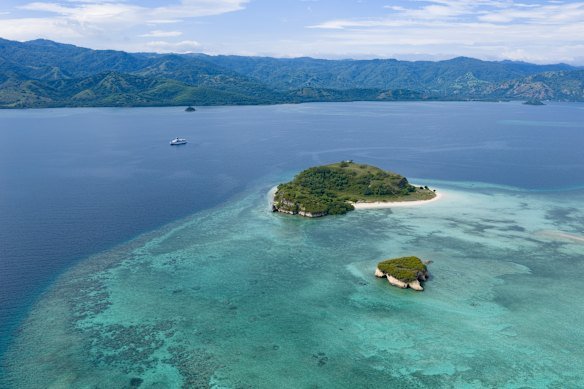
Welcome to the world of small-group expedition cruising. We are spending 11 days and 10 nights sailing through Indonesia’s Lesser Sunda Islands – from Benoa in Bali to Dili in Timor-Leste – aboard the Paspaley Pearl, a 54-metre, purpose-built motor-yacht. The wok-shaped archipelago, which stretches east from Java, includes Lombok, Sumbawa, the islands of Komodo, Rinca and Padar (the main parts of Komodo National Park), Flores, Lembata and Alor.
It occurs to me, in the harried days before departure, that this is a long time to spend, inescapably afloat, in the company of strangers. But then something seems to happen with the simple act of hanging up my clothes and pushing my suitcase under the bed. Surrender. To the daily rhythm of on-board life; to the organisation and knowledge of our expedition leader, Cara, and her three naturalist guides, Rod, Sarah and Danny; and to the expertise of 22 crew members who’ll soon know all of us by our first names and proceed to take care of us like surrogate parents. They’ll determine when we eat and what, where we go and when, even what we wear, and, in the case of mishap, the remedy.
The Pearl accommodates a maximum of 30 passengers, a fact that fosters a special feeling of fellowship as well as semaphoring the company’s commitment to engineering an experience that feels intimate, customised and, yes, expensive. “The small-ship environment typically caters to 100 to 200 passengers,” says Pearl Expeditions’ Sarina Bratton, who conceived the model. “We’ve created something different, something that feels more like home.”
And what a home it is. My “stateroom” comprises a double bed, two wardrobes and a desk, plus a private balcony and a spacious, Aesop-populated bathroom with a large, starboard-facing window in the shower. The Pearl has three decks, two restaurants (one al fresco, one indoor) and three bars. There’s something seductively Golden Age about the decor – luxe, tactile fabrics in tobacco, cream and chocolate.
“On-shore, we’ve spent a lot of time scouting locations and building relationships,” says Bratton. “We go to places where other travellers don’t go because they just don’t have our access.”
By day, we snorkel, swim, hike and visit remote communities and, by night, we return to the serenity of the ship for a hot shower and a recap of the day’s events on her al fresco Horizon Deck. At 6.30pm, we file downstairs, into her retro dream of a dining room on the Ocean Deck, for an exquisite, three-course meal prepared by chefs Amy and Teo in their nearby galley, a universe of polished stainless steel and borderline-pathological order.
On this trip, we’re only nine guests and, by the end of our first dinner on board – Black Angus tenderloin with mustard greens and tallow salsa followed by a chocolate tart – the mood is convivial. A collective surrender has begun.
Sarah tells us that we’re travelling through a region called Wallacea. “There’s an extraordinarily high rate of endemism here – fauna that can’t be found anywhere else on the planet,” she says. “That’s because this island chain was never connected to either the paleocontinent of Sunda [mainland south-east Asia] or of Sahul [greater Australia], which started drifting towards each other 25 million years ago. Zoologically speaking, these islands were a blank slate.”
With deepwater straits enforcing the islands’ isolation, the animals who started to colonise them mostly arrived by accident. “Like the Komodo dragon, which actually originated in Australia,” she says. “Before it went extinct there about 50,000 years ago, it’s likely that a group of them got swept out to sea somehow. Not only can they go for long periods without eating, they can also swim and, hanging on to each other to form a living raft, they can cross great distances. They washed up here about 1 million years ago.”
Another animal that exists only here is the South Sulawesi spectral tarsier, she adds, showing us a slide of a tiny primate with dinner-plate eyes and knobbly, prehensile fingers.
We’ll be hearing the name of Alfred Russel Wallace, for whom Wallacea is named, a lot on this trip. That’s because for naturalists, this gentle, bespectacled, 19th-century English explorer and anthropologist, who was a mate of Charles Darwin (despite lacking Darwin’s money, connections and general megawattage), is one of the most interesting men that history forgot.
Indonesia was to Wallace what the Galapagos Islands were to Darwin. He spent eight years here in the 1850s, meticulously documenting the region’s fauna, and alighted upon his own theory of evolution while Darwin, a notorious perfectionist, was still umming and ahhing about going public with his. In 1858, the friends agreed to publish their joint discovery in a paper known as the Darwin-Wallace Theory. (How Wallace’s star subsequently fell as Darwin’s rose is a riveting topic for another time; it suffices to say that he has a passionate band of supporters in the UK who are intent on reinstating him in the public consciousness.)
On April 5, 1815, Mount Tambora, on the island of Sumbawa, began a five-day eruption that would become the most powerful ever recorded. Eleven thousand people died in the immediate pyroclastic flows, but the repercussions, which quickly became global due to the massive volume of volcanic ash circulating in the earth’s stratosphere, would be felt for years. In the northern hemisphere, temperatures plummeted as a dark, volcanic winter took hold.
Early the following year, three young English writers, Lord Byron, Percy Bysshe Shelley and his lover and soon-to-be wife, Mary Wollstonecraft Godwin, found themselves confined to their rented villa beside Lake Geneva by relentless thunderstorms caused by Tambora’s fallout. They decided to stave off boredom by writing ghost stories and, in short order, Mary, who was only 18, started work on what would become one of the most famous novels ever written, Frankenstein.
There’s no murderous, motherless monster here, mercifully, but Mount Tambora still stands baleful and unrepentant, a hulking presence overlooking Sumbawa’s Saleh Bay. It’s peak wet season and, although the day is warm, the sky is low and grey, the water a gunmetal mirror. The mood is expectant: we’re hoping for a close encounter with another type of creature.

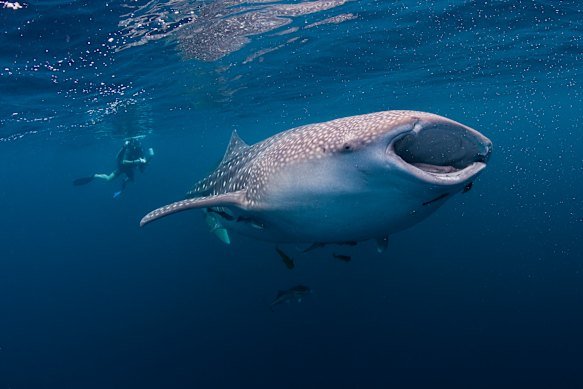
Whale sharks are the largest fish in the ocean, docile filter-feeders that can process up to 6000 litres of water hourly through their wide, letterbox mouths. They can grow to 18 metres in length and live for 130 years, each one bearing its own unique constellation of white spots. But in order to swim with them, we’re reliant on the movements of local fishermen who use halogen lamps to attract the schooling fish which, in turn, attract the sharks. We’re gutted when Cara tells us that the fishermen, worried about the unpredictability of the weather, won’t be venturing out today. Worse still, we have a dragon problem: Komodo National Park, after a fatal accident in high seas off Padar Island last month, is closed to visitors.
We’re rapidly learning a key axiom of expedition travel: expect the unexpected. Summoning the stoicism of American rock climber (and Patagonia founder) Yvon Chouinard, who believes that adventure happens when everything goes wrong, we head out on a Zodiac excursion.
We’re wading in warm, knee-high water, Sarah explaining how important mangroves, and the bat colonies that inhabit them, are to the region’s extraordinary biodiversity, when we hear a noise, faint at first, like the sighing of wind moving through trees. As it becomes more insistent, we turn around to see a bright, shimmering curtain of water sweeping across the bay towards us. Suddenly, we’re enveloped in rain, drumming, drenching and absolute, fat, silver droplets bouncing off the hammered surface of the water all around us. Just as quickly as it arrived, the deluge, elemental and unstoppable, moves on. Chris, who lives in northern England and is no stranger to sudden downpours, looks stunned. Even in this universe of wetness, I can see that his eyes are moist: “I feel quite emotional,” he says.
Later, as the Pearl slides past the islands of Komodo, Rinka and Padar – home to the elusive, giant monitor lizards – we gather on the Horizon Deck and scour their misty, green flanks for signs of lumbering, reptilian life, but they’re as dark and ungiving as Mordor.
As we sail east, the weather starts to lift, the sun making longer appearances and, lifting its face to the sky, the sea becomes opalescent. The relief is palpable: we’re hovering above a kind of sub-aquatic nirvana unparalleled anywhere else on the globe. Nearly 40 per cent of the world’s reefs, along with 76 per cent of its coral species and more than 2000 species of reef fish, live in the region.
Thanks to immense currents, the world’s largest movement of water happens here. Called the Indonesian Throughflow, 15 sverdrups of water (that’s 15 million cubic metres per second) flow south-west from the Pacific into the Indian Ocean through Indonesia’s deep-water channels. (Warmer and less salty, the Pacific actually “stands” at least 20 centimetres higher.) “In the resulting underwater chaos, cold water and nutrients are churned upwards from the seabed in a phenomenon called ‘upwelling’,” explains Sarah, “which delivers an abundance of food to large organisms and small, including coral. The cool water also protects the reefs from heat stress.”

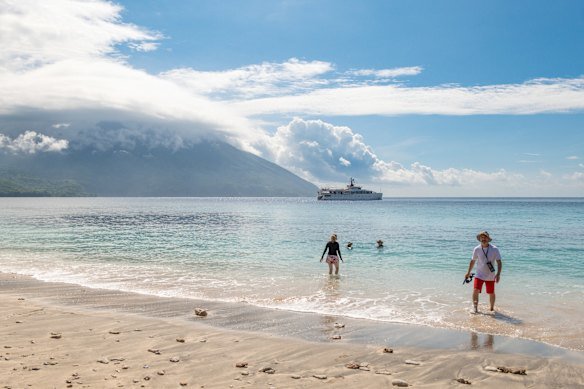
With underwater visibility improving, experienced snorkellers are invited to tumble backwards, with Cousteau-like elan, out of the Zodiac into the Suva Sea; others of us (OK, me) enter from the beach which, with fins on, necessitates a significantly less stellar backwards shuffle. The swim out to a fringing reef 100 metres or so off Lembata Island is its own reward, though: a sandy floor segues into tapestry-coloured cities of coral, complete with darting, sometimes curious denizens, which, as we swim further out, to gin-clear depths of 25 to 30 metres, morph into sparser townships patrolled by bigger fish.
There’s a cast of characters to rival that of any Pixar movie: the butterfly fish with its distinctive false eye designed to befuddle predators; the parrot fish with its hard, beaky teeth, a super-eater and -excreter that smells so bad it must create a mucus bubble in which to sleep safely; and, of course, the clown fish that keeps house for the carnivorous bubble-tip anemone, in return for which it gets to lay its eggs safely among its dusky-pink tentacles. There are elongated trumpet fish, neon-blue damsel fish and the odd flamboyantly costumed lion fish (“Look, but don’t touch,” warns Cara).
But what’s that constant crackling we can hear underwater, like the sound of bacon frying in a pan? Danny, who bears more than a passing resemblance to Robert Irwin in looks and enthusiasm, says it’s the work of one of his favourite marine animals: the pistol shrimp. Barely four centimetres in length, it has one large claw in which it manufactures a special “cavitation bubble” that it dispatches with such force – that’s the noise we can hear – it serves as a bullet, stunning nearby prey.
Encouraged by Danny, who floats beside him in a Zodiac, Andrew, a sustainability student from Sydney, ventures further out still. He’s still buzzing at lunchtime: “It’s an incredible privilege to be so exposed out there but to feel so safe, too,” he says.
Early one morning, we come to the port of Maumere on Flores, an island named by its Portuguese occupiers in the 16th century for its lush, tropical appearance. Soon, we’re in a minibus rattling up into the green hills of Sikka Regency. Reaching the village of Nita, we pull up at Lepo Lorun, a clearing of traditional dwellings with thatched roofs, bamboo floors and wooden ladders. Clay pots bubble over small fires; the smell of woodsmoke hangs in the air.
We’ve landed, it seems, in some sort of bucolic paradise inhabited solely by women. Wearing traditional utang (sarongs) and brightly coloured blouses, their thick, black hair coiled into high buns, they devote their days to quiet industry: the weaving of tenun ikat, the traditional fabrics that accompany them at every significant stage of their life’s journey – birth, marriage, death – each piece as individual as a thumbprint.
At the centre of the hive is queen bee Alfonsa Horeng, who started this cooperative 23 years ago as a young university graduate determined to rescue a precarious craft from oblivion. “When a weaver starts to weave,” she explains, “her ancestors are with her, guiding her. Each piece of cloth holds many hundreds of years of tradition. I wanted to develop what we have without taking the traditional values out of the way.”
The women grow the cotton here as well as the other plants they use to make the dyes that colour the threads. They harvest the cotton – tufted, white clouds of it teased from husky bolls – bat it with a stick to fluff up the fibre, spin it into thread, tie and dye the thread and then, sitting on the floor at backstrap looms for six or seven hours a day, weave the cloth. The work is slow and painstaking, some pieces taking many months to complete. The mastery required is absolute, a truth you can really only comprehend when you understand this fact: the pattern of each cloth is dyed into each individual thread, warp and weft, before the weaving actually begins. Each region, explains Alfonsa, has its trademark design motifs and colours. Here, they are lizards, pineapple flowers and stars in indigo and brown.
Over a mid-morning snack of coffee, banana fritters, coconut and cassava with a chilli sauce that’s hot enough to wake the dead, Alfonsa shows us a building that’s under construction nearby: it will be a school where grandmothers, mothers and aunts will teach their skills to the next generation. “We are a centre of excellence for international scholars of tenun ikat,” she tells us proudly.
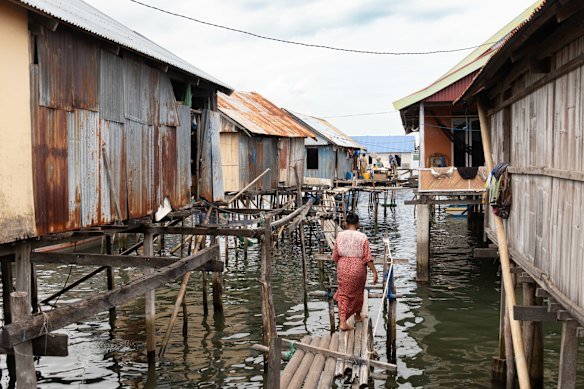
After lunch, we visit Wuring, a fishing village to the north. Here, the Muslim Bugis tribe, who came here 300-odd years ago from South Sulawesi, live in wooden houses on stilts with corrugated-iron roofs, the walls painted, like their long phinisi boats floating in the bay, faded turquoise, pink, yellow and red.
Every morning, the fishermen sail out into the Flores Sea to catch sea cucumber, sardines, squid and octopus using traditional handlines, nets and traps; back in the 17th century, though, the Bugis had so fearsome a reputation as pirates, it’s believed that English sailors coined the word “bogeymen” to describe them.
Our welcome couldn’t be warmer. Hijab-wearing women, sitting behind tables of drying fish and nests of chillies, bob their heads and, smiling demurely, wish us, “Selamat siang” (“Good afternoon”). Their children, wearing lurid, cartoon-character T-shirts that have seen better days, crowd around us, clasping our hands and touching them to their foreheads in an antique gesture of respect before posing for photographs like 21st-century Insta pros – heads tilted, smiles broad, one hand in a peace sign.
“Some visitors find the under-development of life here confronting,” says Danny as we navigate the rickety, bamboo walkways that often look too fragile to support heavy visitors. Outside one house, a man is sanding the blades of a boat’s propeller while, just below us, in the water, another is steering a makeshift vessel – a large polystyrene rectangle covered in a tarpaulin – with a paddle. Beside him is a young woman in a hijab, her hand steadying a large crate brimming with freshly caught fish. They look up at us and smile.
There’s no government sanitation here and, as a result, the water under each dwelling is a sea of household garbage, an eyesore that only becomes more apparent at low tide. But if you lift your gaze, you can see, unexpectedly beautiful, the golden cupola of a small turquoise mosque glinting in the afternoon sunlight. It might be the only floating mosque in the world.
At Alor, the last island in the Sunda chain, we dock at Kalabahi, a port located at the end of a long, finger-like inlet teeming with jellyfish. Thirteen kilometres away, in the mountains, lies the secluded village of Takpala.
The setting is Tolkienesque: a cluster of traditional lopo houses with thatched, pyramid-shaped roofs housing four bamboo storeys: the first for living in, the second for cooking and sleeping in, the third for food storage and the fourth for the keeping of valuables; chief among these are bronze kettledrums called moko.
When we arrive, the women are wearing traditional, strapless ikat dresses in dark red and dark blue and carrying square, handwoven shoulder bags. They are barefoot, wearing just two or three thick brass circlets around each ankle. Two wiry men and a young boy, perhaps seven or eight years old, wearing head-dresses and carrying bows and arrows, perform a deep bow and begin a welcome Cakalele dance to the accompaniment of a drum. Then the women, who’ve arranged themselves in an interlocking circle around a stone altar decorated with three moko, begin to sing, a melodic call and response, the stamping of their feet and the jangle of their anklets marking the beat.
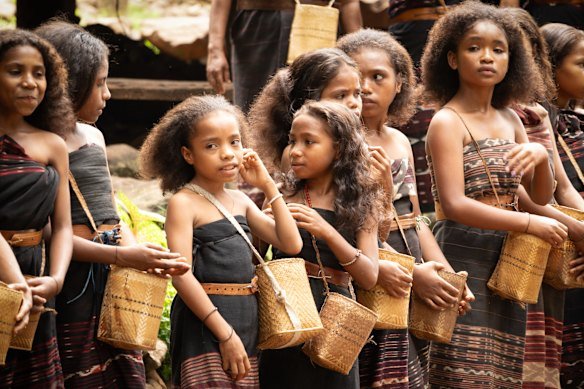
The chief joins the circle for a Lego-Lego dance of unity as the women begin to move anticlockwise in a series of rhythmic steps. One of them walks over to me and, with an infinitely gentle hand on my elbow, invites me to join them. As the raw harmony of their voices rises into the air, the dance gathers momentum and then I’m moving, too, the women on either side of me tightening their grip around my waist so I don’t stumble. And then we are all in the circle, dancing and laughing.
Later, I watch two young women standing by the altar remove iPhones from their woven bags and begin to scroll. There’s an instant of visual dissonance before I remember something I read before our journey began – in Elizabeth Pisani’s 2014 travelogue, Indonesia, Etc: 64 million Indonesians use Facebook, she noted (at time of writing). Eighty million live without electricity. One hundred and ten million live on less than $US2 a day. Yet Jakarta, she added, issues more tweets in a single day than any other city on the globe. This last fact is still true today.
John Riady, an Indonesian businessman and editor of the Jakarta Globe, has observed that, despite the fact that one in 29 people on the globe is Indonesian, the country is still the most invisible in the world. Perhaps it’s her atomisation – her 17,500 islands, 1300 ethnic groups and 700 living indigenous languages – that makes her so unknowable.
For us, Pearl Expeditions has brought a string of little-known islands into sharp, technicolour focus. There have been disappointments – we came in search of sharks and dragons and found none – but there have also been moments of transcendence: climbing into bed at night, doors open to the warm air and the sound of the Pearl’s prow slicing through the water, and being rocked to sleep. Looking over my balcony one afternoon to find two dolphins arcing through the sapphire waves below me, so close I can hear them breathe. Going for a hike on the tiny island of Matagateh and realising that we’re actually walking on ancient outcrops of coral, the vivid carnelian of organ-pipe skeleton still so noticeable in the green scrub – a reminder that this was seabed until a violent, geological cataclysm of the late Pleistocene period thrust it skywards.
It’s unlikely Renaissance-era philosopher Michel de Montaigne was talking about small-group, boutique cruising when he suggested it’s the journey, not the destination, that truly matters – but he could’ve been. He might’ve added that there’s something powerfully connecting in swapping impressions each night, over excellent food, with fellow travellers who are strangers no more. Together, we came, we saw and, each step of the way, we marvelled.
The writer travelled as a guest of Pearl Expeditions, which operates tours in Indonesia, Papua New Guinea, Borneo, The Kimberley and Arnhem Land ($14,995-$35,995 per person)
Get the best of Good Weekend delivered to your inbox every Saturday morning. Sign up for our newsletter.
Read more from Good Weekend:
Read the full article here