


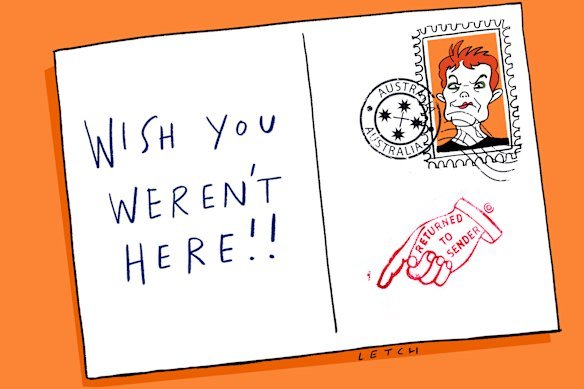
Having spent 36 years as a social science teacher, I thought I had a reasonable grasp of migration issues. Intrastate, interstate, net and gross migration, various classes of visas, the Pacific Australia Labour Mobility system and even the Colombo Plan found their way into my classrooms. Now I feel I must apologise to my students for having got it all wrong, as One Nation has clarified the issue to the point where I am totally confused (“Five days on, Hanson still finds it hard to explain migration policy”, August 28). On the same subject, Waleed Aly is absolutely correct when he says “the devil has convinced us the details don’t matter” (“One Nation policy all about the vibe”, August 28). I can’t wait for further enlightening policy announcements from “our future prime minister”. Peter Cooper-Southam, Frenchs Forest
Like Waleed Aly, I have been fascinated by the Goldilocks figure of 130,000 net migrants. Assuming some arrive with families of three or four, does this mean they have calculated that only about 60,000 new migrants will be available to fill vacancies in high-demand sectors such as aged care, hospitality and healthcare, given that not all dependents in family units take part in the workforce? The reason Pauline Hanson has not yet been able to arrive at a scientifically defensible migration figure is that population planning and labour demand require deep analysis, projections, assumptions and, more importantly, data gathered from the ground up. Simply plucking numbers from the air as part of a bidding war for votes may attract support because of the “vibe”, but it will not produce workable solutions for the nation. Cultural grievances may be part of the conversation, but they cannot be the sole lens through which complex policy problems are viewed, however tempting that may be. Manbir Singh Kohli, Pemulwuy
Waleed Aly demonstrates very clearly that One Nation’s policy, whatever it is, is a circular argument, designed to make people feel rather than think. This is not news, just a clarification. It’s been obvious for some time that no one in One Nation seems to understand its own policy position, let alone be able to explain it. David Farley tried to calm the waters and explain that we still need migrants in his electorate. George Christensen doesn’t want the cat let out of the bag. Hanson can’t explain, because it can’t be explained. Barnaby Joyce is all about nonsense policy, presented as common sense. The figures in this alleged policy cannot be defined, capped or clarified because that is not the point. The point is that Hanson presents a nebulous group of people to blame for all our woes – “migrants” – regardless of why they arrive or how long they intend to stay. Geoff Nilon, Mascot
Remember when the Reverend Fred Nile was receiving undue coverage with his evangelical rants? Pauline Hanson is pretty much in the same boat, only Fred did no harm and made us laugh with his prayers for rain on the eve of the Mardi Gras. Hanson, on the other hand, has the potential to do considerable harm with her xenophobia and her far right-wing leanings. Fortunately, Herald correspondents this week have put her blusters into true perspective. Ray Alexander, Moss Vale
For someone in the political arena for over 30 years; a leader who put immigration front and centre of her party’s manifesto, Pauline Hanson has consistently and remarkably failed to master the policy basics. The so-called national conversation is fraught enough without confusing and straight-out incorrect information swamping us. Please explain, Ms Hanson. Cathryn Callaghan, Croydon
Climate denial
Mike Keene explains the problems climate change causes in ski resorts perfectly (Letters, August 28). He says: “For climate deniers, the easiest way to solve a problem is to deny it exists.” This is why we deny that world overpopulation is the No.1 problem humans face. So many other real problems stem from it. We live on a planet with finite resources, and denying it won’t help our children. Please speak up. Henry Schneebeli, Moree

Parking mad
The push to reduce apartment parking makes sense, particularly when more than 40 per cent of existing spaces sit empty overnight. Sydney’s rapid growth in apartment living has also contributed to worsening traffic congestion. As your editorial argues, the transition away from car dependency will work only if we improve public transport (“Homes can do without car parks but only if there’s great public transport”, August 28). Bikes, and particularly e-bikes, can then play an important supporting role, allowing people to cycle to and from stations and extending the reach of buses and trains. But if we want to encourage their use, we need to address where all these e-bikes are going to be parked. Sydney’s councils should collaborate to develop sensible standards for secure bike and e-bike parking at transport hubs, in apartment developments and around shopping centres. Reducing car parking is only part of the equation. If we want people to leave their cars at home, we need to make the alternatives practical and that includes giving e-bikes somewhere sensible to park. John Kempler, Rose Bay
Inner West Council will allow some developments without parking spaces. Maybe NSW needs the system that applies in Tokyo, which requires a car buyer to prove they have a parking space before they are allowed to register a car. Steven Lee, Faulconbridge
Yes to red tape
More of the same self-serving offerings from the business elites of the Business Council of Australia (“‘Consume, be silent, die’: that’s the PM’s message, say fed-up business chiefs”, August 28). Decades of neoliberalism have increased corporate profits and overly generous executive remuneration while they snatched any productivity gains for themselves and watched wages stagnate or go backwards. But that is still not enough for them. They want more profit and less red tape. On the contrary, I say more red tape to stop large companies avoiding income tax. I say more red tape so that when companies collapse, they are not a maze of shell companies specifically designed to hide the true state of affairs of the principal corporation. There would be no red tape at all if all businesses operated ethically, but they don’t. Graeme Finn, Campsie
GST hurts all
Tony Martin says raising the GST is a fairer strategy for the Reserve Bank to employ instead of rate rises for mortgage holders, spreading the pain to all (Letters, August 28). How many times do they employ this strategy, once? Or every time it’s needed? One could ask, why should those without mortgages, or those on pension, or welfare payments, et cetera, subsidise wealthy property owners who have large mortgages and who are struggling to service them? The cost of living is already rising to alarming levels and families are struggling. The GST affects almost everything we rely on to survive, and it should not be used to make life harder for all. Lynn Nadjarian, Forster
Powerhouse mystery
The back door on Powerhouse Parramatta has finally opened a crack (“Powerhouse Parramatta chief Lisa Havilah departs just weeks from opening”, August 28). It would be a travesty if the Powerhouse Ultimo tragedy does not also get an airing. In brief terms: A budget of $300 million was set in March 2023 for the so-called revitalisation of the Powerhouse Museum. A year later, the museum closed its doors and its entire collection of objects, including the priceless and fragile B&W steam engine, was carted off to that giant warehouse in Castle Hill. This year, without any legitimate public consultation, the Wran Building and the Galleria, both of them the very essence of the Powerhouse Museum, were turned into landfill. It can’t be physically confirmed, but all evidence indicates that the heritage-listed Powerhouse building itself has been gutted and is now just an empty shell. Yet to this day, the government has not corrected the myth that this project is on budget and will deliver a revitalised applied arts and sciences museum. The reopening date remains in limbo. Garry Horvai, Pennant Hills

The news today that the Parramatta Powerhouse is in chaos is not surprising. Not really since the days of Neville Wran has there been any government that has understood what heritage is. The state’s heritage is in chaos – the Harbour Bridge is rusting away and so is Cleveland House, Australia’s oldest house, in Bedford Street, near Central Station. The Ultimo Powerhouse has been demolished and its historic collection has been taken away. Heritage is something we should be proud of, but we seem only to be ashamed of it. Clive Lucas, Neutral Bay
Cashing in
Ted Bush (Letters, August 28) insinuates that US Democratic politician Nancy Pelosi is comparable with US President Donald Trump without presenting any evidence that she or her husband traded using confidential government information, whereas the correlation between White House decisions and the trading patterns of Trump and his family are well documented. Pelosi and her husband’s increase in wealth of $230 million happened over 40 years, not outside the norm for an astute share trader. Trump’s increase has been about $4 billion over two years. Stein Boddington, St Clair
Heed disasters’ lessons
Through no fault of their own, villagers and their homes are swept away by a terrifying ice avalanche (“A terrifying roar, then came the fury of the flood: How disaster unfolded in Nepal”, August 28). As UN chief Antonio Guterres has said: “The rooftops of the world are caving in.” Hard on the heels of record heatwaves and wildfires across the northern hemisphere, some of which are still burning, the warning for humanity is absolutely deafening: “Stop burning fossil fuels!” Rob Firth, Red Hill (ACT)
The folly of placing financial gain above the care for our planet has been horrifically demonstrated in Nepal. Through climate change, nature has demonstrated its power and exposed life’s fragility and our hubris. And not just this event but catastrophic and record-breaking bushfires, floods, heatwaves and severe weather events around the world. When will governments react comprehensively and decisively to climate change, as they do to its resultant disasters? Stop opening new gas and coal mines, stop the diesel subsidy, tax the gas giants, introduce a climate trigger, expand the transmission network, promote clean energy exports, financially support EV purchases and infrastructure and improve home thermal efficiency. A major duty of our government is to protect its citizens. So do it! Rowan Godwin, Rozelle

Europe’s on fire. Glaciers are collapsing in the Himalayas. Grass is growing in Antartica. Hey Tony, Matt and Pauline, tell us about the “climate hoax” again, will you? Phil Bradshaw, Naremburn
Degrees of knowledge
A friend once admitted that despite having two degrees in economics, he still didn’t understand it. He said it was all based on assumptions, and to highlight that impracticality, he told a joke that economists tell about themselves. Three people are marooned on a desert island: an engineer, a doctor and an economist. They have one can of baked beans between them. The engineer says, “Let’s smash it against that rock.” The doctor says, “Let’s sharpen that stick on that rock and pierce it.” The economist says, “Assume we have a can opener.” Malcolm McEwen, North Turramurra
Name games
In the 1960s, our geography teacher taught us to remember the names of the Great Lakes of North America by the words “Sydney Morning Herald Early Order”. How dare Mr Trump mess that up (“Trump orders Lake Ontario to be renamed ‘Lake America’ amid Canada trade war”, August 27)? Margaret Swinbourne, Drummoyne
I don’t understand why Donald Trump hasn’t changed the name of New Mexico yet (Letters, August 28). Brendan Jones, Annandale
I can’t wait for Trump to rename Earth. Maybe “Planet America”? Kevin Farrell, Beelbangera
Read the full article here