

The soldiers threw Rokeiya Begum’s baby into the fire.
“I was crying loudly for my child. As I was crying, they threatened to shoot me. They were pulling me to the village.”
It was August 30, 2017, and soldiers from the Myanmar military had set the village of Tula Toli alight.
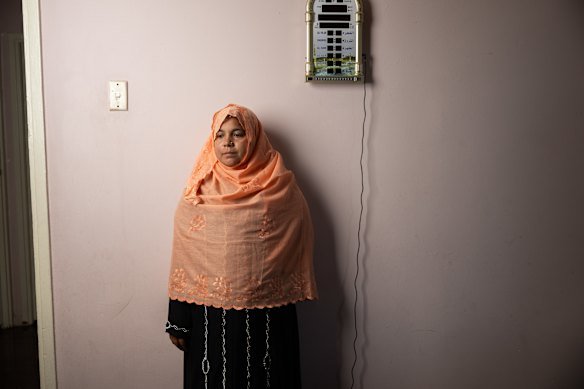
Nine years later, Begum, a Rohingya refugee, tells her story from a worker’s cottage in Brisbane’s southern suburbs, where she has been living since arriving in Australia on a humanitarian visa in January.
On that day in Tula Toli, down by the river, Begum said the soldiers picked the men and teenage boys and killed them – shooting them and stabbing them, some of them with long, pointed wooden farming tools called hossa flails.
“Then they would pull them away and make a pile of the dead bodies along the river. As far as I could see, I saw all the dead bodies,” Begum said.
The soldiers pushed the women towards the burning village, and ripped Begum’s child from her arms. “They burned my child alive,” she said.
Mohammed Sadek was 18 months old.
As she cried for her dying child, the soldiers pushed Begum and other women into a hut. Without going into further detail, she said the soldiers “did whatever they wanted to do”.
Then they set the hut on fire too.

The brutality was part of “clearing operations” conducted by Myanmar’s forces in the Rakhine State, on the nation’s western edge bordering Bangladesh.
The aim was to push the Rohingya – an ethnic Muslim minority in a largely Buddhist nation – out.
Conservative estimates say more than 7000 Rohingya were killed in the region in August 2017 alone, with more than 700,000 forced to flee.
As a result of the 2017 operations, and other violence dating back to 1982, more than a million Rohingya have crossed the wide and shallow Naf River into Bangladesh, where they now live in the largest refugee camps in the world.
It was in this river that Saddam Hossain found himself late one night at the height of the attacks.

Nine years later, Hossain sits on the couch in Begum’s house recounting his story.
Along with his wife Rashida Begum and their one-year-old daughter, he had been pushed into the water from an over-crowded boat while fleeing the violence.
Shot three times while trying to free his cattle in the village of Mash Fara, 70 kilometres south of Tula Toli, Hossain could not move himself through the water.
“My body had become white because I had lost a lot of blood,” Saddam said.
Rashida, who was heavily pregnant, was pulling at his body with all her might, but to no avail.

In the dark, all they could see were a few lights twinkling across the water.
“I thought that those were boats, so I told my wife, suppose I am dead, and take the child and take care of yourself. Try to go towards the light,” he said.
He watched his wife and child wade away. When she came ashore, Rashida left a blanket to show where Saddam was.
She was then found by Bangladeshi border guards, who told her they would search for her husband in the morning.
It was a long night, but somehow, he survived.
In the morning, two border guards and two Rohingya men who had made it on boats went to look for him.
“From the water where I got stuck I could see them, they were looking for something,” Saddam said.
“They were looking for me, but they couldn’t see me, but I could see them. I became too weak, I was unable to move.”
Using all his strength, he lifted his arm into the air. They saw him and brought him ashore to Shah Porir Dwip, on the very southern tip of Bangladesh.
It was days before he reached a Médecins Sans Frontières-run hospital in the Kutupalong refugee camp, and a week before he received proper surgery in Chittagong, he said.
In 2026, Hossain lifts his sarong to show the bullet wounds, remembering how pus seeped from the old wound for years while he lived in the camp.
His left thigh is pulled in like a belly button holding back a gut. On his right hip, a scar marks where another bullet ripped straight through him.

Both Hossain and Begum are some of the lucky few who have made it out of the camps on humanitarian visas, landing in Australia this year, almost nine years after the attacks.
For Begum, who only arrived in Australia in March, it is hard to imagine life without those who didn’t make it out.
During the attack on Tula Toli she lost seven family members, including her mother and 10-year-old brother. Now 30, she was 21 at the time of the clearing operations.
After the soldiers set the hut she was in alight, she escaped through the back door.
As violence continued around the region, she walked to the Naf with a group of survivors and was ferried across in a rowboat.
Like Hossain, she was taken to a crowded MSF hospital, where, by chance, she met her surviving brother.

“My brother asked me: ‘Do you know where your husband is?’ I said: ‘No, maybe he was killed by the military.’
“He said: ‘No, he came to Bangladesh with me. He is here in the camp.’
“That’s how I came to learn about my husband after six days of separation.”
Now, their two daughters run around the worker’s cottage as she and Hossain recount their stories.
Mohammed Rofique, Begum’s husband, sits quietly, occasionally reminding her of a detail or taking one of the children into his arms.

Robi Alam, the 26-year-old president of the Rohingya United Youth Network in Brisbane, said Rohingyas had recently been re-added to Australia’s humanitarian intake, leading to a surge in the community’s population.
Alam was born in the Nayapara refugee camp, next to Kutupalong, and was one few Rohingyas allowed in Australia on humanitarian visas in 2009 and 2010.
“Some of us are genuinely scared that our identity [and] our language are at stake,” he said.
“If we don’t do whatever we can within our capacity and whatever means we have, then no one will.”
Along with three other Rohingya groups, Alam and Rohingya United – a football team he helped establish in 2014 – have organised an event on Saturday in Logan, south of Brisbane, to commemorate the victims of the events in 2017.
Over the past 10 years, slightly more than 3000 Rohingya have been resettled in Australia.

In the past two years, Alam said between 500 and 600 settled in Queensland – among them, Begum and Hossain, who will be at the event.
“The diaspora community is very grateful to Australia for that, but we must emphasise that there must be more done,” he said.
Since 2017, Myanmar has only become more volatile, with the military junta officially seizing power from elected leader Aung San Suu Kyi in a 2021 coup.
Australian lawyer and former Human Rights Commissioner Christopher Sidoti, who was part of a three-person team tasked by the UN to investigate whether the clearance operations constituted genocide, said between 500,000 and 600,000 Rohingya remain in the Rakhine State.
There have been reports of violence similar to that perpetrated by the military conducted by a local Buddhist militia known as the Arakan Army.

Sidoti said the Arakan army controls much of the state, and there was a burst of Rohingya fleeing to Bangladesh in 2024 when fighting intensified.
“The Rohingya have always faced the problem of being the meat in the sandwich, with the military on one side and the Arakan Army on the other, and neither of them being very supportive or accommodating,” he said.
Sidoti’s work investigating the 2017 killings led to the Gambia accusing military leaders of genocide in the International Court of Justice, from which a ruling is expected later this year.
For Begum, the search for justice is something to hold on to.
“I have lost a lot of family members. I want to live a life like other normal people here in Australia, but I cannot do that. So having the legal proceedings, I feel good about that,” she said.
“In Bangladesh they call us Rohingya because we are Rohingya, but in Myanmar, our own homeland, we cannot introduce ourselves as Rohingya.
“They have made us stateless. We need justice for the crime they have committed.”
Start the day with a summary of the day’s most important and interesting stories, analysis and insights. Sign up for our Morning Edition newsletter.
Read the full article here