



With Canada, the European Union has opened the door to a new way for the European project to affiliate with third countries that aren’t even on its own continent. The rest of the world will be watching closely.
Canadian Prime Minister Mark Carney spearheaded the idea of an alliance of middle powers in his seminal speech in Davos earlier this year. A few months later, Canada might provide the blueprint for how the EU integrates third countries.
On Wednesday, European Commission President Ursula von der Leyen invited Canada to become “the first associate member of the European Union,” proposing an unprecedented arrangement that still has to be fully defined.
Whichever framework Brussels and Ottawa manage to agree on will have consequences well beyond Europe, as there is international attention on whether the EU can create an attractive blueprint to pull other democracies into its orbit.
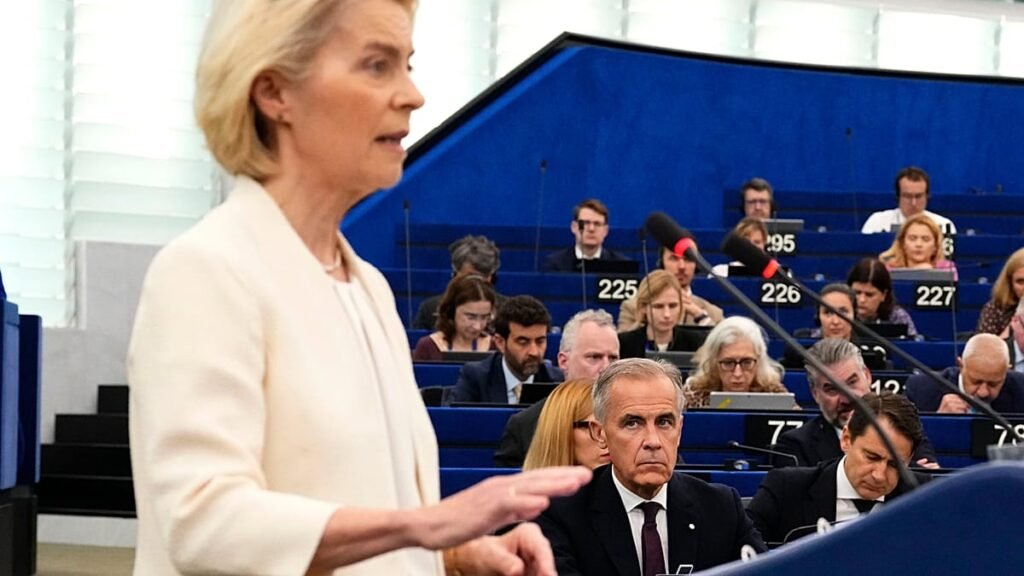
“A Canada-EU alliance would create a beacon for other democracies. An alliance not defined by what we oppose, but about what we are for: freedom, solidarity, prosperity, sustainability,” Carney told the European Parliament on Thursday.
Unprecedented arrangement
The EU does not currently envisage an “associate membership.” The idea was first floated by German Chancellor Friedrich Merz as an innovative way to integrate Ukraine into the EU, but the proposal was rebuffed by President Volodymyr Zelenskyy.
So far, the Union has consisted solely of member states and candidate countries. Canada, meanwhile, has no intention of joining the bloc, as Carney has made clear, and its treaties would not permit it in any case, given that Canada is not a European country.
“The precise nomenclature is a question for Europe,” the Canadian PM said, arguing that what mattered was the substance.
The EU treaties do allow some flexibility, as they state that “the Union may conclude with one or more third countries or international organisations agreements establishing an association involving reciprocal rights and obligations, common action and special procedure.”
What exactly this associate status would entail is still not clear. Carney proposed deep cooperation across the full range of strategic capabilities, including critical minerals, defence industrial capacity, AI and compute, energy security, space and payments.
But while the details remain to be hashed out, what appears clear is that whatever deal Brussels and Ottawa reach will be a highly influential precedent for how the EU engages with other partners.
Trusted partners
The idea of making Canada an associate member of the EU was first made public via a WSJ report earlier this week.
“We are on the same page,” Australian Trade Minister Don Farrell told the Sydney Morning Herald. “We will take great interest in what Carney does.”
In an exclusive interview with Euronews, European Parliament President Roberta Metsola said that Australia and New Zealand might follow Canada’s path, as the EU seeks to deepen ties with like-minded countries.
MEP Tobias Cremer (Germany/S&D) told reporters he was receiving an increasing number of media requests, not only from Canadian outlets but also from Australian, British and Japanese ones.
Meanwhile, the UK is reportedly feeling left out of Brussels’ newfound love for Canada, as some in London believe the EU is more interested in closer relations with Canada than with the UK.
“We need to think of partnerships that go beyond EU membership,” Austria’s Foreign Minister Beate Meinl-Reisinger wrote on X. “Let’s make that a model for the future — one that Europe also offers to other partners: Norway, Iceland, Japan, South Korea, New Zealand.”
In other words, the success of the special relationship with Canada might put the EU at the centre of a new international alliance, as democratic countries that have lost faith in the US as leader of the Western world realign.
International order
The newfound alignment between Brussels and Ottawa might be one step closer to the realisation of Carney’s vision of an alliance of middle powers, meant to strengthen each other’s sovereignty by weathering shifting geopolitical realities together.
“I want to be precise about what I am not proposing. I am not proposing a third bloc in order to become a great-power rival, only with better manners,” he said.
“We do not seek power to dominate others. On the contrary, we are pursuing resilience so that no one can control our open markets, impair our sovereignty, threaten our territorial integrity, or undermine our freedoms, our democracies, our rule of law,” Carney continued.
In Brussels, officials tend to point out that, while member states taken on their own might be middle powers, the EU as a whole is not, and might actually emerge as a leader of a democratic coalition to support the faltering rules-based international order.
“We are by definition a convening power of middle powers in the way we function. I think that makes us actually attractive to many other middle powers, because the EU, like no other global player, has in its DNA leveraging small and middle powers without trampling on their interests,” Cremer said.
At the same time, as the EU pursues global ambitions to forge deeper ties with democracies on other continents, some fear it might lose sight of its most immediate neighbourhood.
Unsettled candidates
The acceleration of the EU-Canada partnership, and the entirely new format on offer, has fallen flat especially among countries that have been standing in line to join for decades, such as in the Western Balkans.
It is not the first time the EU has floated a new membership structure. Candidate countries have seen, in close succession, the growth plan, reverse enlargement, gradual integration and now a tiered form of membership.
There is also a risk that the move further strains transatlantic relations with the US, with President Donald Trump already threatening possible retaliation, which might put pressure on candidate countries to pick a side between the two blocs.
“I don’t feel comfortable with the constant new ideas over membership and the lack of discussion concerning the acceptance of new members,” Obrad Kesić, the head of Bosnia and Herzegovina’s mission to the EU, told Euronews.
“Canada is a large country, it could have negative ramifications for small candidate countries if the discussion becomes too broad. It changes the contour of the debate,” Kesić said. “Conceiving memberships as going beyond Europe opens up a new set of issues.”
Read the full article here