






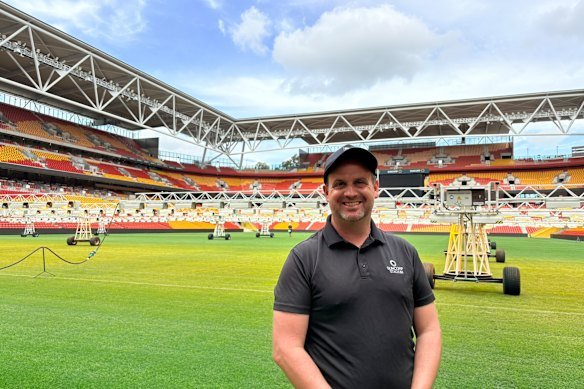
While all eyes will be on the field during the NRL Magic Round and a total of 300-odd pairs of boots ripping up the grass, Matthew Oliver’s will be looking to the sky.
“I’m always looking to the sky hoping that it’s going to be dry.”
His job as Suncorp Stadium grounds manager would not often be at the front of mind of punters in the lead-up to the Women’s State of Origin Game 2 or NRL Magic Round, but it’s vital to the success of the tournament.
And unfortunately, his team’s success relies heavily on the weather forecast.
“All it takes is one really wet weekend, and it can undo a lot of our hard work and our future plans,” he told this masthead while walking the field one sunny Tuesday.
“We’re always praying that if we do get rain on an event day, it’s either before or after the match.”
Since the NRL and NRLW draw was released in November, Oliver and his team have been preparing for this coming weekend – there will be nine games over four days, including the second Women’s State of Origin showdown.
But the popularity of the stadium often works against them. Suncorp Stadium is the busiest rectangular stadium in the country and the only one to host four tenant clubs across three sporting codes – Brisbane Broncos and Redcliffe Dolphins in the NRL, Queensland Reds in Super Rugby and Brisbane Roar in the A-League.
“[With that] event schedule, you’re not quite getting the recovery that you need. If we just had one tenant, [it’d be a] different story.”
That doesn’t stop Oliver and his team from maintaining the high standards expected in professional sports games.
“We may never win a beauty contest, particularly when we’re really, really busy, but the players love playing here, they always know what to expect when they come here – it’s going to be a dry, firm, fast track for rugby league and that’s all we can really ask.”
Oliver’s motto is simple: “Green is good”.
Producing that green, however, isn’t just a matter of crossing some fingers and hoping for the best. It involves a lot of fertiliser, mowing and two pieces of equipment you wouldn’t expect to see in an open-air stadium – grow lights and fans.
“We’re dealing with many different microclimates in here.”

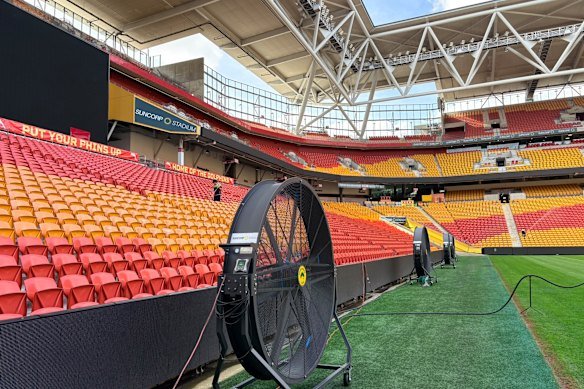
When this masthead visited the stadium, four large portable turbine fans were set up on the northern tryline, along with several grow lights reaching from sideline to sideline.
“[The grow lights] are essentially brought in to replicate the sunlight in the part of the field where we get very little or no sunlight this time of year,” explained Oliver, who had been in the industry for 21 years and at Suncorp Stadium for five seasons.
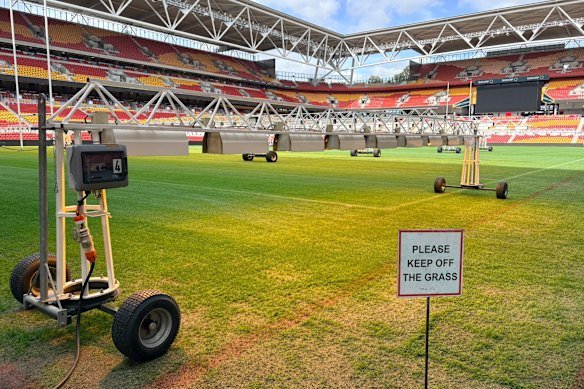
Once they’re towed onto the field, they’re left in the same position for 48 hours to help stimulate grass growth and ensure it not only survives, but thrives. Weighing 1.9 tonnes, they are moved by hand with a “bit of manpower” to avoid unnecessary machinery trampling the grass.
“One of the little-known facts around these grow lights is that the soil temperature will increase by around 3 degrees … 3 degrees here compared to the southern end of the field is quite remarkable when you’re considering the southern end’s sitting in sunlight for six or seven hours a day.”
The fans work to dry the field after rainfall and prevent the growth of fungal pathogens.
“These have really revolutionised how we manage this end of the field,” Oliver explained.
Over the course of the tournament, Oliver and his team walk the field to ensure there is “nothing untoward” and fill in any divots. But time will be of the essence; they only have at most 15 minutes between matches to prepare the field for play.
“While the games are on, we’re always planning what we’re going to be doing post-match, and we’ve always got a set plan, but that needs to be quite fluid.”
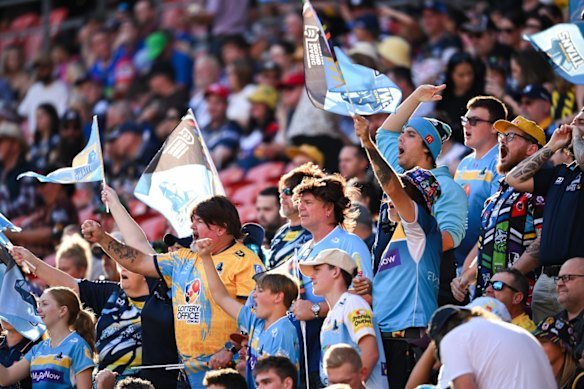
Once the punters have packed up and gone home, the work continues. Mowers come out, liquid fertiliser is applied to try to perk the leaves back up to have the field ready for the morning. They’ll mow again in the morning and mark all the lines again.
Over the four days of games, they’ll lay an estimated 7km of lines.
This time last year, the grounds team faced a significant obstacle, having to replace over half the field ahead of the tournament. They finished on the day of the first match.
This year’s prep, despite a dreary-looking forecast, was looking more predictable.
“We’ve done this a few times now. We know what to expect,” he said.
“We’re really confident in our preparation and the actual grass type, the system that we’re using on the field of play. It’s handled lots of high-impact matches in the past.
“We’ll hopefully be the canvas to put on some really awesome rugby league next weekend.”
Start the day with a summary of the day’s most important and interesting stories, analysis and insights. Sign up for our Morning Edition newsletter.
Read the full article here