




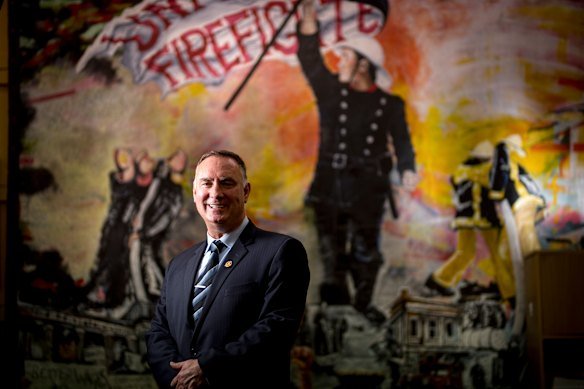
The workplace regulator should try to oust United Firefighters Union leader Peter Marshall from office over findings by Victoria’s corruption commission of backroom misconduct, according to prominent anti-corruption barrister Geoffrey Watson, SC.
Victoria’s Independent Broad-based Anti-corruption Commission released its Operation Richmond report on Wednesday, following a long-running legal battle by Marshall to prevent its release.
It detailed events from 2014 to 2019 as the state Labor government and the UFU battled over enterprise bargaining agreements applying to fire agencies.
And a decade after the political firestorm described in the report engulfed the Andrews government, many of the issues continue to loom large in Victoria’s fire services, with Fire Rescue Victoria recently accusing the union of bullying in an open letter posted to its website.
The Operation Richmond report, released this week, found senior public officers engaged in serious and concerning conduct, but on Thursday, Marshall rejected all accusations made against him in the document.
“The IBAC report is very creative writing,” Marshall told this masthead. “That could have been done with a crayon. The only thing that’s missing is the pictures.”
The investigation exposed how former premier Daniel Andrews, ministers and senior bureaucrats ran secret backroom operations, misled cabinet, purged public boards, and repeatedly capitulated to pressure from Marshall and his union.
The watchdog detailed secret hotel negotiations, middle-of-the-night text messages to ministers, undisclosed conciliation back channels, and the dismissal of boards that resisted union-backed workplace agreements.
Watson, who advised the administrator during the federal intervention into the CFMEU producing the landmark Rotting from the Top report, said the Fair Work Commission must examine whether Marshall remains fit to hold office under federal workplace laws.
“There is no way that a person who’s identified as having conducted himself in such a manner – which involved threatening conduct and was the subject of complaints, and who avoided following procedures in a very careful, practised manner – there’s no way in the world that person should be heading up this union,” he said.
Jane Hume, opposition industrial relations spokeswoman, said Prime Minister Anthony Albanese should remove the UFU’s affiliation with the Labor Party in the wake of IBAC’s Operation Richmond report. “The UFU isn’t interested in integrity in the union movement,” she said.
Federal Workplace Relations Minister Amanda Rishworth was approached for comment, but her office did not respond by deadline.
Marshall, 64, has operated as the central powerbroker of Victorian emergency services for more than three decades, transforming his 4300-strong union into one of the state’s most formidable political forces.
Raised in a working-class family in West Brunswick, Marshall joined the Metropolitan Fire Brigade as a firefighter and responded to major industrial disasters, including the 1991 Coode Island chemical storage fire.
He became state secretary of the firefighters’ union in 1995 and has held the post ever since. Disclosures filed with the Fair Work Commission show the union paid him a wage of $447,839 last financial year.
Watson said there was mounting evidence that problematic union leadership in Australia led “to massive downstream problems. Marshall should go as the leader of the UFU, and I would urge the people at the Fair Work Commission to look at Operation Richmond with a view to seeing whether they can take steps to remove him.”
He said the Fair Work Act gave the Federal Court “ample power to have certain people declared” as inappropriate to lead a union.
Defending his record and approach, Marshall rejected suggestions that his advocacy crossed boundaries or that his access to government figures was improper. “I’m privileged to represent very decent people who do a very important job, and that is they put their life on the line, protecting life and property,” he said. “I only have one audience to answer to, and that’s my members.”
Marshall defended his frequent communication, including calling Andrews at 4am, with senior politicians and public officials detailed in the Operation Richmond report, arguing this was standard across politics. “You tell me which union doesn’t speak to the government of the day. You tell me which business person doesn’t speak to conservative governments. Are we really saying that we want to put parliament into a glass bubble?”
Marshall also attacked the corruption watchdog’s methods, questioning its use of phone intercepts and raids.
“Phone intercepts in relation to criminality or corruption have a place,” he said. “My house was raided by eight IBAC officers. They took my private papers, my family papers, my medical records. They listened to phone calls between my [partner], my family. There’s a total intrusion in your privacy. There’s an abolition of any civil rights you may have.”
Watson countered that standing integrity bodies needed strong powers to investigate public sector misconduct and unpick complex arrangements.
“You need extraordinary investigating powers which enable you to unpick [corruption]. The point with the public sector is that you do need these powers,” Watson said. “Of course [anti-corruption agencies like IBAC] should have them; it’s a critical component of the investigative powers of an organisation like this.”
Watson also criticised the legal challenges that had delayed publication of Operation Richmond for several years. “This thing has been delayed for years by court processes,” he said, comparing Victoria’s processes with NSW, where “procedural fairness is afforded in a particular fashion”.
Many of the issues at the heart of IBAC’s findings on Wednesday continue to plague Victoria’s fire services today.
In July, Fire Rescue Victoria Commissioner Gavin Freeman wrote an open letter to the UFU urging it to put away “disgraceful” tactics to influence his organisation. He said that this “clearly amounts to bullying and creates a serious risk to the health and safety of FRV employees”.
Freeman also noted the union had “unique” access to FRV workplaces, employees and systems, and urged them not to abuse this access.
On Thursday, Victorian government minister Vicki Ward said it was taking IBAC’s recommendations “very seriously”.
Start the day with a summary of the day’s most important and interesting stories, analysis and insights. Sign up for our Morning Edition newsletter.
From our partners
Read the full article here