




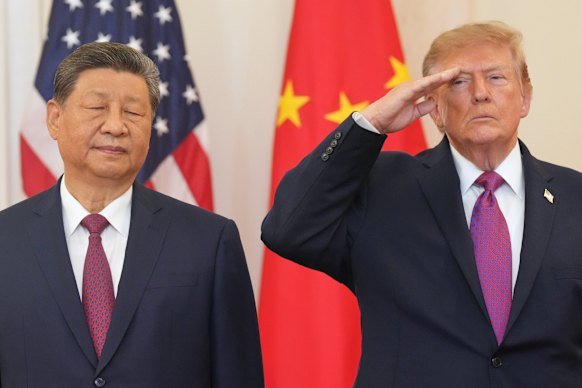
The news that US President Donald Trump offered to sell arms to China is the latest proof that Trump’s America is an unreliable ally (“Alarm at offer to sell China weapons”, September 29). China’s military drills, flyovers and ship rammings in the Strait of Taiwan and the South China Sea, as well as its sponsorship of the nuclear-armed North Korean regime, present a grave threat to the security of the Pacific. Yet American weapons supplies, which have already been diminished by the supply of arms to Ukraine, are now being severely depleted by Trump’s war in Iran, while China only grows stronger day by day. The United States and its allies must avoid prolonged, unwinnable foreign entanglements, stop delaying the sale of armaments to Taiwan, and develop an industrial policy to revitalise their manufacturing industries. Deterring Chinese aggression must become the West’s most important foreign policy priority for the foreseeable future. Nikhil Dhanabal, Clyde North (Vic)
That would be a great step forward in globalisation, wouldn’t it, for the USA to sell arms to China? But just think about it. Instead of waiting until the late 2030s and into the 2040s for our AUKUS submarines, Australia could buy them now from the Chinese, thus avoiding the wait and possible embargo from a capricious US president. Greg Baker, Fitzroy Falls
Donald Trump’s offer to sell weapons to China reminds me of the old political maxim: “The capitalists will sell us the rope with which we will hang them.” Trump is nothing if not a capitalist, a capitalist with an unquenchable thirst for gold and the moral compass of an alley cat. Oh, and he’s also the leader of the free world. James Walsh, Woronora
Peter Hartcher’s characterisation of President Xi Jinping as “a dictator leading an enemy state” (“How Trump’s grovelling emboldens China and imperils the Asia Pacific”, September 29) is both unnecessary and misleading. Describing the complex, highly institutionalised political system of the PRC in these terms is not only inaccurate, but counterproductive. If we are to navigate the delicate security and economic balances within the Asia-Pacific, our media commentary must favour pragmatic, diplomatic realism over inflammatory rhetoric. Derek Kreckler, Austinmer
Even though our healthcare, aged care and transport systems are desperately in need of funding, Australia is wasting $368 billion on nuclear submarines that we may or may not get, and if we do they will probably be obsolete by then. The pretext is to protect us from China, which, in its 3500-year history, has never attacked our shores. Call me stupid but the only people profiting from this bogeyman nonsense are the American weapons oligarchs who get richer from wars, and the former Australian politicians, usually retired defence ministers, who lucratively lobby for them. Paul Miles, Chain Valley Bay
Smoke signals
The news that Meta and TikTok have been routinely running illegal cigarette and vape ads comes as no surprise but will no doubt be shrugged off by the companies involved (“TikTok and Meta ran hundreds of ads for illegal tobacco, vapes”, September 29). They seem to think they are above the law. Perhaps it’s time to turn up the heat on these multinational leeches. On a recent trip to China it was obvious that Western-style social media is almost totally banned there. No one wants that oppressive approach here but perhaps it’s time to hold up China as an example of the “big stick” these big companies could face if they continue the way they have been on issues most Australians think are pretty crook. Mark Southcott, Thirroul
Unfortunately, the whole world is laughing at our inept and destructive tobacco and vape regulations. We are the only country in the world where our politicians and over-the-top anti-tobacco lobby groups have managed to make smoking cheap and cool again. Peter Barrett, Woonona
Spending solutions
Paul Sakkal and Matt Wade analyse the real dilemma facing our treasurer: a failure to manage spending (“Chalmers blames war as RBA hike looms”, September 29). When governments fail to manage the economy, the RBA is forced to step in. The suggestion of increasing super contributions as an alternative to interest rate rises is a salient reminder that we only have a super system because the government of the day did a deal with the unions to offset wage rises with compulsory super to cool the economy. Instead of treating the super system as some holy grail, it needs to work for all Australians. Contrary to the views of most observers, the compulsory element of super quickly made it an additional impost on employers and not an offset to wage increases. It was gifted to us by government and should be used where helpful to benefit us all. Brian Barrett, Padstow

When the Reserve Bank raises interest rates, it raises the amount property investors have to repay, which they then pass on as increased rent to their tenants. Surely this is inflationary. Even if the landlord is negative gearing, some investors are on interest-only loans. Also, owner/occupiers with a mortgage are certainly not the ones with discretionary spending. That is more likely to be retirees who own their own home, spending their superannuation. It seems the RBA is targeting the wrong people and now wants unemployment to increase to drive more Australians into a cycle of poverty and disadvantage. Mark Berg, Caringbah South
Instead of constant interest rate hikes to fight inflation, let’s temporarily increase the concessional cap to $50,000, allowing workers, where able, to salary-sacrifice more into superannuation. Less money being spent now, more money being invested in a worthy nest egg. Michael Blissenden, Castle Hill
Energy sapping
It’s been 10 years since South Australia’s statewide blackout that led to the game-changing decision to build a big battery in South Australia (“Two billionaires, one online bet and a turning point for Australian energy”, September 27). The flow-on consequences have been immense. Rather than halt the energy transition to renewables, the responses to the blackout sped it up without the disruption and repeat of major blackouts predicted by some. In South Australia especially it brought greater innovation and stability. Nationally, the politics of the energy transition may not have moved but the technological and economic progress achieved in the past 10 years means impeding the momentum for ideological reasons risks severely hiking electricity prices, something any sane politician in power surely would baulk at. Jim Allen, Panorama (SA)
We are constantly urged to watch out for misinformation. On the topic of including the electricity sector in the safeguard mechanism – our only legislated means to support emissions reduction – the Australian Energy Council lobby group and the independent Grattan Institute have quite different thoughts (“Push to extend coal plant pollution laws”, September 29). Let us hope the government can spot the misinformation. Lesley Walker, Northcote (Vic)
Building value
One of the reasons so many tech organisations want to build data centres in Australia is because so many US states have simply said no. So if we are going to allow them, we need to extract maximum value and ensure minimum negative impacts. They must supply and pay for their own power and water. They must train key workers such as electricians, rather than simply stealing ours. And we must obtain value from their use of the data, rather than just end up giving it away. They should be required to underwrite new local renewable energy plants and fully fund power transmission upgrades, providing water infrastructure and, finally, cash to help better community facilities. Margaret Wright, Millers Point
Picky workers
When I went fruit picking fifty years ago I did not see one overseas worker. They were all Australians. If you worked hard you could actually make a decent amount of money. I wonder if that is possible today (“Labor pushes to boost Pacific workers as Joyce says some Australians ‘bung lazy’“, September 29)? The PALM workers would find that any Australian dollars they did manage to send back home would buy far more than they would in Australia, so they have an incentive. I suspect many of the backpackers are only doing this work as a condition of their visas. They are like medieval indentured serfs. I once read a letter from a university lecturer from Singapore telling how she worked picking fruit in Australia when she was a student. She explained that after working very hard for the mandatory hours on the farm she ended up saving nothing. She could understand from experience why Australians do not want this type of work. Tony McIntyre, Lower Mitcham (SA)

When the Bondi shooting happened we had hundreds of prominent citizens calling for a royal commission. When the government made changes to tax on property investments another bunch of well-known citizens signed a letter against those reforms. But they seem to have gone silent about the changes to immigration demanded by the right-wing populist parties, which will deny backpackers entry to Australia and will hurt regional businesses. Please explain. Jeremy Richards, Manly
Mike not Magic
Didn’t former premier Mike Baird get bitten on the backside (figuratively speaking) when he tried to ban greyhound racing in NSW? It was the start of his slide from office. Now that he’s lost his job as chair of Cricket Australia over his position on privatising the Big Bash League, maybe he should look outside of sport for gainful employment (“Boon takes CA hotseat after Baird resignation on the back of BBL row”, September 29). Privatisation, which marked his term as premier, is not the answer to every issue. Best wishes to cricketers David Boon and Ed Cowan, who will fill the managerial void left by Baird. Glenn Johnson, Leura
Altmanheimer
Is Sam Altman the modern-day equivalent of J Robert Oppenheimer (“Anthropic boss to skip Senate grilling into rogue AI agents”, September 29)? Both men recognised the potential for misuse of a powerful new technology while working to advance its uses in medical, economic and scientific endeavours. The human race is teetering on the edge of a perilous slope. Like nuclear technology, let’s hope artificial intelligence loses its appeal if the threat to humanity reaches a dangerous level. Irene Nemes, Rose Bay
Psychiatric rethink
The repercussions of the de-institutionalisation of psychiatrically unwell individuals has highlighted the failure of the Richmond report recommendations (“Alarm as courts send mentally ill to EDs”, September 28). The costs of their care have now shifted to the public health system, prisons and charities. They are unable to access help and end up homeless, in jail or deceased from misadventure. Stretched emergency departments always have difficulty finding a public psychiatric bed, as there are never enough. Private psychiatrists are unaffordable. Surely, it is time to reopen major psychiatric institutions to help give these people proper care with trained staff. Jill Pallas, Saratoga
Mugged by charity
I’m mate of the tall ship Soren Larsen. Last week we tied up at Campbell’s Cove after a week-long sail-training cruise for a private school. Some seventy or so parents and relations were waiting to visit. There was an extended wait before they could come aboard and I noticed three chuggers (charity muggers) working the group, folders and card readers in hand. All good-looking, articulate, polite, and working for commission. These people are a curse. Presumably they were at The Rocks to ambush passengers from the big cruise ship that was docked at the time, and saw us as an opportunity. It’s a very bad look for Sydney. Mark Bresman, Brookfield
Grand gift
The positive mental benefits of caring for grandchildren are real (“Taking care of your grandchildren may help arrest cognitive decline”, September 29). After caring for 10 grandchildren over a 17-year period, I can attest as well to the physical benefit of sleeping very well at night after an exhausting day. Sally Spurr, Lane Cove
Tattoo alley
I can remember my grandmother taking me to the Royal Easter Show in the 1950s. At sideshow alley she paid sixpence entry fee for me to see “the Tattooed Lady”. Nowadays I can go to the local shopping centre to see a multitude of them for nothing (Letters, September 29). Peter Ryall, Hallidays Point
The Big Chiko
The Chiko Roll may be uniquely Australian (“We eat 17 million of these a year. No wonder this Aussie snack’s been with us for 75 years”, September 28), but to be a true Aussie icon requires a “big” version on a roadside in some country town, like the Big Banana and the Big Prawn. After 75 years I would have thought someone would have created a monument to the Chiko Roll. Dale Bailey, St Leonards
After reading your 75-year birthday review of the famous Chiko Roll I had to go and buy one. Thank goodness for Greek fish and chip shops – they still stock them, and they’re still yummy. Now, I’m off to Pilates. Kevin Jurd, Potts Point
Blanket of bogongs
Just when we thought bogongs were bygones, they’re back. Your photograph shows “an aggregation of bogong moths” in a cave (“After a catastrophic decline bogong moths are back, and naturalists are celebrating”, September 29). I understand that the collective noun is “cloud”, which is appropriate enough when they’re on the wing, but perhaps in their settled state a “blanket” or “shawl” of bogongs would be a better term. Doug Walker, Baulkham Hills
Reader Judy Hungerford writes “please don’t spray or kill them, just let them go on their way” (Letters, September 29). In other words, let bogongs be bogongs. David Mackinnon, Kings Cross
- To submit a letter to the Sydney Morning Herald, email letters@smh.com.au. Click here for tips on how to submit letters.
- The Opinion newsletter is a weekly wrap of views that will challenge, champion and inform. Sign up here.
Read the full article here