





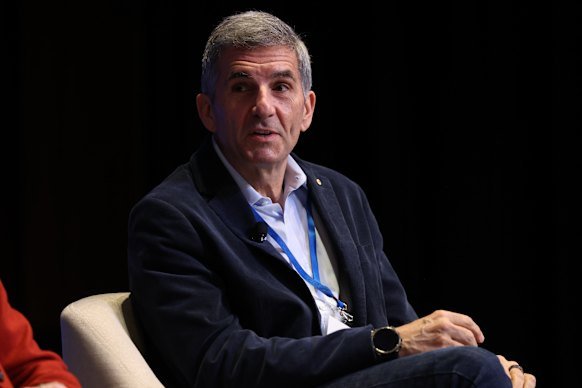
Emerging from Peter FitzSimons’ discussion with Daniel Petre, Australian expert on the effects of the digital revolution, is the issue of the role that work plays in our humanity (“Should AI scare us? Our top tech bro weighs it up”, June 28). To be fully human we need to work in some fulfilling way. To be fully human is to be productive, whether it be in creating ideas or something tangible, to do things ourselves. While many tasks currently carried out by humans will eventually be done more efficiently by AI, if life is to retain meaning, then it is essential that education institutions and governments promote the value, indeed the necessity, of people being able to engage in work in its widest possible understanding. Paul Casey, Callala Bay
In today’s world, a dose of Some (Some Over-Manic Egotists), and the controlling AI, will never be able to create a happy, stable utopian world. Real intelligence that has the ability to labour over complex problems, admit mistakes and change direction mid-stream, will always have a much greater chance of creating a brave new utopia for all. Joy Cooksey, Harrington
Daniel Petre paints a worrying future with artificial intelligence. He also says that the Chinese have most of the world’s robotic development and expertise. Interestingly, elsewhere in the edition there is an article about Australian universities having to adapt to attract Chinese students. All of which begs the question: Why do the Chinese send their students to western universities in light of their own development in AI and robots? What courses are the Chinese seeking? Even with improved robotic dexterity I can’t see plumbers being replaced as easily as lawyers. So I’m thinking law isn’t an attraction. Maybe there’s a lesson for us there. Chris Commens, Rosebery
Peter FitzSimons’ interview with Daniel Petre about the pros and cons of artificial intelligence is a must-read. When asked about One Nation’s AI policies, he didn’t hold back and succinctly identified the lack of intelligence artificial or otherwise with the party and its leader. More power to him. Mike Keene, Mollymook Beach
Medical concerns
Samuel Castle (“I went to uni to learn. My AI generation terrifies me”, June 28) is rightly concerned about the “education” students are receiving at universities across the country. Take home exams, video responses, no end-of-semester exam. How do lecturers check what their students actually know when they are no longer accurately assessed on their own knowledge of content, but wilfully encouraged to use AI to think for them? Do they not care about the standard of knowledge their students are leaving university with? One would hope those in the medical faculties, at least, would be concerned about who will be treating them as they age. I certainly am. Jane Lieschke, Woonona
While I love the development and capacities of tech generally, it has bothered me since I first heard about LLMs (Large Language Models) maybe four or five years ago that students could save all that thought work and throw some data at a computer and have it spit out half an essay or maybe the whole darned thing. My husband was a rigorously trained civil engineer, who properly learned all the intricacies of load bearing, various forces applying to structures. He also learned on the job with the smarts of decades trained superintendents and lead hands. Then he applied all that knowledge to the projects. I have no hesitation crossing any of his balanced cantilever bridges (and that’d be true for hundreds of years to come), but I’m equally sure I’d hesitate to cross any bridge that was project managed by a graduate fresh out of today’s uni with a degree cobbled together with some LLM. Angela Williamson, Exeter
Samuel Castle raises useful points. We must not outsource our thinking to Large Language Models like ChatGPT, or we will lose our ability to think critically. We already know LLMs and similar can hallucinate, and potentially act in their own interests, but also they cannot distinguish between “truth”, “fiction”, and the incremental nature of research. For example, scientific papers that are retracted and otherwise disproved remain part of their system, as does fiction, dis- and mis-information, anything the greedy text eating monsters can find. Use them by all means if you must, but also fact check them, and maintain thinking critically on their output, as you would any other source of information. Mary Anne Kennan, Burwood
Giuffre recognition
The article about Anastasia Treharne (“After two rapes, the legal system caused Anastasia further trauma”, June 28) is a powerful reminder that the pursuit of justice can require extraordinary courage long after the abuse itself. That is why we should also recognise the bravery of women like Virginia Giuffre, who endured years of public scrutiny, legal battles and personal attacks to expose powerful abusers. Her courage encouraged countless other survivors to come forward. There is now a public petition calling for a rare posthumous Australian honour for Virginia Giuffre. We rightly recognise physical bravery; exceptional moral courage deserves recognition too. Roz Townsend, Queanbeyan East
Three-day questions
How does Larry Woldenberg (Letters, June 28) know that three days is sufficient time for “the transition of the dead person to the realm from which we came”? Has someone come back to tell him? What if the dead person was only halfway when cremation began? Would s/he be stuck in limbo? So many questions, so few answers. David Gordon, Cranebrook
- To submit a letter to the Sydney Morning Herald, email letters@smh.com.au. Click here for tips on how to submit letters.
- The Opinion newsletter is a weekly wrap of views that will challenge, champion and inform. Sign up here.
From our partners
Read the full article here