






 Markets
Shaun Riddell is “over the moon” — figuratively, if not quite yet literally — since his Langley, B.C., firm was named among three companies hired by the Canadian Space Agency to lay the groundwork for human and robotic missions to the lunar surface.
Riddell, the CEO of SpaceDirt, says he was “blown away” by the awarding of the $500,000 contract, given the competition for the national grant.
SpaceDirt makes technology for autonomous robotic resource development on Earth, aimed at predicting where to drill and making discovery faster, safer, and more cost-effective in extreme environments.
Riddell says the long-term vision for the company’s robots is to be the “dump trucks” of the moon, while the current project will draw a road map on how “Canada will contribute to the overall mission of developing resources on the moon.”
The Canadian Space Agency says over the next 10 months SpaceDirt, Volta Space Technologies and Canadian Strategic Missions Corp. will assess what’s needed to generate and distribute power on the moon’s surface and manage lunar soil.
The project will also examine how lunar resources such as ice, metallic elements, and soil can be extracted and transformed into usable materials.

Get daily National news
Get daily Canada news delivered to your inbox so you’ll never miss the day’s top stories.
Riddell says with rocket technologies improving, going to the moon becomes “quite attractive,” and it has transitioned from a final destination into a “proving ground” for deeper exploration into the space by humans.
“The moon’s a great kind of sandbox for space exploration as a whole. There are other interesting places to go, Mars being one of them, or asteroids, but they’re much further away, and the missions become much more complex,” Riddell says.
“What the moon gives us is a kind of a close place where we can validate a bunch of the technologies and also from the perspective of any interaction with Earth, it’s much simpler because the communications and other systems are much more available, let’s say,” he added.
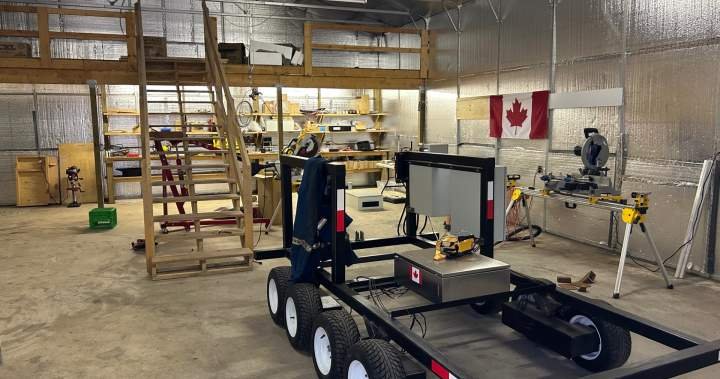
Riddell says one robotic vehicle that they are working on for a possible moon mission is called Sled 75, which functions like a large shopping cart with four wheels, and has a payload of 250 kilograms.
“Over the next six months or so, I’m sure you’ll hear more from us. We’ll be showing that rover off a lot at various client sites, hopefully,” said Riddell.
Riddell says they are also working on an eight-wheeled robotic vehicle, but that model continues to change as his team tests out different technologies, batteries and motors.
“Once there are companies looking to do mining and more significant industrial activity in space, we’re designing equipment that is simpler and more robust in a way that the space agencies maybe can’t be. Our systems aren’t designed to discover the origins of life or to transport astronauts,” said Riddell.
“But we’re trying to hit one level down and just be a bit simpler, and we’ll be running those dump trucks,” he added.
Riddell says the moon has rich resources, from ice to highly valuable Helium-3, making it a “most compelling place” to explore.
“Getting out there and getting further into the solar system and allowing humanity as a whole to understand a bit more about our universe and the larger area outside of Earth is an important mission, and that’s what I want to support,” says Riddell.
Read the full article here