






 Markets
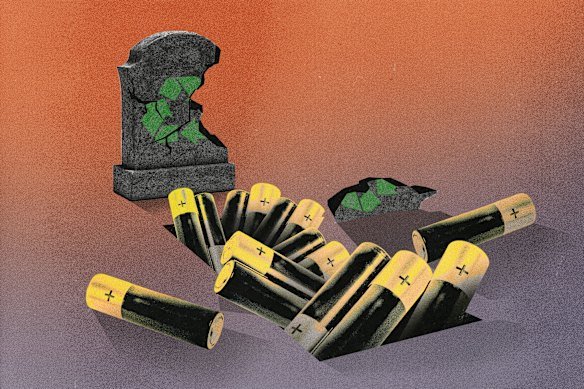
The recycling company that runs the national network of Ecobatt battery collection bins at major retailers such as Coles, Woolworths, Aldi and Bunnings is being accused by former employees of dumping, stockpiling or burning millions of batteries instead of recycling them.
“It’s systemic and it’s routine,” said a former senior employee of the nation’s biggest battery recycler Ecocycle, who asked not to be named because they said they had been involved in illegal dumping.
An investigation by this masthead has found evidence that the Ecocycle group of companies has been persistently evading the audits that would shed light on its battery processing claims.
The Battery Stewardship Council, which administers the national B-Cycle scheme, conceded it has been unable to verify what has actually happened to all the 10,000 tonnes of used batteries Ecocycle has collected. It has now launched its own investigation into the company.
Data from AirTags secretly placed inside batteries collected by Ecocycle show them being diverted away from the company’s main processing centre in Melbourne to a suburban scrapyard with a troubled environmental history, where they vanish.
Ecocycle denies any wrongdoing and said all the batteries it collects are processed properly at its main facility in Campbellfield, in Melbourne’s north.
A company spokesman said the Environment Protection Authority had found no recent problems at Ecocycle worksites.
Asked if he could guarantee the public that all batteries collected under the government-backed B-Cycle scheme were properly recycled, the spokesman said “absolutely”.
‘Just enough so they don’t get caught’
Australia’s growing dependence on electronic devices has created a glut of used batteries, and it’s becoming one of the nation’s most pressing and lethal environmental problems.
A dozen people have died and hundreds have been injured in household battery fires around the country over the past four years and lithium batteries are the nation’s fastest-growing fire risk, fire authorities say.
In NSW and Victoria, exploding lithium batteries spark fires almost every day, while single-use alkaline and nickel-metal hydride batteries bring their own sets of toxins that can poison people and the environment. The average Australian uses about 13 batteries a year, with most ending up in landfill.
The B-Cycle scheme was established in 2022 as an attempt to manage the problem by linking householders who wanted to drop off old batteries for recycling with industry that could access the valuable minerals inside.
Under the scheme, battery importers such as Duracell and Energizer pay a fee that is typically added to the price when people buy batteries. The fees are used to pay rebates to companies that collect and recycle them.
Ecocycle quickly emerged as the scheme’s dominant player, scooping up the lion’s share of rebates.
It set up over 6000 battery collection points and now controls about 90 per cent of Australia’s battery collection market.
But numerous former workers told this masthead the company had been collecting more batteries than it could safely handle.
Eyewitness accounts and photos from numerous former workers allege illegal dumping and improper recycling practices.
“Batteries are mixed in with other rubbish, hard rubbish, and dumped at a tip,” said the former senior Ecocycle employee. “It’s just a case of not doing it too much at once – just enough so they don’t get caught.
“The fact is they don’t have the processes in place to process all the batteries,” the former employee said. “The machinery doesn’t handle the volume. They have ended up with a serious volume of batteries without any way to deal with it.”
Ecocycle blamed industry rivals for spreading misinformation about its recycling practices.
“We’re the biggest battery recycler in Australia and people are just pissed off with us,” the company’s spokesman said. “Why didn’t they go and invest and spend the money? We don’t have a mandate over it. There is a lot of jealousy over what’s happened.”
Other recycling companies were reluctant to publicly criticise Ecocycle, but they feared that the question marks over the market’s biggest player could undermine public trust in recycling.
“It’s at the point now where this is reputational,” one said.
Some industry players decided to test Ecocyle’s recycling claims last year by concealing Apple AirTags inside battery casings and dropping them into Ecobatt bins around Sydney and Melbourne so that the batteries could be discreetly tracked.
The AirTags in Sydney were placed in Ecobatt collection bins at Bunnings stores in Artarmon and Campbelltown, and at Campbelltown Community Recycling Centre.
In Melbourne, tagged batteries were deposited at Bunnings stores in Narre Warren, Melton, Altona North, Notting Hill and Broadmeadows, along with a Coles supermarket in Burnside and a Woolworths in South Preston.
According to the tracking data, all the tagged batteries were trucked to Ecocycle’s central plant at Campbellfield in northern Melbourne, where the company says all of the batteries it collects are processed.
But instead of being destroyed at Campbellfield, the AirTags kept “pinging”.
‘Where the magic happens’
Nine of the 11 tagged batteries were tracked from the Campbellfield plant to a second site, owned by an Ecocycle sister company Recycal, at Ringwood, in Melbourne’s outer east.
The Ringwood site is a scrap metal processing facility known for past environmental problems, including in 2021, when Victoria’s Environment Protection Agency investigated an anonymous tip-off alleging the site was being used as a rogue e-waste processing station.
The agency found stockpiles of discarded batteries and vehicle airbag detonators, allegedly stored in violation of fire safety, environmental and dangerous goods regulations.
The company said at the time that it had made “mistakes” but would work with regulators to fix the mess. It blamed the backlog on the COVID-19 pandemic and said it had been misled by a customer about the nature of the batteries being stored on the site.
The agency issued Recycal three penalty notices and fines of $22,976 for failing to properly store and manage combustible waste and failing to provide reports in a timely manner.
The company told this masthead that no batteries had been processed at the Ringwood site, despite the AirTags travelling there and vanishing.
“There’s no battery processing at Ringwood,” the Ecocycle spokesman said. “We’ve been processing batteries at Campbellfield for six years. There’s been a lot of speculation that we’ve been processing batteries out here [but] they’re all done in Campbellfield.”
Former workers at the site disagreed.
“Ringwood is where the magic happens,” said another ex-employee of Ecocycle and Recycal.
According to people who have worked for the companies, loads of lithium-ion batteries have been placed in an industrial furnace at the Ringwood plant, which uses a controlled pyrolysis process to bake them at high temperatures so they do not explode when they are crushed or shredded.
“They put the batteries into the furnace and make them inert,” the ex-employee said. “The idea is to ‘make it safe’. Outside the building is a hammer mill, they smash them into powder.”
The furnace is not rated to safely handle lithium-ion batteries, and Victoria’s Environment Protection Agency said it would likely be improper to process batteries there.
A third former worker at the Ringwood site said staff did not question the loads of batteries that were allegedly coming in.
“You don’t want to overthink it, you just did it as part of the job. Like ‘everyone does this type of thing’.”
Photographs taken by a drone in December appear to show large containers of charred battery remnants stacked near the furnace.
Other images from December show containers of rusting batteries stacked outdoors and a shipping container packed with what appears to be shredded remnants of lithium-ion batteries.
Photographs from the site taken in 2022 show thousands of batteries on a conveyor belt going into a shredding machine.
Ecocycle suggested the AirTags, which are about the size of a 50-cent piece and about 1 centimetre thick, could have survived a shredding process intact and continued to function when shredded battery casings were taken to the Ringwood site for temporary storage.
This masthead spoke to other recyclers who use AirTags to verify their own recycling streams about the likelihood of the tags surviving an industrial shredding and separation process and continuing to function. Most thought it unlikely.
“Our experience is that the process for safe destruction of batteries is effective, including for small batteries and items such as AirTags,” said Steven Marshall, general manager of recycler Envirostream, which tracks its own batteries for internal verification purposes.
“While small components may occasionally remain partially recognisable, they are not intact and are no longer operational.”
In a response to written questions about the AirTag data and the alleged improper use of the furnace to process batteries at Ringwood, Ecocyle said it “takes these matters extremely seriously and rejects any suggestion that it disposes of batteries in a manner inconsistent with environmental or regulatory requirements.”
“During shredding and materials handling, non-battery items or embedded foreign objects can persist or be redistributed within metal streams,” the statement said.
“The presence or movement of such items is not evidence of improper disposal, nor does it indicate that batteries are being sent to landfill.
“We would caution against drawing conclusions from unverified tracking methods or partial datasets, particularly where those methods do not account for the realities of industrial processing environments.”
‘Potential harm to human health’
An eyewitness also alleged illegal dumping of lithium-ion batteries by Recycal at a tip in Werribee in Melbourne’s south-west in October, and posted photos on the LinkedIn website earlier this year.
They claimed a green-liveried Recycal truck dumped a load of rubbish containing thousands of batteries at the tip’s “deep burial” section, where loads of waste are quickly buried by bulldozers, and took photos of some of the batteries on the surface before they were covered up.
Werribee Council, which runs the tip, said there had been lithium battery fires at the facility, but none had been linked to Recycal. The company no longer had a relationship with the tip, the council said.
Ecocycle denied Recycal had participated in any illegal dumping.
“We are aware of recent allegations raised on social media,” it said in a statement. “These claims lack critical context and are not an accurate representation of our operational standards.”
The Victorian Environment Protection Authority agreed that processing batteries at Ringwood would be improper, but it had not found any evidence that this was happening during its site visits.
“EPA has conducted multiple inspections at both Ecocycle and Recycal in response to community reports of incorrect management and treatment of batteries, but has not identified any breaches,” a spokesperson said.
“EPA has taken action at different times against both companies, including issuing fines and will not hesitate to use enforcement powers to address future non-compliance should it occur.”
It issued the company with a provisional licence to process limited amounts of e-waste at the Ringwood facility in February.
The EPA said it believed the company’s battery processing all happened at Campbellfield, where Ecocycle unveiled a new “battery-in-device” shredding machine in September.
The ceremony was addressed by Victoria’s then-environment minister Steve Dimopoulos and former federal minister Christopher Pyne, whose lobbying firm Pyne & Partners has facilitated meetings between Ecocycle and state government ministers.
The company has received generous support from taxpayers, including $2 million from state government agency Sustainability Victoria that partly paid for the Campbellfield battery processor, and $1.7 million from the Western Australian government in 2024 to support battery recycling in Perth.
This is despite a series of environmental red flags, in addition to the fines levied against Recycal for breaches at the Ringwood facility.
In NSW, dangerously sloppy work practices were found in 2020 at the company’s e-waste facility at St Marys in western Sydney, where batteries from NSW are gathered before being trucked to Melbourne.
The NSW Environment Protection Agency made a pre-announced inspection and discovered pallets of lead-acid batteries stored in the open air and apparently leaking acid into a drain.
Lithium-ion batteries and shredded e-waste were stored in cardboard boxes next to explosive marine distress flares, without proper fire risk measures in place.
The agency found that “water pollution, land pollution and potential harm to human health is likely to occur” and issued two penalty notices, including one for failure to pay a fine on time.
At Recycal’s scrapyard near Launceston in Tasmania, regulators allegedly discovered even more disturbing practices, resulting in blood testing in the community for possible lead poisoning.
A major fire at the scrapyard in 2022 was followed by a water pollution incident that saw toxic runoff allegedly contaminate a nearby farm.
The scrapyard also produced huge quantities of “shredder flocc” – waste material made up of rubber, plastic, metals, plastic and textiles – that was stored on the site but allegedly being blown around by winds, raising lead levels in the surrounding area.
Blood tests for lead exposure were offered to residents in the suburb, and the Tasmanian EPA eventually seized control of the shredder at the site.
Last month, a major fire ignited at a Recycal facility in the Brisbane suburb of Hemmant, requiring a dozen fire crews to contain it.
“In their storage processing area, materials have caught on fire, primarily around lead-acid and household batteries, and with a small amount of lithium batteries,” Queensland Fire Department local area commander Rohan Wilschefski said.
The ‘black mass’ mystery
Just over 10,000 tonnes of batteries have been reported by Ecocyle as being collected from Ecobatt bins in every state since the B-Cycle scheme commenced in 2022.
But, despite the company’s public commitments to transparency over the full life cycle of the batteries it collects, what has actually happened to them remains unknown.
Recycling batteries involves gathering, sorting them into different types such as alkaline and lithium-ion, and then shredding or crushing them under controlled conditions to generate a black powder, generally known as “black mass”, which is rich in minerals such as lithium, cobalt, nickel and lead.
The black mass can then be used as a resource for offshore manufacturing processes that require concentrated mineral ores, including manufacturing new batteries, while the shredded metals and plastics from battery casings can also be melted and recycled.
These processes would have left Ecocycle with at least several thousand tonnes of black mass, or a less-refined product sometimes known as “ash with mixed minerals”, from the past four years of its battery recycling.
The Battery Stewardship Council (BSC) said it believed most of the batteries Ecocycle collected had been properly recycled, but had no way of being sure because the company had refused to share key parts of its data, citing commercial-in-confidence concerns.
“BSC has been clear that the provision of this information is essential for verifying recycling outcomes,” the council’s chief executive, Libby Chaplin, said in a statement.
“BSC was made aware of allegations of improper recycling practices in March 2026 and treats these claims seriously.”
The Herald and The Age have established that the company exported about 200 tonnes of black mass-like material in 2024, and a few hundred tonnes of alkaline batteries collected by Ecocycle were processed by a separate company.
An unknown amount was apparently blended with other processed e-waste collected by the company and sold through commodity markets.
But Ecocycle is coy about how much material is extracted or specifics about where it ended up – information that is required by the Battery Stewardship Council, which has obligations under its mandate from the Australian Competition and Consumer Commission to transparently account for the full lifecycle of the materials the recycling system is handling.
“It’s not my job to tell you how to be successful and compete against us,” the company’s spokesman said. “At the end of the day, it’s a commodity so it gets mixed with other materials. The BSC don’t get it. If I can upgrade it and blend it, what’s wrong with that?”
The spokesman said Ecocycle would comply with “all relevant” audits, but it did not believe it should explain the fate of all batteries to the BSC or anyone else.
“I just feel very uncomfortable that I have got to justify how I run my business to someone in the media,” the company’s spokesman said. “It’s my business.”
Get to the heart of what’s happening with climate change and the environment. Sign up for our fortnightly Environment newsletter.
 Ben Cubby is an investigative reporter for The Sydney Morning Herald.Connect via X or email.
 Bianca Hall is The Age’s environment and climate reporter, and has worked in a range of roles including as a senior writer, city editor, and in the federal politics bureau in Canberra.Connect via X, Facebook or email.
From our partners
Read the full article here