






 Markets
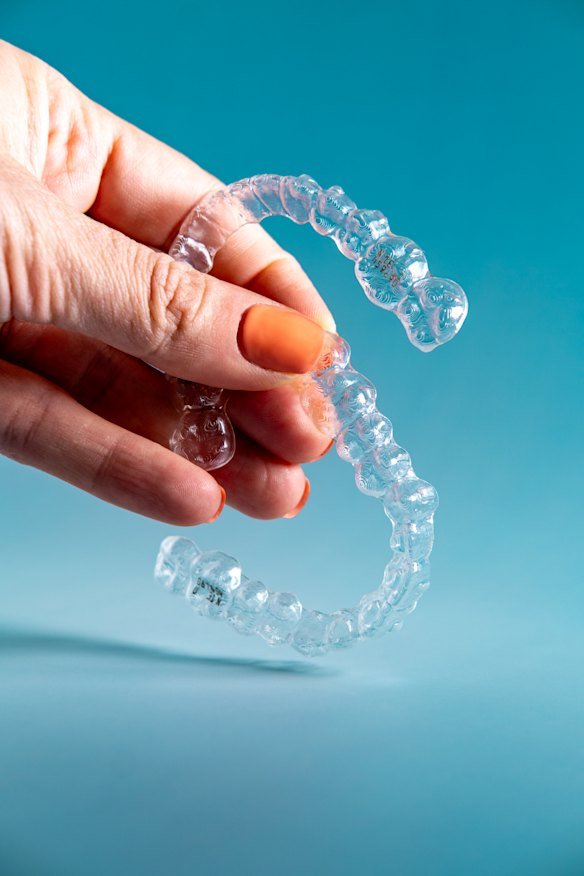
All Reanah Ford wanted was straight teeth. She had long felt self-conscious about her two front teeth, a feeling worsened by a social feed full of smiling influencers with straight, gleaming white teeth.
Ford noticed many mentioned great results with a product she had never heard of: Byte. Byte promised straight teeth in weeks, using clear aligners that looked a bit like transparent mouthguards.
It was heavily promoted on social media. “I’ve honestly been loving them,” said one influencer. “I’ve started seeing results probably in the first two or three weeks.”
The aligners had the Therapeutic Goods Administration’s (TGA) tick of approval required for all medical devices sold here. “It all looked very legit,” said Ford.
A few months into the treatment, Ford was in pain, had a cracked tooth, and was $3700 out of pocket – meaning she couldn’t afford to see a dentist to get the damaged tooth fixed.
“I lost my money,” she said. “And it probably damaged my teeth more.”
Byte shut down earlier this year after suddenly notifying the regulator of dozens of injuries linked to its aligners, leaving Australian customers in the lurch, and raising questions about how the TGA regulates “low-risk” devices.
Byte is one of more than 28,000 medical devices the TGA considers so low-risk they barely warrant scrutiny.
While manufacturers are required to hold evidence they are safe and effective, that data is not checked by the regulator before the devices are approved.
In fact, an investigation by this masthead reveals a computer is automatically approving these so-called “Class I” medical devices.
“With Class I devices, basically there is no oversight from the TGA,” said a person with direct knowledge of the process. “Nobody is actually checking. There are so many devices, they have just decided they are going to leave it there and just chase it up if there is a problem.”
Dr Christopher Rudge, deputy director of Sydney Health Law and an expert on medical device regulation, described the rules around Class I medical devices as “effectively self-regulation”.
Yet, these devices do cause harm, an investigation by this masthead reveals. The Medical Malfunctions investigation used automated website scrapers to crack open the TGA’s database to extract about 81,000 publicly available documents detailing adverse-event reports submitted to the TGA since 2012.
Medical Malfunctions has already highlighted issues with the operation and regulation of portable defibrillators that ambulance services distribute to volunteers, glucose monitors and insulin pumps used by hundreds of thousands of Australians, and spinal pain pumps.
Since 2012, Class I devices have been linked to 5424 adverse event reports, including 714 injuries and 24 deaths, according to an AI-assisted analysis of the TGA’s injury database.
A litany of complaints
Byte is the subject of 169 adverse event reports since September 2024, making it one of the most-complained-about Class I devices.
The TGA notes that an adverse event report, which can be submitted by a patient, health professional or any other member of the public, does not mean the device caused the event. Nor can such a report be used in isolation to assess the safety of a medical device.
The reports about Byte aligners include bone loss, tooth discolouration, chipped and broken teeth, bleeding gums, gum recession, pain, enamel loss, migraines, jaw joint pain and grinding, broken crowns and fillings, periodontal disease, mouth ulcers, overbites, tooth loss, locked jaw and a cut tongue.
They are marked by an unusual pattern.
The TGA is meant to monitor medical devices for emerging side effects. To do this, it relies on sponsors passing on reports of side effects from customers. In this context, sponsors are Australian residents or incorporated bodies responsible for manufacturing or importing a medical device.
But sponsors have broad latitude to “exempt” cases from reporting if they believe they are irrelevant, and have a clear incentive not to report, said a former TGA staff member.
Byte was approved in July 2022. Approval took just three days, and the regulator did not audit the device. By November 2024, Byte had accumulated just two reports of adverse events.
Then Byte suddenly stopped selling to Australian customers.
A month later, on December 10, Byte submitted 77 new adverse event reports, including accounts of chipped teeth, bone loss, stripped enamel, broken crowns, gum recession and bleeding, loose and lost teeth, periodontal disease, misaligned bites and locked jaws.
Byte’s parent company told this masthead those additional complaints “followed a review of historical complaints as part of Byte’s reporting processes” and “reflected that review and Byte’s efforts to strengthen post-market surveillance and reporting processes”.
The TGA declined to comment on whether Byte had breached its legal requirement to submit adverse event reports within 30 days of receiving them. It would not say if it had taken any action against Byte.
No dentist involved
Byte was shut down globally in 2026.
“The existence of adverse event reports does not, on its own, establish that a product is unsafe or ineffective,” Byte’s parent company, Dentsply Sirona, said. “Dentsply Sirona is committed to patient safety, product quality and responsible engagement with regulators.”
Byte’s model was simple: a box filled with Play-Doh-like clay and mouth trays would be sent in the mail to customers. The patient then took an impression of their teeth at home and mailed that mould back to Byte. The company would then send a series of clear retainers that would gradually push on the customer’s teeth to shift their smile around.
The initial mould box cost just $29. “Then after that, you start getting the hard sell,” said Kate, a former customer who asked not to have her last name published. “And I mean, they call you around the clock. It’s like a used car salesman – I just started getting phone call after phone call.”
Kate was trying to fix her teeth before her wedding. An orthodontist quoted her $8000 and said the treatment could take up to two years. Byte quoted her $3300, and said it would be done in just eight weeks.
Dental experts told this masthead the product was never going to work effectively. Dr Chris Sanzaro, president of the Australian Dental Association, said that without solid attachment points bonded to the teeth by a dentist, Byte’s aligners were limited in how much they could move teeth.
The moulds, made at home by patients, could be inaccurate, leading retainers to push teeth in the wrong direction.
“For the patient, they don’t know,” said Sanzaro. “It could be horribly misfitting, and they wouldn’t know. It can damage the tooth by pushing too hard.
“Ultimately, you can end up with some pretty significant changes in the bite. You wouldn’t be able to bite or chew food effectively.”
Dentsply Sirona told this masthead each customer’s treatment plan was approved by a dentist who “would make the final decision as to whether the customer could proceed with treatment”.
But none of the five customers this masthead spoke to ever had contact with a dentist – even when things went wrong.
“They send you a box. You never see a dentist. You never go into a dentist,” said Kate.
Almost as soon as she put on her new retainers, Reanah Ford knew something was up. They barely fitted and made her jaw ache. It felt like one of her teeth was being shunted into another one.
“It was starting to damage one of my teeth. I had a slight crack,” she said. She recalls thinking, “This isn’t working. It’s hurting, and it’s making my teeth shitter.”
Susannah Loyed spent $3399 on Byte, hoping the overnight aligners could close a gap between her front teeth. They did – but during the day, the gap would open again.
She complained to Byte, who asked her to attend a dentist “to have a bit of bone lasered off”.
Then, in November 2024, just before the company dropped its burst of alerts with the regulator, Loyed received an “urgent safety alert” from Byte.
“We have determined that our patient onboarding workflow may not provide adequate assurance that patients with active periodontal disease, severe open bite, severe overjet, tooth malocclusion requiring surgical correction, mixed dentition, dental prosthetics or dental implants, or adolescents with skeletally narrow jaws do not enter treatment with BYTE Aligners,” the safety alert read.
The alert instructed Loyed to visit a dentist to check if she had any of the conditions and get X-rays. She was required to send the X-rays and medical records to Byte. The company offered a rebate of up to $200.
“I was like, ‘Why are you asking me this now?’” Loyed said. “Surely, this is something you should have asked at the beginning, not now. And they wanted me to go and have X-rays at the dentist.”
Dr Theresia Sudjalim, spokeswoman for the Australian Society of Orthodontists, said trying to move teeth when there was underlying disease was dangerous.
“I’ve seen cases where roots are sitting out of bone,” she said. “Where they haven’t diagnosed there are teeth that are impacted or underlying. They haven’t diagnosed decay or gum problems.
“The virtual-only workflow does not work. Because it does not screen out unsuitable patients.”
Kate spent $3300 – only to find the retainers did not fit her teeth, despite her best efforts to “shove them in”. She received a letter asking her to sign what she felt was essentially a declaration she did not have a condition that would have made her unsuitable for Byte’s treatment.
“You’re asking me to sign a document under duress. My retainers are no longer fitting me,” she told this masthead.
Byte said the November 2024 alert was “a precautionary, non-recall action intended to provide additional information about the use of Byte Aligners by customers with contraindications and to support appropriate dental reviews where needed”.
It said the alert had made it clear that there had been no change in the “quality, performance or safety profile of Byte Aligners”.
The Examine newsletter explains and analyses science with a rigorous focus on the evidence. Sign up to get it each week.
Read the full article here