






 Markets
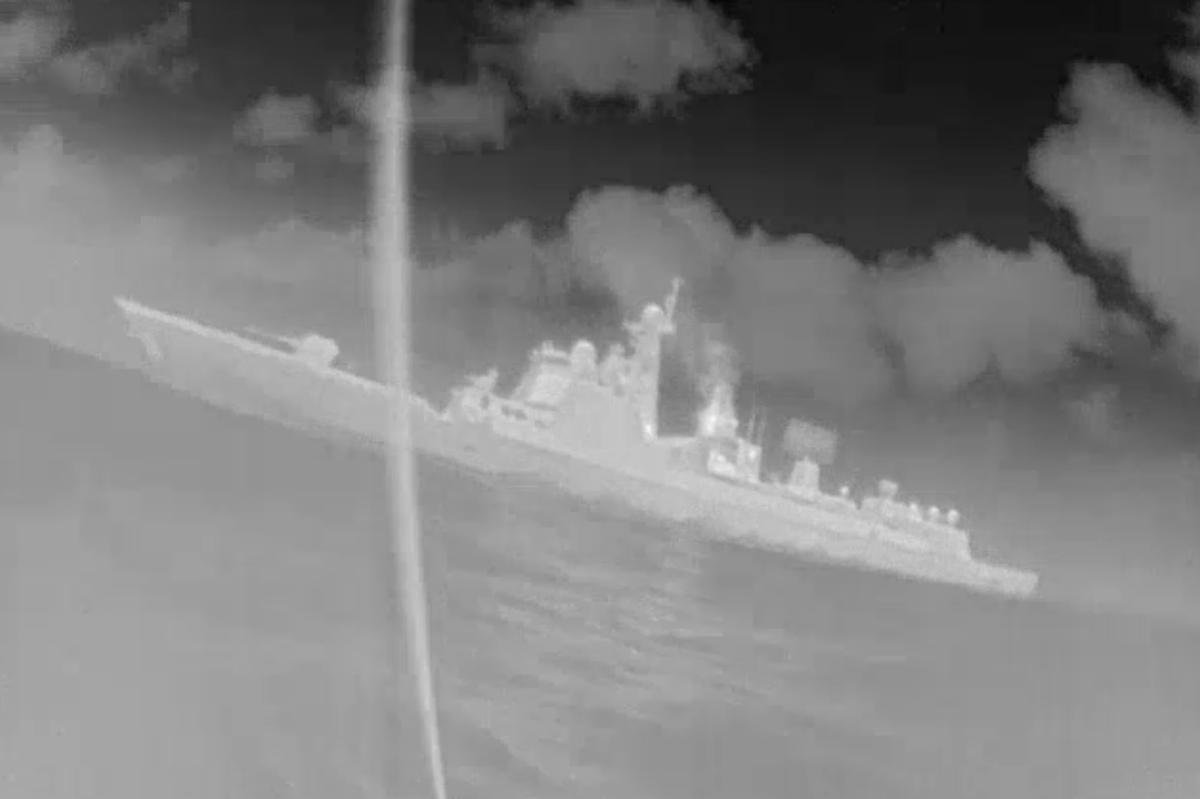
Stunning video taken by a covert sea drone shows a Chinese warship lingering inside the Philippines’ exclusive economic zone.
The 42-second clip shows a ship identified by Reuters as a Chinese People’s Liberation Army (PLA) Navy Type 052D guided-missile destroyer, floating 65 miles off Luzon Island in the Bashi Channel on June 16.
The ship was identified by “the deck layout, superstructure, crane and mast,” according to the company, “which matched archive imagery.”
Seasats, a San Diego startup, told The Post its drone, the Lightfish USV, was “conducting a commercial operation to prove the feasibility of autonomous operations in the Taiwan Strait.”
The company believes the footage is the first of its kind recorded by a private U.S. firm.
The 12-foot skiff, the Lightfish, has the ability to communicate the coordinates of China’s ghost fleet, track weather, signal submarines, and spot smugglers and illegal fishing operations.
The Lightfish is the smallest vessel in the company’s lineup and can be launched from the back of a pickup truck, Reuters reported. Its designed to operate for months at a time.
“We’re able to go out and film and get up close and record all this data off of a Chinese ship,” Seasats CEO Mike Flanigan said.
The ships can be operated far from shore. The boats listen for acoustic messages underwater, which it then translates into radio signals that it beams up to satellites and back to the ships’ operator on shore.
China did not acknowledge the ship in comment to Reuters. The Phillippines appeared to warn China, saying that it is reminding “all parties to avoid actions that would escalate tensions, especially if found trespassing through the Philippines’ Exclusive Economic Zone.”
The company told Reuters that it has had multiple encounters with Chinese warships over the years.
In May, the company touted its abilities to track the Chinese ships undercover, which has earned it millions in defense contracts.
One of their vessels encountered “multiple Chinese warships” well within Taiwan’s exclusive economic zone. None of the vessels were transmitting their identity via the Automatic Identification System.
“The Lightfish was able to track these vessels and capture images confirming their type and origin,” the company said. The trip was the first autonomous transit of the Taiwan Strait, a contested waterway between Taiwan and mainland China.
The company says the ships are especially useful because they can perform reconnaissance in a covert manner, and in a way that shore-based radar systems can’t.
“In this era of ubiquitous satellites and sensors, it may surprise some that a ship can hide in the ocean environment,” Declan Kerwin, chief of staff at Seasats, said. “That’s why these long-range autonomous vessels are so compelling. They can provide maritime awareness where shore-based radars can’t reach.”
The company has raised $40 million from investors and $100 million from government contracts.
Download The California Post App, follow us on social, and subscribe to our newsletters
California Post News: Facebook, Instagram, TikTok, X, YouTube, WhatsApp, LinkedIn
California Post Sports Facebook, Instagram, TikTok, YouTube, X
California Post Opinion
California Post Newsletters: Sign up here!
California Post App: Download here!
Home delivery: Sign up here!
Page Six Hollywood: Sign up here!
Read the full article here