






 Markets
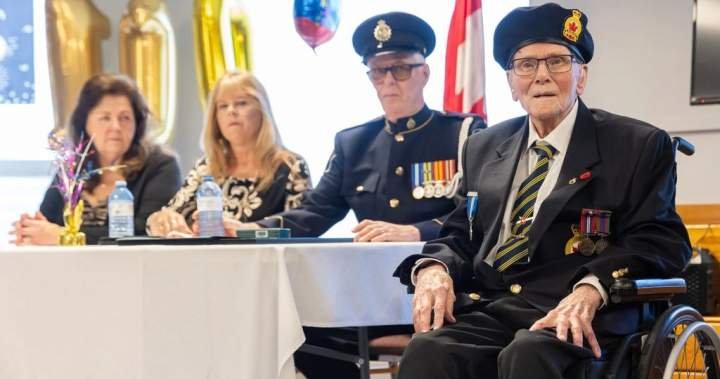
Burdett Sisler, the oldest known living man in Canada and one of the oldest Second World War veterans in the world has died. He was 110.
Sisler’s son Norman says his father died with family members by his side after his health took a turn for the worse in recent weeks.
“It’s bittersweet. You don’t want to see him go, of course. But he had a long life,” Norman said. “It was a great life.”
A statement from Gov. Gen. Mary Simon’s office says she and her husband were saddened to learn of Sisler’s death and are sending condolences to his friends and family.
Born in Akron, Ohio on April 14, 1915, Sisler moved to Toronto when he was three years old. He served as a radar technician in Canada’s military during the Second World War before settling in Fort Erie, Ont., to work for the Canada Border Services Agency.
The supercentenarian told The Canadian Press last year that it’s not too hard to make it to 110 years old – and that all you have to do is stay alive.
Sisler’s wife, Mae, died in 1985. He is survived by five children, 12 grandchildren, 23 great grandchildren and 14 great great grandchildren, according to his obituary.
In an interview with The Canadian Press, Sisler’s son reflected on just how much the world changed during his father’s lifetime
“He has seen two pandemics and two world wars and two solar eclipses,” Norman said, adding that Sisler moved to Toronto when his father, Norman’s grandfather, was transferred to work at the then newly opened Goodyear Tire and Rubber Company factory.

Get breaking National news
Get breaking Canada news delivered to your inbox as it happens so you won’t miss a trending story.
“Cars were starting to become popular and that’s why they came to Canada,” Norman said.
In her statement, Simon said Sisler was “a member of the generation that shaped modern Canada.”
“He witnessed profound moments in history while embodying the values of service and perseverance that continue to inspire us all,” she said Saturday.
Veterans Affairs Minister Jill McKnight also paid tribute to Sisler’s decades of service to the Canadian public.
“Mr. Sisler was among the veterans whose sacrifice and resilience helped shape our country,” she said, adding that he leaves behind a legacy that “continues to inspire future generations.”
Sisler enlisted in the Royal Canadian Army in 1943. He originally wanted to join the Royal Canadian Air Force but even though enlistment officers told him he was one of their best candidates, he was turned away because of a bad eye.
Sisler trained to become a military gunner in Nova Scotia and later took radar training in Barriefield, Ont., where he became a telecommunications mechanic. In 1945, he joined the Corps of Royal Canadian Electrical Mechanical Engineers, where he ultimately became a sergeant.
The Second World War ended before Sisler was deployed abroad.
“I have to think back to those who had a rougher time than I had. I never got the chance to go overseas,” Sisler said in an interview last year. “A lot of soldiers didn’t come back.”
After the war, he settled his young family in Fort Erie, where he soon became a customs agent with the Department of National Revenue, stationed at the Peace Bridge border crossing.
The couple made frequent summer camping trips to Ontario’s provincial parks with their children. Sisler also sang in a barbershop quartet in the 1960s and ran a side business with a friend fixing TVs and radio sets.
“He had an ad which stated, ‘If you have a whistler, call Hanes and Sisler,’” Norman said. “That’s just a small example of his humour.”
Sisler’s son said that of all the technological changes his father witnessed, the evolution of TVs was especially puzzling to him.
“It took him a while to digest these flat screen TVs,” Norman said.
His father was used to fixing “huge” cathode ray tube TVs and “he was really amazed at how you could get a picture on such a flat screen,” Norman added.
Last year, when asked for the secret to longevity, Sisler admitted he didn’t have any significant tips. It helps that he never enjoyed the taste of cigarettes, he said, and mostly liked to have a cold beer after mowing the lawn on a hot day.
Norman said his father never took life too seriously and he will miss Sisler’s sense of humour the most.
Norman added that he’s overwhelmed at the outpouring of support for him and his family following Sisler’s death.
“It’s just amazing,” Norman said. “He would be pleased, he would be very pleased.”
–
Read the full article here