



 Markets
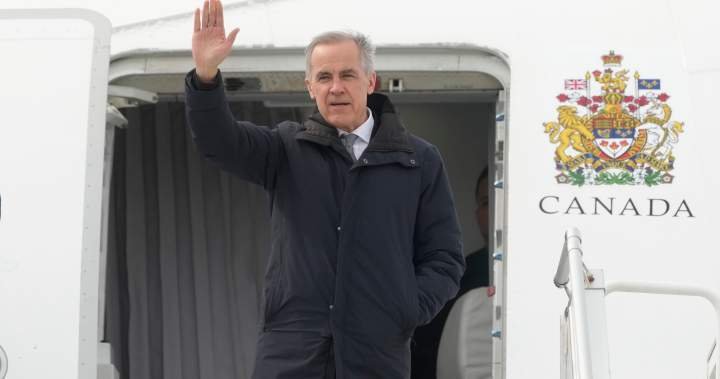
Prime Minister Mark Carney will visit Armenia this weekend for a summit on European strategic issues amid signs Ottawa is shifting its focus toward bolstering trade and defence ties on the continent.
Carney’s office confirmed the visit hours after it was announced Tuesday by European Council President Antonio Costa on social media.
The prime minister will be in the Armenian capital, Yerevan, from Saturday until Monday for the European Political Community summit that touches on strategic co-operation for the continent’s politics, security and infrastructure.
European leaders launched the twice-annual summits after Russia’s full-scale invasion of Ukraine in 2022. They include all EU members as well as others such as Iceland, Azerbaijan, Turkey and Montenegro.
Costa wrote that Canada is the first non-European country to take part in the summit and that this highlights joint efforts “to defend peace, shared prosperity and multilateralism.”
Carney’s office said he is attending at the invitation of Costa and Armenian Prime Minister Nikol Pashinyan. Ottawa is framing the visit as a chance to drum up investment and diversify trade as well as to “meet with European leaders to reinforce collective security and transatlantic defence readiness, while advancing support for Ukraine.”
Get breaking National news
Get breaking Canada news delivered to your inbox as it happens so you won’t miss a trending story.
The prime minister’s news release did not touch on recent history in the Caucasus region, where the former Trudeau government weighed in multiple times on ethnic conflict, often linking its statements with support for the Armenian diaspora in Canada.
“In a more dangerous and divided world, Canada’s government is focused on what we can control,” reads the news release.
Under the Trudeau government, Canada’s special envoy to Europe at the time, Stéphane Dion, was tasked with supporting “fragile” democracies in former Soviet states such as Armenia that were trying to move out of Russia’s orbit.
This included support for civil society and work against disinformation, particularly after Russia launched a full-scale invasion of Ukraine in 2022 and ethnic tensions escalated in the region of Nagorno-Karabakh.
The region is globally recognized as part of Azerbaijan that was largely populated by ethnic Armenians, and both Armenia and Azerbaijan fought for control of the area after the collapse of the Soviet Union.
When the Ukraine invasion thinned the presence of Russian peacekeepers in the region, Azerbaijan blockaded access routes to Nagorno-Karabakh in what human-rights observers compared to a siege. Azerbaijan then launched a military campaign against separatist forces that in 2023 displaced virtually all 100,000 ethnic Armenians from the area.
Canada joined an EU security mission before the mass evacuation of Armenians — which Canada’s ambassador to the United Nations at the time, Bob Rae, said amounted to “ethnic cleansing.” Ottawa opened an embassy in Yerevan in 2023.
Former foreign affairs minister Mélanie Joly at one point described the Nagorno-Karabakh region by using the name preferred by secessionists, Artsakh, during a speech to Montreal’s Armenian community, prompting a formal rebuke from Azerbaijan’s foreign ministry.
The Carney government shelved Dion’s role and has instead appointed an envoy focused strictly on economic and security co-operation with the EU, with a mandate that does not touch on democracy in countries on the outer edges of Europe.
Read the full article here