






 Markets
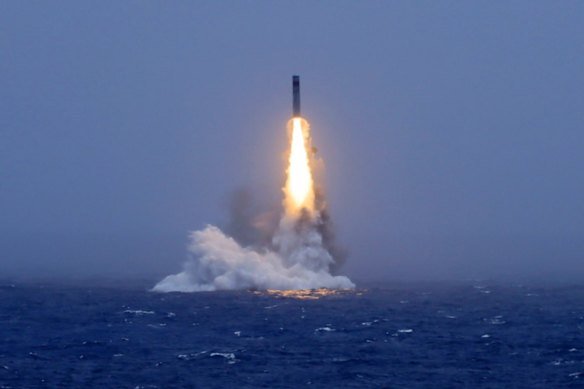
At midday on Monday a Chinese submarine launched a nuclear-capable missile carrying a dummy warhead towards “relevant high seas areas of the Pacific Ocean”. The missile plunged into the ocean about 1000 kilometres north-east of Solomon Islands.
To China, there was nothing to see here, governments should not “overinterpret” a business-as-usual moment in the development of the nation’s defences.
Other countries, viewing it through the prism of China’s ambition towards Taiwan and the broader concerns of stability in the Pacific, rightly regard the move as a provocation.
South Pacific nations have been unequivocal in their censure of China.
Prime Minister Anthony Albanese, who yesterday was in Solomon Islands, said there was “no doubt that this is a provocative act by China, which does destabilise the region, and therefore we will put forward our strong view”.
The prime minister also castigated China for its lack of notice of the testing at only a few hours instead of the standard 48 hours. The federal opposition was of a similar view and creditably did not seek to score points from this moment. Its foreign affairs spokesman, Ted O’Brien, said the launch was “irresponsible, and it is not welcomed”.
New Zealand’s Foreign Minister, Winston Peters, said he was deeply concerned. “We, like our neighbours in other Pacific countries, have no interest in China using the South Pacific as a testing site for missile capability.”
Japan, too, was not happy, holding “grave concern over the Chinese military’s increased activity”.
Joseph Wu, Secretary-General of Taiwan’s National Security Council, called the missile test “a provocation that destabilises the Indo-Pacific. China just proved itself again to be a bully on the block.”
The US joined the condemnation. State Department spokesman Tommy Pigott said the US wanted China to “engage in meaningful arms control discussions. Beijing’s rapid and opaque nuclear weapons build-up is of great concern to the region and the world.”
Given such widespread criticism, it is disingenuous and patronising that China should say it hoped “relevant countries will not overinterpret the matter”.
The last time China launched a missile with a dummy warhead was in 2024, and the time before that was in 1980. Yes, it is not alone in missile testing; the US, Russia and India have done so in the past year.
But it is only a week since China’s top diplomat in Australia chided this country’s intelligence agencies for having the temerity to state the – undeniable – fact that China had spied here.
Xiao Qian said such language “deeply wounded the feelings of the people of both China and Australia, and undermined the atmosphere of friendly co-operation between the two sides”.
How absurd those hurt feelings look now. By the time the comments on them were published, Chinese naval ships were already positioning themselves in the region to monitor the launch. As for “friendly co-operation”, lobbing nuclear-capable missiles into another country’s backyard without sufficient warning is many degrees worse than a spy chief laying out his stall.
Given the long deployment timeframe, it is extremely unlikely that China conducted the test to coincide with Albanese’s Fiji visit for the signing of the Ocean of Peace defence pact with his Fijian counterpart, Sitiveni Rabuka.
Tonga, Papua New Guinea and New Zealand will be invited to join the pact as well. This latest pact means Australia has added a fourth formal treaty ally. The others are the United States, New Zealand and Papua New Guinea.
Albanese visited Solomons Islands this week in an effort to make progress on a new defence treaty with Prime Minister Matthew Wale. The latter, who is also head of the Pacific Islands Forum, last month promised to re-examine the nation’s security agreement with China, and has proposed a Pacific-wide security pact.
Monday’s missile test throws into light the realpolitik of China’s ambitions both militarily and geographically.
It would be hypocritical to deplore China’s efforts to build its navy as we do the same. But how that’s done and an accompanying respect for international guardrails matters. It matters immensely.
Australia’s relationship with China is complicated because of the huge amount of trade we do with it, estimated at $326 billion in goods and services annually. But it would be a betrayal to ourselves if we did not protest at its actions when we felt it was necessary to do so. This is one such time.
Start the day with a summary of the day’s most important and interesting stories, analysis and insights. Sign up for our Morning Edition newsletter.
 The Herald’s View – Since the Herald was first published in 1831, the editorial team has believed it important to express a considered view on the issues of the day for readers, always putting the public interest first.
From our partners
Read the full article here