






 Markets
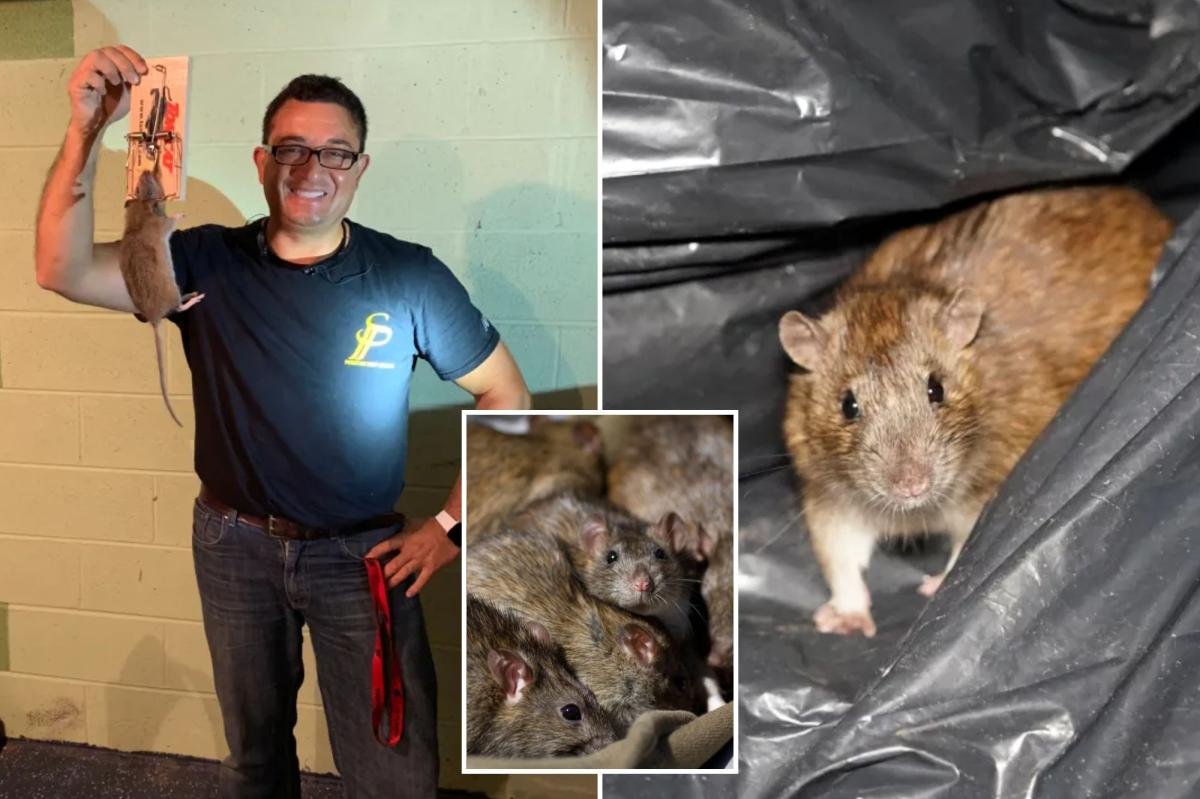
Tourists won’t be the only thing hogging the Big Apple sidewalks this summer.
When people think of New York City rats, they usually picture woodchuck-size vermin darting through alleyways, or bursting through basement ceilings a la “Ratatouille.”
They’re not wrong.
During a recent ride-along with veteran exterminator Favio Ulloa, The Post didn’t spot a single rodent —we must’ve gotten lucky.
But our lack of sightings wasn’t evidence that they weren’t there.
What was discovered was the almost imperceptible cracks in the wall they exploit, the poison used to dispatch them and the constant snake-and-mongoose battle between Gothamites and the city’s most resilient varmint — all telltale signs that we were in the presence of the city’s furry arch-nemesis
“They have to [block the holes] with mesh,” said Ulloa, owner of Prestige Pest Services, as he points to gaps in the plumbing at an infested Bronx laundromat. “If you close an opening with just sheet rock, the rats eat through it. They eat through sheet rock like paper.”
By shadowing Ulloa, who has spent 25 years waging the war on rats, on a hot summer day, The Post was able to glean a behind-the-scenes look at why these beasts thrive in NYC, how to know if a rat problem is in one’s vicinity and what New Yorkers can do to keep our unofficial mascot at bay.
It’s shaping up to be a rat summer
According to experts, summer is when these fun-size squatters become especially active.
“At the beginning of the season, we do see a hurricane season for rats,” Gil Bloom, the president of NYC extermination company Standard Pest Management, told The Post. “So you’re always going to see an increase in rodents and rodent activity as we head into summer.”
The reasons are straightforward.
They breed more in warmer, but not scorching, weather, food is plentiful, and humans spend more time outdoors and are more likely to notice them, causing 311 complaints to climb. However, Bloom quipped that many supposed infestations could simply be the same animal running back and forth.
Ratopia
Whether New Yorkers are facing more rat-ivity than years past depends on who you ask.
Through June 28, the city’s 311 hotline had received 7,960 reports of rat sightings, down from 10,492 for the same period last year — an over 24 percent decline.
Meanwhile, Bloom agrees that the city is less ratty than the post-pandemic rat boom, when outdoor dining areas and “makeshift food service areas” created a Valhalla for varmints.
“We’re better in 2026 than we were in 2023, but not as good as we were in 2017, 2019,” said Bloom.
The problem also varies by borough.
From 2023 to 2024, ratcalls fell in Manhattan, Brooklyn and Staten Island but soared in Queens and the Bronx, with Jamaica Hills experiencing a 119 percent spike.
Hard to kill
The battle remains extraordinarily challenging as these cheese-eaters are supremely adaptable. Ulloa recalled one Brooklyn job where rats swam up through a building’s sewer lines and chewed their way up through several floors.
A Post reporter has experienced their relentlessness firsthand. Several years back, the vermin had stolen into a seemingly impregnable steel storage unit, littering it with droppings and ripping into a sealed box to locate a single piece of forgotten beef jerky. Bloom suspects they likely entered from above.
New York’s seemingly permanent construction zones present another opportunity.
“You’re putting pipes down, you’re putting building materials down,” Bloom said. “You’re bringing in a workforce of 200 people who eat breakfast and lunch on site and aren’t always the neatest in their garbage.”
This is a real issue given that there are an estimated 3 million of the critters in the city — three for every person.
Unfortunately, deploying poison isn’t a foolproof solution. Ulloa said that these “very smart” critters learn to avoid bait that appears to be “killing” their colony, forcing exterminators to rotate bait types, trap locations and even colors.
“If you have an exterminator that’s using the same product all the time, it’s not going to be successful,” the rat-man warned.
The verminator pointed out what looked like a festive pink popsicle — except it was bait laced with a potent anti-coagulant that causes the rodent to bleed out and die.
Due to the danger posed to pets and children, they can only be deployed in tamper-resistant stations.
“If a dog eats this, we buy a dog,” he cautioned. “A cat, children — you got to be very careful.”
Meanwhile, researchers have found evidence that Big Apple rats were building an immunity to various rodenticides like a vermin vaccine.
Risk factors
The problem extends beyond the “ick” factor. Rats are vectors for over 35 different diseases, ranging from hantavirus to leptospirosis, while also causing costly damage.
Ulloa recalled investigating a Queens apartment where a rat had chewed through the cables behind an electric stove, exposing live copper wires that could’ve sparked a fire.
During the ride-along, Ulloa showed The Post a macabre pic of a dead rodent that had nibbled a cable connected to a circuit breaker in a Manhattan property, electrocuting itself so badly that it singed all its fur off like a roast guinea pig.
The war on rodents
The most effective way to curb the scourge? Cut off the rats’ food supply.
The city’s anti-rat campaign, spearheaded by former Rat Czar Kathleen Corradi and continued by the current regime, has focused heavily on garbage through measures including rat-proof Empire Bins, and rules that require residents to deposit trash in stationary containers that can be emptied by side-loading sanitation trucks.
“Three years ago, the city had no requirements that any trash be put into a container,” said Vincent Gragnani, press secretary for the Department Of Sanitation’s Office of Public Affairs. “We had mounds and mounds of trash bags sitting on the street day and night.”
Today, he said, more than 70% of the city’s trash — including all food waste — is required to be stored in sealed containers. Garbage is also being placed on the sidewalk later and collected earlier, further cutting into the curbside buffet.
Officials credit these changes with the reduction in rat sightings of late.
Vermin vigilantes
Fortunately, citizens can do their part to combat infestations as well. Bloom advises New Yorkers to look for both the obvious droppings and also “rub marks” — the oily brown tracks left behind by rodents repeatedly squeezing through the same openings.
Most important, per the pest expert, is eliminating their source of sustenance. “If you start to see rodents, you need to look into what are they feeding on?” he added. “Where’s the food source? Eliminate that.”
For Ulloa, one of the biggest mistakes is leaving pet food outside.
“I see in the parking garages, people leave cat food around and they leave the cat food for their cats to eat,” said Ulloa. “But they put it in the morning, the food, and they leave it unattended all day. Guess who is eating the cat food?”
Thankfully, the city-wide rodent campaign has expanded public education through programs like the Department of Health’s Rat Academy, which teaches “safe and effective methods for rat prevention” like filling in inactive burrows and a Rat Walk that highlights the relationship between humans and rats.
There’s even a community service project where aspiring verminators showcase what they’ve learned in the field.
Despite the plethora of increasingly sophisticated preventative measures — and declining numbers of sightings — the experts believe that rats will always be part and parcel of living in the Big Apple
“Rodents are holding their own,” said Bloom. “They’re not going away.”
Read the full article here