



It was a clear August afternoon in 2024, and Jenny Hombsch was making her way home after visiting a neighbour.
Despite having a hip injury, Jenny loved to walk around her suburb of Baxter, on Melbourne’s Mornington Peninsula – often taking the family’s dog, Ollie, out twice a day. Since retiring, there was also more time for travel. She and husband Steve were in the midst of planning a caravan trip across the country.
But the couple never made it on that trip. Just 100 metres from home, a car exiting the nearby freeway struck Jenny, 68, as she was crossing the street. Paramedics arrived quickly, but she died a short time later.
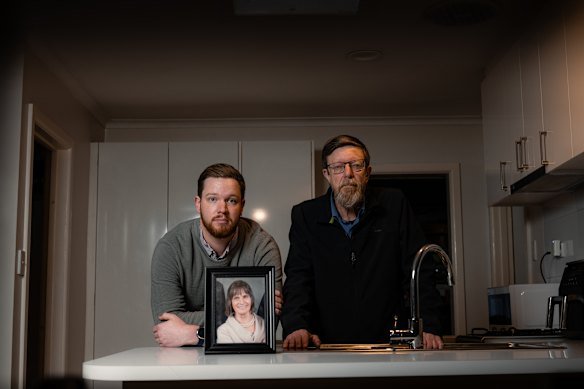
Jenny’s son, Daniel Hombsch, said his mother was a kind, caring and selfless person. Raised on a farm near Adelaide, she later moved to the Mornington Peninsula with her husband to raise Daniel and his brother, Michael.
“She was a very determined, very stoic woman … I was very blessed to have really good parents, especially Mum,” Daniel said. “My brother and I were probably the most significant thing to her. And she always put us first.”
In 2025, the driver involved in Jenny’s death pleaded guilty to a single charge of careless driving of a motor vehicle. She was eventually fined $2000 with a conviction in the Frankston Magistrates’ Court and had her licence suspended for six months.
The woman behind the wheel – who was 64 at the time of the crash – wasn’t impaired by drugs or alcohol, she wasn’t using a phone, and wasn’t speeding.
The court found she had simply failed to operate her vehicle with the care and attention expected of a reasonable person.
The maximum penalty for a first offence of this kind in Victoria is $2509, rising to $5227 for any subsequent offences.
The offence does not carry a prison term or mandatory licence disqualification, although a magistrate can suspend or cancel a driver’s licence. Nor can the maximum fine be increased when careless driving results in a death.
Daniel, now a lawyer who works at a community legal centre, understands the driver didn’t intend to hit his mother, but, years later, he still struggles to accept the sentence.
“Regardless of the victim’s age or gender or what they did for work or their personal circumstances, I don’t see how it can be just to put a $2000 cost on someone’s life,” Daniel said.
Careless driving that results in death is distinct from the more serious offences of dangerous driving causing death or culpable driving causing death.
A person found guilty of dangerous driving causing death faces a maximum of 10 years’ prison, while someone found guilty of culpable driving causing death can be sentenced to a maximum of 20 years.
“There’s nothing to fill the gap between the standard careless driving offence – as it stands now – and dangerous driving causing death,” Daniel said. “The magistrate needs to have the discretion to sentence something greater than a fine.”

This sentencing gap attracted statewide attention in September 2025, when a driver was fined $2000 over a crash a year earlier that killed 11-year-old Jack Davey while he was at school.
Jack’s parents Michael and Jayde were outspoken about the need for legal change outside the Magistrates’ Court after the sentence was handed down, calling the current laws inadequate and inappropriate.

In July, the Victorian government announced a large-scale review into the state’s dangerous driving laws, which will be carried out by the Victorian Law Reform Commission.
The terms of reference included the consideration of a potential “mid-tier” offence for driving that does not meet the threshold to be considered dangerous, but still results in death or serious injury.
Law Institute of Victoria criminal law section chair Jarrod Behan said the review would examine whether the current penalties for offences like careless driving align with community expectations and allow for judicial discretion.

“The review could lead to changes if it finds that Victoria’s current laws do not adequately deal with cases where careless driving – or other forms of dangerous driving – causes death [or] serious injury,” he said.
Other states have specific offences carrying significantly higher penalties. In New South Wales, a first offence of negligent driving causing death carries maximum penalties of a $3300 fine and 18 months in prison.
In Western Australia, careless driving causing death or grievous bodily harm holds a maximum penalty of $36,000 and/or three years in prison, as well as at least three months of licence disqualification.
Because Victoria has no separate offence for careless driving causing death or serious injury, relevant sentencing statistics are also difficult to isolate.
The latest data from the Sentencing Advisory Council show 8999 careless driving charges were finalised in the Magistrates’ Court in the three years to June 2023.
Behan said the current laws also limited the sentencing options available to judicial officers.
While magistrates and judges have greater sentencing discretion for more serious offences like dangerous driving or culpable driving, the lower maximum penalty for careless driving limits the sentences available.

“It’s trite to say that these types of cases are very difficult and tragic for all involved,” Behan said.
“Often, it’s the case that there’s no allegation that the driver intended to cause any harm. There is rather a moment of inattention or another careless act which leads to a tragic outcome.”
The Victorian Law Reform Commission is expected to deliver its report to the attorney-general by March 2028. Any legislative changes would require government support and would need to pass through both houses of parliament.
A Department of Justice and Community Safety spokesperson said the review will examine whether current maximum penalties are adequate, and whether new dangerous driving offences should be introduced.
“We have listened to the families who have lost loved ones on Victorian roads. Their voices matter and where the law falls short, we will strengthen it,” they said.
The review has been welcomed by families like Jenny’s. Daniel said news of the announcement made him finally feel that his concerns had been heard.
“It could be a long time away, and we don’t know what might actually come of [the review] yet. But it at least feels like a big relief to feel like we’re actually getting somewhere,” Daniel said.
“I think it’s a great first step.”
Start the day with a summary of the day’s most important and interesting stories, analysis and insights. Sign up for our Morning Edition newsletter.
Read the full article here