



 Markets
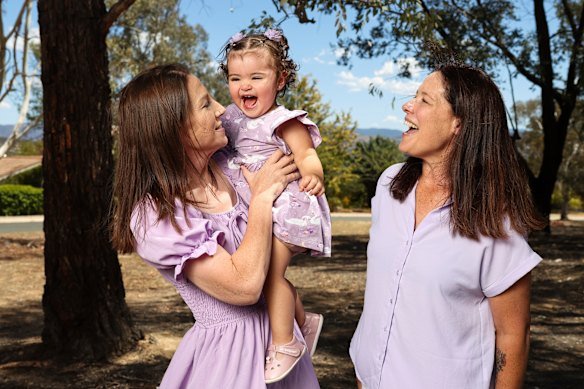
Melinda McCann had insisted she wanted an ethical surrogacy experience.
Instead, she alleges she was stranded in Colombia with a newborn who did not have legitimate paperwork to apply for Australian citizenship, financially supporting a struggling postpartum surrogate, Danna Martinez, who had been paid half of what McCann thought she would be.
Speaking to this masthead, Martinez alleged that she felt she was “deceived” and treated as “disposable”, was not provided postpartum medical and psychological care, had a doctor changed when they placed her on bed rest, and was not paid on time.
McCann found herself questioning how she and her wife, Gail, had been sucked into censured Melbourne lawyer Paul Norris-Ongso’s “crazy car salesman” trappings with his company Global Surrogacy, and his $100,000 contract seemingly full of false promises.
Driven by rising infertility, the global surrogacy industry was valued at $27.9 billion in 2025 and is projected to reach $201.8 billion by 2034. In Australia, only altruistic surrogacy is legal, where surrogates are reimbursed only for expenses. This restriction drives parents towards commercial surrogacy abroad, where murky regulations allow unscrupulous operators to flourish.
This masthead has spoken to numerous former clients, a surrogate, and former staff, all of whom accused Norris-Ongso of running an unethical enterprise that links international clients with women in developing countries.
Norris-Ongso has three children born to two surrogate mothers with his husband. Global Surrogacy has since rebranded to KinPath Surrogacy. He no longer holds an Australian legal practising certificate and, in 2019, was subject to disciplinary action by the Victorian Legal Services Commissioner.
Norris-Ongso denies any wrongdoing or running an unethical practice.
A ‘disposable’ surrogate
In 2023, the Canberra couple transferred close to $100,000 to Norris-Ongso and his company, Global Surrogacy, to expand their family after McCann recovered from ovarian cancer.
“I told [Norris-Ongso] I did not want an unethical program,” McCann said. She told him she wanted a relationship with the surrogate.
They were matched with Martinez, a stay-at-home mother of two from Colombia’s north. Martinez saw surrogacy as a way to support her family while helping another. She said she regretted her decision to become a surrogate after her experience with Global Surrogacy.
The McCanns said they were told that Martinez would be paid about $40,000.
However, Martinez’s contract, which she had to screenshot because it was set to “view once”, stipulated 10 monthly payments of $900, insurance and social security, and a $10,500 post-birth bonus. Medical-related costs were also included. Her total direct payments amounted to just over $20,000, half of what the McCanns believed she was being paid.
Norris-Ongso denied telling the McCanns a payment amount. He said that, on average, Colombian surrogates received $20,000 directly, with another $20,000 covering insurance, medical fees, transport, translation and operating costs.
While the McCanns’ contract includes clauses for Martinez to have an independent lawyer, an obstetrician to treat and advise her for a “reasonable time” after the birth, and psychological support, Martinez said she received none of these services.
Norris-Ongso said that each surrogate is entitled to psychological support and offered independent legal advice, claiming there “was no discrepancy” between the contracts.
The McCanns were added to a group chat with Martinez that was monitored by Norris-Ongso. Martinez said she was told that it was illegal under Australian law for her to contact the McCanns independently.
Norris-Ongso said that Global Surrogacy was one of the few agencies that contractually required clients to communicate with their surrogates and to be able to contact them freely, with translators and interpreters provided on request.
‘I handed them the baby, and then to them, I was just disposable.’
Danna Martinez
As Martinez’s pregnancy progressed, she developed severe nausea and was vomiting, with high blood pressure, but said that her concerns were dismissed by staff.
“It was a pretty bad pregnancy; I was bleeding and having pains. They just kept telling me it was normal,” she said, adding that she was placed with a different doctor early on, after the first one placed her on bed rest and travel restrictions.
At 18 weeks’, the McCanns travelled to Colombia for the gender scan. There, they learnt how Martinez was being treated. “She was basically exploited, something shocking,” Melinda said. “She was violently ill, and they did nothing.”
Later, the company ordered Martinez to travel alone to Bogotá – a 17-hour drive, or 90-minute flight – to give birth, contrary to her original doctor’s advice and with no plan for who would care for her children.
Norris-Ongso said that medical records showed she did not present with serious symptoms at her 25-week scan. He said that while she was prescribed rest after a bleed, these measures were followed, and her doctor never changed, and he denied that staff dismissed her symptoms.
He said she was asked to travel because a former staff member “did not properly assess” the McCanns’ case, and it was necessary to travel to Bogotá for citizenship paperwork. He said he offered to accommodate Martinez and her children.
“We assess all of our surrogate candidates carefully, and [Martinez] passed the home visit and security check before we undertook any medical and psychological screening of her,” he said.
“We respect all of our surrogates and take care of them medically and psychologically … It is important to us that the surrogate feels like she is being well treated and cared for during the pregnancy.”
The stateless newborn
Martinez gave birth via caesarean in October 2024 at a hospital near her home city. She said she was not allowed to have her mother or another support person in the delivery room. McCann stood beside her, watching the delivery.
“I was alone, enduring the pain,” she said.
The McCanns named the baby girl Alexis Bella Danna in Martinez’s honour.
Seven days after the birth, the group travelled to Bogotá to sign away Martinez’s parental rights. The McCanns paid for Martinez’s children to travel with her.
There, Martinez said, she was made to hand back her blood pressure monitor and leftover medication, and her medical treatment ceased. “I was left suffering,” Martinez said.
Norris-Ongso denied that Martinez’s medical care was terminated, stating that the surrogates’ health insurance was continued for three months after the birth. However, he later said that her health insurance expired 2½ months after birth, which could be extended upon request.
He said she was discharged from the hospital following a “normal” medical evaluation with normal blood pressure.
Instead of the promised lump sum, Martinez was paid in instalments over weeks, causing her to lose a house she intended to buy.
‘He bailed on me.’
Melinda McCann
“[I felt that] I’d given birth, I was useless now,” she said. She has struggled with the separation from the baby, and said she wished there was mental health support to help cope.
Norris-Ongso said psychological support was available on request. He said his bank blocks him from paying surrogates in large lump sums, so surrogates are paid in instalments, and this also avoids surrogates from paying taxes. He said this is written in their payment agreements. It was not in Martinez’s agreement, as seen by this masthead.
Meanwhile, the McCanns entered a bureaucratic nightmare. Melinda said Norris-Ongso failed to file citizenship paperwork accurately. After he stopped responding to calls, the McCanns appealed to the media and Senator David Pocock. Alexis was finally granted citizenship after two months had passed.
“Norris-Ongso did not uphold his end of the bargain … He bailed on me,” Melinda said.
The McCanns remain in near-daily contact with Martinez and visited her last year.
Norris-Ongso said he obtained the baby’s birth certificate 10 days after birth and lodged the citizenship application the week after, which he viewed as a “good outcome”. He said delays were caused by McCann’s “own actions” after she contacted the Department of Home Affairs and took over the application.
Norris-Ongso accused McCann of becoming “angry”, causing him to reduce communication. “We provided the service that the McCanns contracted us to provide. We did so in a professional, ethical and efficient manner,” he said.
Norris-Ongso added personal criticisms of the couple and said he was “disappointed” by their decision to publicise the allegations against him and Global Surrogacy.
“It was we, perhaps I could say I personally, who allowed them to achieve their dream when all others had told them it was not possible,” he said.
He has threatened the McCanns and this masthead with legal action.
Be the first to know when major news happens. Sign up for breaking news alerts on email or turn on notifications in the app.
 Amber Schultz is a crime and justice reporter with The Sydney Morning Herald.Connect via X or email.
From our partners
Read the full article here