Markets

Published on
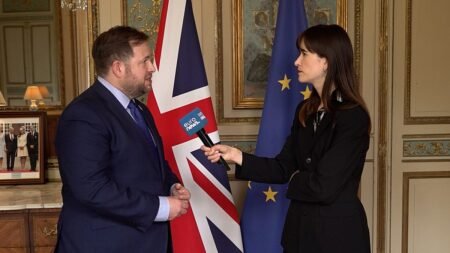
Forcing the return of hundreds of thousands of Syrians living in Europe without financial support would lead to “chaos” in the country, Foreign Minister Asaad Hassan al-Shaibani told Euronews in an exclusive interview in Brussels following talks with EU counterparts.
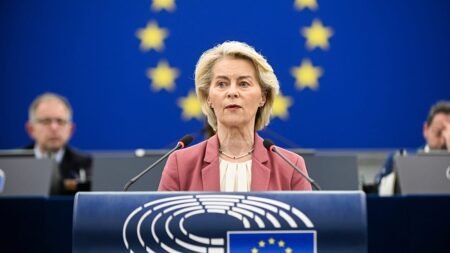
Al-Shaibani met EU foreign policy chief Kaja Kallas this week as the EU looks to support Syria’s fragile political transition following the ousting of Bashar al-Assad in 2024, after a brutal civil war that displaced millions and devastated the country’s economy.
European governments led by Germany have also called on Syrian authorities to facilitate the return of Syrian nationals living in Europe. Earlier this year, German Chancellor Friedrich Merz suggested 80% of the close to one million Syrians who fled the country coinciding with the outbreak of the war should return to Syria by 2030.
His proposal sparked controversy, with human rights groups and opposition parties warning that forced returns could put thousands of lives at risk.
The German Economic Institute also suggested that the number of Syrians working and paying social contributions in Germany is higher than the Chancellor indicated.
Al-Shaibani defended his government’s record, saying there are “no majorities or minorities, just Syrians”, but warned that a rushed return process would lead to chaos and insisted that returns on such a scale must be accompanied by financial support.
Echoing remarks by President Ahmed al-Sharaa, he said Damascus had neither committed to a specific target for returnees nor agreed to a timetable.
“We have warned that forcing the involuntary and undignified return of Syrians will lead to chaos,” he told Euronews. “The situation in Syria requires creating a suitable environment. This needs the involvement of the international community, especially the European Union, to support the Syrian government” in the reconstruction process.
Al-Shaibani also told Euronews that there is no formal agreement on returns or “on the number” of Syrians expected to return.
“We are not encouraging the return of Syrians in a hasty, unorganised manner,” he said, adding that rebuilding the economy and creating are prerequisites for large-scale returns.
Syrian reconstruction – with strings attached
As Europe’s political landscape shifts towards tougher migration and asylum policies, the EU sees stabilising Syria as key to accelerating returns. Brussels also views Damascus as a potential partner in the Middle East, provided it can be drawn away from what the bloc describes as “malign actors” operating in the region, including Russia.
The EU has also said that financial assistance will be conditional on the Syrian authorities ensuring the protection of ethnic and religious minorities in the country.
“For us, it is important that all the minorities are taken into account by the government, there needs to be inclusivity,” Kallas told reporters ahead of the meeting. “This is why we are offering our help in drafting the constitution so they can actually have elections.”
A European diplomat involved in the discussions told Euronews that the EU takes concerns over inclusivity seriously and sees it as a condition to build a deeper relationship.
Still, this week the European Council announced it would reinstate the full implementation of the EU-Syria cooperation agreement allowing for more bilateral trade. The agreement was first suspended in 2021. Its reinstatement follows a string of EU measures easing restrictions on the country after the fall of the Assad regime.
Last year, the Council also lifted economic sanctions on Syria.
Al-Shaibani brushed off concerns in comments to Euronews, arguing that, “since “European countries are no longer accepting asylum applications from those leaving Syrians, it shows that they perceive the situation is safe and stable”.
Read the full article here